Best Roman History Books in 2026
Curated by Skriuwer Editors · Updated April 2026 · Affiliate links
Rome built an empire that lasted centuries and left its mark on law, language, and culture across the Western world. These are the best Roman history books ranked by reader reviews, covering the Republic, the Caesars, the legions, and the eventual fall of the greatest empire in antiquity.
Rome is the best-documented civilisation of the ancient world and one of the most studied in all of history, which means the number of books about it is staggering. This list cuts through that abundance and focuses on the books that real readers have found most compelling, from the rise of the Republic to the final collapse of the Western Empire in 476 AD. The ranking is by reader review count, so it reflects sustained popularity rather than academic prestige.
Roman history divides naturally into three periods, each with a distinct character. The Republic (509 to 27 BC) is a story of competitive aristocratic politics, extraordinary military expansion, and ultimately catastrophic civil war. The Principate (27 BC to 284 AD) is the high Empire, the age of Augustus, the Julio-Claudians, the Five Good Emperors, and the crisis of the third century. The Late Empire (284 to 476 AD) is a story of military despotism, Christianity's rise to dominance, and eventual fragmentation.
The books on this list cover all three periods, plus the lives of specific figures (Julius Caesar, Augustus, Marcus Aurelius, Constantine), specific institutions (the legions, the Senate, the bureaucracy), and specific events (the Punic Wars, the fall of the Republic, the sack of Rome). Some are modern narrative histories, some are primary source translations, and some are scholarly works written accessibly enough for general readers.
If you are not sure where to start, the FAQ below recommends entry points depending on your interest in the period. If you already have a focus, scroll to the list.
Quick comparison, top 5
The ranked list
- 1

Marcus Aurelius
(75,000 reviews)The "Meditations" of Roman Emperor Marcus Aurelius are a readable exposition of the system of metaphysics known as stoicism. Stoics maintained that by putting aside great passions,…
Buy on Amazon → - 2

Mary Beard
(11,458 reviews)Mary Beard takes the reader through the first thousand years of Roman history, from the legendary founding of the city to the Caracalla edict of 212 CE that granted citizenship to …
Buy on Amazon → - 3

Tom Holland
(10,000 reviews)'The bloodstained drama of the last decades of the Roman republic... is told afresh with tremendous wit, narrative verve and insight' 'I owe a debt of gratitude to Tom Holland not …
Buy on Amazon → - 4
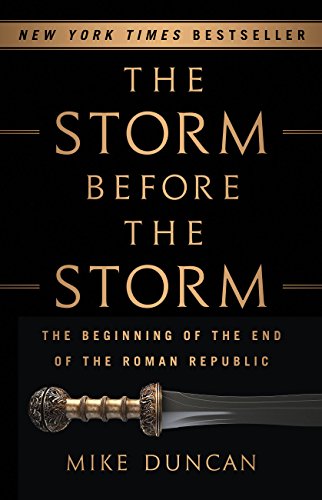
Mike Duncan
(6,800 reviews)Mike Duncan, the historian and broadcaster behind The History of Rome podcast, traces the years 146 to 78 BCE, the half-century before Caesar in which the Roman Republic quietly br…
Buy on Amazon → - 5
Toby Wilkinson
(3,600 reviews)Toby Wilkinson tells the full three-thousand-year story of ancient Egypt, from the first unification of the country around 3000 BCE to its absorption by Rome after the death of Cle…
Buy on Amazon → - 6

Stacy Schiff
(3,500 reviews)Pulitzer Prize-winning biography that strips away two thousand years of Roman propaganda to reconstruct the actual Macedonian queen of Egypt. Stacy Schiff is unusually careful abou…
Buy on Amazon → - 7

Adrian Goldsworthy
(2,400 reviews)A military historian biography of the man who finished the Roman Republic off. Adrian Goldsworthy is excellent on how Roman armies and politics actually worked, not just the famous…
Buy on Amazon → - 8

Bauer, Susan Wise
(2,271 reviews)The Story of the World: History for the Classical Child: Volume 1: Ancient Times: From the Earliest Nomads to the Last Roman Emperor, Revised Edition by Bauer, Susan Wise.
Buy on Amazon → - 9

Adrian Keith Goldsworthy
(2,200 reviews)By the end of the fifth century, Roman rule had vanished in western Europe and much of northern Africa. Applying the scholarship, perspective, and narrative skill that defined his …
Buy on Amazon → - 10

Daniel P. Mannix
(1,700 reviews)Daniel Mannix's 1958 classic was the source material for the original Gladiator film and the 2024 Peacock series of the same name. Lurid in places but built on close reading of Rom…
Buy on Amazon → - 11

Peter Heather
(1,600 reviews)Peter Heather's political-military account of Rome's collapse, focused on Gothic and Hun pressure on the western frontiers. Gripping, readable, and the standard counterpoint to War…
Buy on Amazon → - 12

Bryan Ward-Perkins
(1,300 reviews)Bryan Ward-Perkins' archaeological argument against revisionist softening of Rome's collapse. Short, sharp, and grounded in pottery, coinage, and roof-tile evidence that beginners …
Buy on Amazon → - 13

David Cordingly
(1,200 reviews)Written by a former curator at the National Maritime Museum in London, this is the myth-versus-reality account of Golden Age piracy. David Cordingly systematically separates what H…
Buy on Amazon → - 14

Edward J. Watts
(1,100 reviews)Edward J. Watts traces how the Roman Republic, stable for centuries, talked itself into autocracy by breaking its own political norms one at a time until violence felt ordinary. Th…
Buy on Amazon → - 15

Skriuwer.com
(93 reviews)This book retells 20 major Greek myths in clear, modern prose while staying faithful to the ancient sources. It presents the stories of gods, heroes, and mortals as they appear in …
Buy on Amazon →
Frequently asked questions
What is the best single book for understanding the Roman Empire?
SPQR: A History of Ancient Rome by Mary Beard is the best modern one-volume account for general readers. Beard is a Cambridge classicist who writes without condescension and with genuine enthusiasm for what the evidence actually shows (and what it does not show). She argues against the tendency to treat Rome as a template for modern nations and instead focuses on what made Rome genuinely strange. At about 600 pages it is comprehensive without being exhausting.
What is the best book about Julius Caesar?
Caesar by Adrian Goldsworthy is the most thorough modern biography in English, using both ancient sources and modern archaeological evidence. For a shorter approach, Caesar: Life of a Colossus by the same author in a condensed edition covers the same ground in about half the pages. For a primary source, Caesar's own Gallic Wars is surprisingly readable as military memoir and gives you his own (carefully self-serving) account of his campaigns.
What is the best book about the fall of the Roman Republic?
Rubicon: The Last Years of the Roman Republic by Tom Holland covers the period from the Gracchi through Julius Caesar's crossing of the Rubicon in 49 BC. It reads like political thriller and requires no prior knowledge of Roman history. Mike Duncan's The Storm Before the Storm covers the generation before Caesar (Marius, Sulla, the Gracchi) and is the natural companion read, showing how the Republic's institutions were already crumbling before Caesar arrived.
What are the best primary sources for Roman history?
Suetonius's The Twelve Caesars covers Augustus through Domitian in gossipy, fast-moving biographies (the Robert Graves translation is still the most readable in English). Tacitus's Annals covers Tiberius through Nero and is denser but extraordinarily vivid. For the Republic, Livy's Early History and Polybius's Histories are the key primary texts. If you want the philosophical side of Rome, Marcus Aurelius's Meditations and Seneca's Letters give you direct access to how educated Romans thought about life and death.
What is the best book about the fall of the Roman Empire?
Edward Gibbon's Decline and Fall of the Roman Empire (six volumes, published 1776 to 1788) is the foundational account but is impractical as a starting point. For modern readers, The Fall of the Roman Empire by Peter Heather gives a clear, evidence-based account of the barbarian invasions and how they interacted with internal Roman weakness. Bryan Ward-Perkins's The Fall of Rome and the End of Civilization is shorter and makes a strong argument that the fall was a genuine catastrophe rather than a peaceful transformation.
Were there good books about daily life in ancient Rome, not just emperors and battles?
Daily Life in Ancient Rome by Florence Dupont covers what ordinary Romans ate, how they socialized, how they thought about time and health and religion, and how Roman cities actually functioned. More recent and more visually supported, Life in Ancient Rome by Paul Wilkinson covers similar ground with more illustrations. Robert Harris's Pompeii, though fiction, is the most vivid account of a Roman town in its final hours and is meticulously researched.
Your next good book, in your inbox
We only write when we find a book worth your time. Hand-picked recommendations across history, mythology, true crime and more.