Best World War 2 Books in 2026
Curated by Skriuwer Editors · Updated April 2026 · Affiliate links
World War II was the defining event of the 20th century, a conflict that reshaped the entire world. These are the best WW2 books available today, from gripping battlefield accounts to psychological profiles of Nazi leadership, ranked by readers who have lived with these stories. Whether you want the big picture or the intimate personal account, this list has it.
World War II generated more books than any other event in human history, and the problem facing any modern reader is simple, where to start. The list below is our answer, ranked by real Amazon review data, not by what war-college syllabi think you should read. We have favored books that are still alive to a reader in 2026, meaning they are paced for modern attention spans, written with narrative craft, and not dependent on the reader already knowing which army was where in 1941.
We split the list across six angles. Grand-strategy overviews, Antony Beevor and Max Hastings being the obvious names. Personal memoirs, which is where the emotional weight lives. Holocaust literature, because that story is non-negotiable in any serious WW2 reading list. Pacific theater, which is systematically underweighted in most American and European WW2 reading lists. The intelligence and code-breaking story, which is genuinely one of the great 20th-century narrative subjects. And a short tail of historical fiction, because a well-written WW2 novel often captures the texture of the war better than straight history does.
Something to keep in mind. The best WW2 book you will ever read is almost always a memoir. Primo Levi's If This Is a Man. Eugene Sledge's With the Old Breed. Viktor Frankl's Man's Search for Meaning. Anne Frank's Diary. Laura Hillenbrand's Unbroken (adapted from Louis Zamperini's experience). Grand-strategy books teach you what happened. Memoirs teach you what it felt like. If you have only time for two WW2 books, pick one of each.
If you are completely new to the war and want one book to orient yourself, The Second World War by Antony Beevor is the default modern recommendation, 900 pages of well-paced single-volume history. If you have read the basics and want something deeper, move to Richard Evans's Third Reich trilogy or Rick Atkinson's Liberation Trilogy. Scroll down for the full ranked list, and the FAQ covers the questions we get most often.
Quick comparison, top 5
The ranked list
- 1
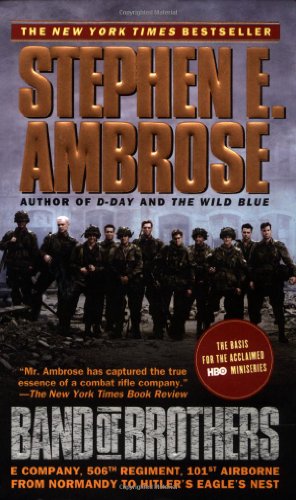
Stephen E. Ambrose
(33,000 reviews)Stephen Ambrose follows Easy Company of the 101st Airborne from training through the D-Day landings to the end of the war in Europe. Built on interviews with the surviving veterans…
Buy on Amazon → - 2
Antony Beevor
(6,200 reviews)Antony Beevor delivers the definitive single-volume history of World War II, moving confidently between every theater from the invasion of Poland in 1939 to the Japanese surrender …
Buy on Amazon → - 3

Annie Jacobsen
(4,200 reviews)Annie Jacobsen's definitive account of the secret US government program that recruited over 1,600 German scientists after World War Two, including former Nazis and SS members, by f…
Buy on Amazon → - 4

Daniel Jonah Goldhagen
(3,800 reviews)This groundbreaking international bestseller lays to rest many myths about the Holocaust: that Germans were ignorant of the mass destruction of Jews, that the killers were all SS m…
Buy on Amazon → - 5
The Craziest Stories of World War 2: Revealing the Unthinkable Past (History of Germany Books)
★ Our PickSkriuwer.com
(44 reviews)Did you know the Allies faked an entire invasion fleet with inflatable tanks? Or that the U.S. military seriously considered strapping tiny firebombs to bats and releasing them ove…
Buy on Amazon → - 6

Skriuwer.com
(40 reviews)The Nazi regime generated more conspiracy theories than almost any other period in history, because it produced so many events that seem too extreme to be real. This book examines …
Buy on Amazon → - 7

Skriuwer.com
(29 reviews)History is usually told about Hitler. This book is told by him. Drawing on his actual writings, speeches, and documented statements, this is a first-person narrative reconstruction…
Buy on Amazon → - 8

Skriuwer.com
(24 reviews)Everyone knows D-Day, Stalingrad, and the Battle of Britain. Fewer people know about the battles that shaped the outcome of the war just as decisively, without ever getting famous.…
Buy on Amazon → - 9

- 10
Skriuwer.com
The official history says Nazi antisemitism was a radical aberration. This book argues otherwise. The Origins of Nazi Antisemitism uncovers the deep roots of hatred that mainstream…
- 11

Bernstein, Adena J.
Stolen Legacies: The Fight for Nazi-Looted Art by Adena J. Bernstein. Thousands of artworks taken during the Holocaust still hang in museums and private collections, not because th…
Buy on Amazon →
Frequently asked questions
What is the best single-volume World War 2 history?
The Second World War by Antony Beevor (2012) is the current consensus pick. It is 900 pages but it reads fast because Beevor is a former soldier and a strong prose stylist, and he balances all major theaters without short-changing the Pacific the way a lot of European-authored WW2 books do. Max Hastings's Inferno is a close runner-up with more focus on civilian experience. If you want something shorter, A World at Arms by Gerhard Weinberg is the old scholarly standard but at 1,200 pages it is not actually short.
What is the best World War 2 memoir?
Three books trade the top spot depending on which war you want to feel. With the Old Breed by Eugene Sledge is the definitive Marine Pacific memoir, it is short, brutal, and it is the core source behind The Pacific miniseries. If This Is a Man (aka Survival in Auschwitz) by Primo Levi is the defining Holocaust memoir, restrained prose, devastating content. For the European ground war from a British perspective, Quartered Safe Out Here by George MacDonald Fraser is the most quoted, and for the eastern front from a German perspective, The Forgotten Soldier by Guy Sajer is the grim standard, though historians debate how much is strictly autobiographical.
What should I read about the Holocaust specifically?
Start with a memoir, not a history book. Night by Elie Wiesel, If This Is a Man by Primo Levi, Man's Search for Meaning by Viktor Frankl, and The Diary of a Young Girl by Anne Frank are the four most-read primary texts and they are all short. For history and analysis, The Holocaust by Laurence Rees is a strong one-volume introduction, and Timothy Snyder's Bloodlands zooms out to cover both Nazi and Soviet atrocities in the lands between Berlin and Moscow, which reframes a lot of what people think they know.
What is the best book about the Pacific theater?
With the Old Breed by Eugene Sledge and Helmet for My Pillow by Robert Leckie are the two memoirs behind HBO's The Pacific miniseries, and both are outstanding. For the strategic story, Ian Toll's Pacific War trilogy (Pacific Crucible, The Conquering Tide, Twilight of the Gods) is the modern gold standard and it is the Pacific-theater equivalent of Rick Atkinson's Liberation Trilogy for Europe. For the Japanese perspective, which is almost always missing from English-language WW2 reading lists, Hirohito and the Making of Modern Japan by Herbert Bix is dense but irreplaceable.
Is Band of Brothers a good book, or should I just watch the HBO series?
The book is good, and the HBO series is faithful enough that you can enjoy one without the other. Stephen Ambrose wrote Band of Brothers in 1992, and he had direct access to the surviving members of Easy Company, 506th PIR, 101st Airborne. Some of his later books have been criticized for sloppy sourcing and passages that echo other writers, but Band of Brothers is generally considered his strongest work. If you want to go further, Ambrose also wrote D-Day and Citizen Soldiers, both from the same period. If you want something less heroically framed, Forgotten Voices of the Second World War by Max Arthur collects first-person interviews from ordinary soldiers and civilians across all the theaters.
What is the best WW2 historical fiction?
All the Light We Cannot See by Anthony Doerr won the Pulitzer, it is the critical default, lyrical prose and interwoven storylines in occupied France. The Nightingale by Kristin Hannah is the popular default, resistance-era France from a sister-duo perspective, and it is the one friends are most likely to recommend. HHhH by Laurent Binet is a different beast, a postmodern novel about the assassination of Reinhard Heydrich that is constantly interrogating its own historical accuracy, absolutely worth reading if you find straight historical fiction too smooth. And Catch-22 by Joseph Heller remains the best satire of the war, it is not history, it is satire, but it is the book that teaches you what twentieth-century military absurdity actually felt like.
What WW2 book covers the intelligence and code-breaking story?
Bletchley Park, Enigma, and the breaking of the Japanese Purple cipher all have their own literatures. For a single accessible pick, The Secret Lives of Codebreakers by Sinclair McKay is the most approachable Bletchley Park history and it draws directly on interviews with surviving code-breakers. Simon Singh's The Code Book gives you the broader mathematical context if you want to understand what Alan Turing was actually doing. For the full history of wartime intelligence including Ultra, Magic, and double-agent operations, Ben Macintyre's Operation Mincemeat is the most entertaining entry point, it reads like a thriller because the actual operation was staged like one.
Your next good book, in your inbox
We only write when we find a book worth your time. Hand-picked recommendations across history, mythology, true crime and more.