Best Ancient Rome History Books in 2026: 12 That Make the Republic and Empire Feel Alive
Rome is not interesting primarily as military history. It is interesting as a laboratory for what happens when a republic loses its institutional guardrails. When wealth concentration destroys civic norms. When the boundary between legitimate authority and personal power dissolves. All of which feel familiar.
Rome teaches this lesson across a thousand years. The Republic fell because the people who defended it stopped believing in it. The Empire persisted because it offered a version of order, even if that order was imposed by violence. The writers who understood this most clearly were not military historians but moral historians: people who watched Rome and asked what institutions are actually made of.
The best Rome books do not treat history as narrative entertainment. They treat it as philosophy made visible. They ask: what actually holds a civilization together? What happens when that cohesion fails? How do we recognize the moment when it is too late to restore the republic?
The Modern Overview
1. SPQR: A History of Ancient Rome by Mary Beard (2015)

Beard covers the first thousand years of Roman history from the legendary founding through the Caracalla edict of 212 CE that granted citizenship to all free inhabitants. She writes with the impatience of someone who has spent a career listening to bad popular history. She keeps cutting back to what the evidence actually says versus what later writers invented.
The result is a Rome that feels lived in rather than mythologized. Beard shows that Rome was messy, that the sources contradict each other, that we do not know as much as we think we know. This uncertainty is more honest than false confidence.
Best for: Total beginners. Anyone who wants one book that explains the shape of Roman history before diving deeper.
The Fall of the Republic
2. Rubicon: The Last Years of the Roman Republic by Tom Holland (2003)

The Roman Republic did not fall slowly. It collapsed in two violent generations. Holland tells that story in the most propulsive narrative history of Rome ever written for general readers. By the time Caesar crosses the Rubicon on page 280, you understand why he had to.
This is the book that turned a generation of readers into Roman-history obsessives. Holland shows that the Republic fell not because Rome was weak but because the elites who ruled it stopped believing in civic virtue. Personal power became more important than communal good. Once that shift happens, the mathematics of collapse becomes inevitable.
Best for: Readers who liked SPQR and want a single late-Republic story told at full pace.
3. The Storm Before the Storm by Mike Duncan (2017)
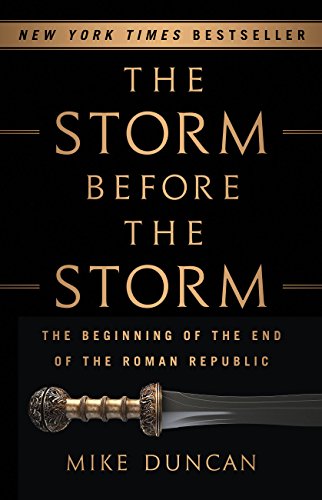
Duncan fills in the half-century before Rubicon. It is the story of the generation that broke the Republic without realizing they were doing it: Marius, Sulla, the Gracchi brothers, the slow normalization of political violence. Every time someone says "we have never done this before, we cannot do it now," Duncan shows a moment where the precedent was set.
The Storm Before the Storm is about institutional decay. It is about how norms erode, one decision at a time, until the unthinkable becomes inevitable. It is the most important book for understanding why republics collapse.
Best for: Readers who want the political and economic causes of the Republic's failure, not just the dramatic end.
The Empire
4. Dynasty: The Rise and Fall of the House of Caesar by Tom Holland (2015)
Holland's sequel to Rubicon covers the Julio-Claudian dynasty: Augustus, Tiberius, Caligula, Claudius, Nero. The family that founded the empire was also one of the most dysfunctional in recorded history. Holland writes them as the soap opera they actually were, without losing the underlying political analysis.
Dynasty shows that the early empire was never stable. It was held together by the fragile personality of its ruler. One unstable emperor could undo decades of policy. The machinery of empire only works if the emperor believes in it.
5. Pax: War and Peace in Rome's Golden Age by Tom Holland
The third volume in Holland's trilogy covers the empire from Nero through the Antonines, roughly 69 to 138 CE, the period historians call Rome's golden age. If SPQR is your single-volume history, Holland's trilogy is the long-form companion that makes the era come alive.
The Ancient Sources
6. The Twelve Caesars by Suetonius (Robert Graves translation)
Suetonius worked in the imperial archives and wrote short biographies of Julius Caesar plus the first eleven emperors. The Graves translation reads like modern narrative non-fiction. It is also the source for nearly every famous anecdote about the early emperors that you have ever heard.
Suetonius is gossipy and anecdotal, but he was close to the sources. His prejudices are visible, which makes him more useful, not less. You learn as much from what he chooses to emphasize as from what he actually reports.
7. Meditations by Marcus Aurelius (Gregory Hays translation)

The private notebook of a Roman emperor, the closest you will get to the inner life of a second-century stoic ruler. Marcus Aurelius was the philosopher-emperor, but the philosophy is not transcendent. It is practical: how to be virtuous when you have power. How to accept what you cannot control.
Best for: Readers who want the thinking of a Roman ruler in his own words.
8. The Histories by Tacitus (Penguin Classics translation)
Tacitus on the year of the four emperors (69 CE) is the single greatest piece of political history surviving from antiquity. He writes with cold precision that no later imperial historian matched. His judgment of character is devastating.
Best for: Readers ready for sophisticated ancient prose and political analysis.
Specialized Topics
9. Caesar by Adrian Goldsworthy (2006)

Goldsworthy is the definitive biographer of Caesar. He traces Caesar's entire life with military precision and political understanding. By the end, you understand Caesar not as hero or villain but as a man who understood power more clearly than anyone else of his era.
Best for: Readers who want to understand Caesar as a historical figure rather than as legend.
10. Cicero by Anthony Everitt (2001)
Everitt shows the Republic through its greatest orator. Cicero is not just a speaker. He is a moral philosopher, a political thinker, a man who tried to save the Republic through argument and failed. His letters reveal a character of tremendous complexity and terrible vulnerability.
Best for: Readers who want to understand Republican political culture through its greatest practitioner.
11. The Fate of Rome by Kyle Harper

Harper rewrites the fall of Rome through climate and disease data: the Antonine plague, the Justinianic plague, the Late Antique Little Ice Age. It is the book that changed how working historians think about why the empire ended. It reads like detective work.
Best for: Readers who want to understand Rome not through military history but through ecological and epidemiological forces.
12. Rome: An Empire's Story by Greg Woolf
Woolf tells Roman history from the provinces outward, not from the city inward. He shows that Rome was not a story of Rome imposing itself on the world but of the world gradually becoming Roman through trade, administration, and cultural adoption. The empire was built on negotiation, not just force.
Best for: Readers who want to understand Rome as a global system, not just as a city-state that became an empire.
How to Read Roman History in the Right Order
A workable sequence:
- Start with SPQR for the shape of Roman history.
- Then The Storm Before the Storm for the long causes of the Republic's fall.
- Then Rubicon for the dramatic end of the Republic.
- Then Dynasty and Pax for the early Empire.
- Then a primary source: The Twelve Caesars or Meditations.
- Then The Fate of Rome for the new economic and climate framing of the end.
This is six books, not seven hundred. By the end you will have a working timeline from Romulus to Constantine and the vocabulary to read anything else in the field.
Why Rome Still Matters
Rome teaches the lesson that every empire must learn: that institutions collapse when the people who defend them stop believing in them. That wealth concentration destroys civic virtue. That the moment when it is too late to restore the republic comes suddenly, and by then it is actually too late.
These twelve books show that Rome was not a military story. It was a moral story: a civilization that understood something about power, that squandered that understanding, and that fell because it did. The lesson is still there if we want to learn it.
If Rome is just one era you want to cover before moving on to the rest of history, see the wider best history books for adults list, which places SPQR and Rubicon alongside picks for WWII, the Cold War, and world history beyond Europe.
Twelve Ancient Rome History Books Worth Reading Today
- SPQR: A History of Ancient Rome by Mary Beard, the modern single-volume history that historians keep recommending.
- Rubicon: The Last Years of the Roman Republic by Tom Holland, the most readable narrative history of the Republic's collapse.
- The Storm Before the Storm by Mike Duncan, the long political backstory that explains why Rubicon happens at all.
- Dynasty: The Rise and Fall of the House of Caesar by Tom Holland, the Julio-Claudians as dysfunctional family and political power.
- The Twelve Caesars by Suetonius, the gossip and anecdote that defined the early emperors.
- The Fate of Rome by Kyle Harper, climate and disease data that changed how we understand the empire's end.
Your next good book, in your inbox
We only write when we find a book worth your time. Hand-picked recommendations across history, mythology, true crime and more.
Are you an author?
Get your book in front of readers like these, for free.
- Free book listing →Your own book page with an Amazon button
- Author page →Photo, bio and links to your site
- Featured placement →A spot in our best-of lists, from €29
Free tools we recommend
Get free honest reviewsReview exchange on iWrity, free to join
Books You Might Like

Sapiens: A Brief History of Humankind
Yuval Noah Harari

The Last Kingdom (The Saxon Stories, Book 1)
Bernard Cornwell
Meditations
Marcus Aurelius

The Hiding Place
Elizabeth Sherrill, John Sherrill Corrie ten Boom