Best Behavioral Economics Books: Why We Make Bad Decisions
You believe you make decisions based on logic. You gather information, weigh the options, calculate the best outcome, and choose accordingly. That's a beautiful theory about how humans work. It has almost no connection to how you actually behave.
Behavioral economics is the study of what really happens when humans encounter money, choice, and risk. The findings are not kind to the myth of rational economic man. You are predictably irrational. You make the same mistakes repeatedly. You can watch yourself make them and still not stop. Understanding these patterns doesn't fix you, but it does let you see yourself clearly and, sometimes, work around your own biases.
The essential foundation: Thinking, Fast and Slow by Daniel Kahneman

Daniel Kahneman won the Nobel Prize in Economics (2002) for his work on human judgment and decision-making. "Thinking, Fast and Slow" (2011) is his magnum opus, and it's the book that explains cognitive biases for readers who've never heard the term before. Kahneman spent 50 years studying how people actually make decisions, and this book is his attempt to summarize a career's worth of experimental findings in a form that non-academics can understand.
The central insight is simple: your brain uses two systems of thought. System 1 is fast, automatic, and operates mostly without effort. It's your intuition, your snap judgments, the thing that fires when you see a face or hear a familiar word. System 2 is slower, deliberate, and requires concentration. It's the mode you use when solving a difficult math problem or learning something new. Most of the time you use System 1, because that's less work. The problem is that System 1 is full of predictable errors.
Kahneman walks you through dozens of these errors: anchoring bias (your judgment gets pulled toward whatever number you saw first), availability bias (you overweight information that comes to mind easily), overconfidence (you believe you understand things better than you actually do). By the end of the book, you see your own decision-making as a landscape of cognitive traps. The gift is that once you see the trap, you can sometimes avoid it.
Get it on Amazon: Thinking, Fast and Slow
For practical applications: Nudge by Richard Thaler and Cass Sunstein

Richard Thaler and Cass Sunstein's "Nudge" (2008) takes the findings of behavioral economics and asks: what if we used these insights to help people make better decisions? The answer is the "nudge," a small change in how choices are presented that can dramatically shift outcomes without restricting anyone's freedom. The classic example is automatic enrollment in retirement plans. When people have to opt in, most don't. When enrollment is automatic and people have to opt out, most do stay enrolled. Same choice architecture, vastly different outcomes.
The book works through dozens of real-world applications: how to improve organ donation rates, how to help people save money, how to reduce energy consumption, how to frame health decisions so people make better choices. Each example shows how understanding behavioral economics can design systems that work with human nature instead of fighting it. It's not manipulation because people remain free to choose. It's just better design.
Thaler and Sunstein's work influenced actual government policy. The UK created a "Behavioural Insights Team" specifically to apply these principles to public policy. The US government has done the same. This book is the bridge between academic psychology and real-world policy implementation.
Get it on Amazon: Nudge: Improving Decisions About Health, Wealth, and Happiness
For market psychology and investing: A Man for All Markets by Edward Thorp
Edward Thorp's "A Man for All Markets" (2017) is a different kind of behavioral economics book. Rather than explaining the psychology of irrationality, it shows how Thorp used an understanding of human behavior, mathematical advantage, and strategic thinking to beat the casinos, the stock market, and every other game he encountered. Thorp didn't get rich by following conventional wisdom. He got rich by finding places where other people's biases created exploitable opportunities.
The book is part memoir and part tutorial in how to think about risk, probability, and advantage. Thorp explains the mathematics behind card counting in blackjack, the option-pricing model that made him millions, and the strategic approach that let him outperform markets when other investors were making emotional decisions. What makes it essential reading for behavioral economics is that Thorp's success came from exploiting other people's cognitive biases while avoiding his own.
This book is particularly useful if you're interested in investing or trading. Thorp shows how markets consistently misprice assets and how systematic thinking can identify those mispricings before the crowd notices. It's a masterclass in applying mathematical thinking to places where human psychology creates inefficiency.
Get it on Amazon: A Man for All Markets
For understanding predictable irrationality: The Upside of Stress by Kelly McGonigal
Kelly McGonigal's "The Upside of Stress" (2015) tackles one of the most pervasive behavioral biases: the belief that stress is always bad and should be avoided. McGonigal, a health psychologist, synthesizes decades of research showing that your mindset about stress dramatically affects how stress actually impacts you. If you believe stress is harmful, it becomes harmful. Your stress response becomes a threat response that damages your health. If you believe stress is enhancing, the same physiological stress becomes a challenge response that improves performance.
This is behavioral economics applied to health and performance. McGonigal shows how your beliefs (which are often shaped by cultural narratives rather than evidence) directly change your physiology. The book demonstrates that what matters isn't whether you experience stress, but whether you interpret that stress as threatening or strengthening. This single reframe can shift outcomes in education, athletics, public speaking, and health.
The practical applications are immediate. If you understand that your mind's interpretation of stress shapes the actual impact, you can change your approach to pressure situations without changing the situations themselves. That's behavioral economics in its most useful form: knowledge that directly improves decision-making and outcomes.
The deeper puzzle: why understanding doesn't fix the bias
One of the surprising findings in behavioral economics is that knowing about a bias doesn't eliminate it. You can understand anchoring bias completely and still get pulled by the first number you see. You can know about overconfidence and still overestimate your abilities. Experts who spend their careers studying these biases still fall prey to them in their own decisions.
This is humbling, but it's also the reason behavioral economics matters beyond intellectual curiosity. If biases were easy to overcome through understanding alone, we could all just read the research and fix ourselves. Since they're not, the real value of behavioral economics is in designing systems, habits, and environments that work around your limitations. That's what separates a useful field of study from just another set of interesting facts you forget by next week.
Your next good book, in your inbox
We only write when we find a book worth your time. Hand-picked recommendations across history, mythology, true crime and more.
Are you an author?
Get your book in front of readers like these, for free.
- Free book listing →Your own book page with an Amazon button
- Author page →Photo, bio and links to your site
- Featured placement →A spot in our best-of lists, from €29
Free tools we recommend
Get free honest reviewsReview exchange on iWrity, free to join
Books You Might Like

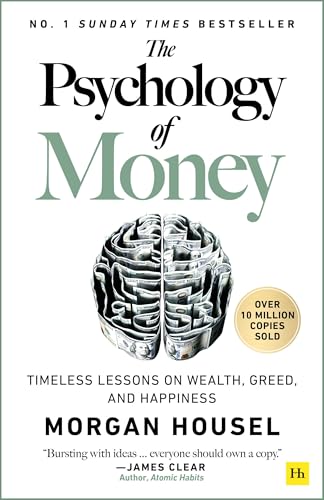
The Psychology of Money
Morgan Housel
Thinking, Fast and Slow
Daniel Kahneman

Man's Search for Meaning
Viktor E. Frankl