Best Books About Ancient Persia in 2026: 10 That Reveal the Empire That Rivaled Greece and Rome
Most people learn about ancient Persia through the Greeks. Thermopylae. Salamis. Xerxes and his million-man army. That framing does something specific: it turns the largest empire the ancient world had yet seen into a backdrop for Greek heroism. The Persians become the enemy, defined entirely by their failure to conquer Athens.
The reality is more interesting. The Achaemenid Empire, founded by Cyrus the Great around 550 BCE, governed a territory stretching from Egypt to the borders of India. It was, by most measures, the most sophisticated administrative state the ancient world had produced up to that point. It practiced a form of religious tolerance that was genuinely unusual for the period. The Cyrus Cylinder, discovered in Babylon in 1879, records Cyrus's policy of allowing conquered peoples to return to their homelands and practice their own religions, a policy that freed the Jews from the Babylonian captivity and earned Cyrus a unique honorific in the Hebrew Bible. No other foreign ruler is called "messiah" in that text.
None of this fits the "300" version of Persia. These ten books tell the fuller story.
1. Persian Fire by Tom Holland
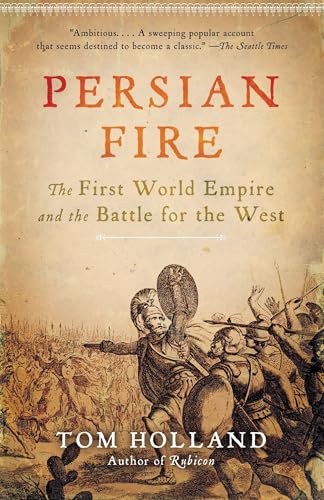
Holland writes narrative history with the pace of a thriller, and Persian Fire is his best work. It covers the Persian Wars from both sides, drawing on Greek and Persian sources and archaeological evidence to reconstruct the conflict between the Achaemenid Empire and the Greek city-states. What separates this from most accounts of the period is that Holland takes Persian motivations seriously. Xerxes was not a cartoon despot sending hordes to die; he was a king managing an empire that had, until Greece, expanded without serious military resistance. The book is gripping and scrupulously sourced.
2. From Cyrus to Alexander: A History of the Persian Empire by Pierre Briant
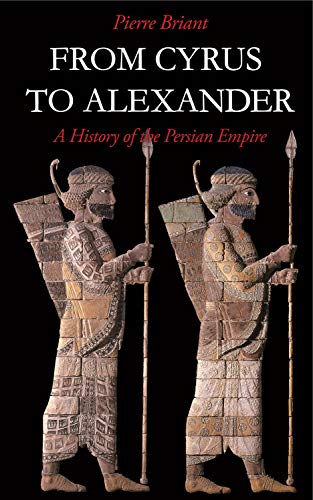
This is the definitive scholarly account of the Achaemenid Empire in English. Briant, the leading French historian of ancient Persia, spent decades synthesizing Greek literary sources, Babylonian administrative texts, Elamite treasury tablets, and archaeological evidence from across the empire. The result is a 1,000-page work that replaces the Greek-filtered version of Persian history with a picture built from Persian evidence. It is dense and scholarly but rewards serious readers with a level of detail available nowhere else.
3. The Persian Empire: A Corpus of Sources from the Achaemenid Period by Amélie Kuhrt
Kuhrt's two-volume anthology collects primary sources from across the Achaemenid Empire: royal inscriptions, administrative documents, Babylonian chronicles, Greek accounts, Egyptian texts, and more. It is the essential companion to any serious study of Persian history. Rather than reading one historian's interpretation of Persian sources, you read the sources themselves, with Kuhrt's careful contextual notes. The breadth of evidence assembled here makes clear just how large and diverse the empire actually was.
4. The Persian Empire by Lindsay Allen
Allen's book is the most accessible modern introduction to the Achaemenid Empire aimed at general readers. It covers the full span of the empire from Cyrus to Darius III, with strong material on Persian art, architecture, and court culture. Allen is particularly good on Persepolis, the great ceremonial capital that Alexander burned in 330 BCE, and on what Persian royal ideology actually looked like from the inside rather than through Greek eyes. A good starting point before moving to Briant.
5. The Histories by Herodotus
You cannot study ancient Persia without reading Herodotus, and not only because he is the main surviving ancient source for the Achaemenid period. His account is genuinely interested in Persia on its own terms. He records Persian customs, geography, and royal succession with curiosity rather than pure contempt. His portrait of Cyrus, Cambyses, and Darius is detailed and often sympathetic. The Greek bias is real and identifiable, but Herodotus is not a propagandist. He preserves Persian traditions and court stories that survived nowhere else.
6. Iranian Nationality and the Persian Language by Shahrokh Meskoob
Meskoob's essay is short but sharp. It examines how Persian identity survived the Arab conquest of the seventh century CE and re-emerged in the New Persian literary tradition, and it does so through the lens of language. His argument is that Persian survived as the vehicle of a cultural identity that had deeper roots than political boundaries. For readers interested in the long arc of Persian civilization from the Achaemenids through the Islamic period, this is a key text.
7. Shahnameh: The Persian Book of Kings translated by Dick Davis
Ferdowsi's Shahnameh, completed around 1010 CE, is the national epic of Iran, a 50,000-couplet poem covering the mythological and semi-historical kings of Persia from creation to the Arab conquest. Dick Davis's translation is the standard English version, widely praised for combining scholarly accuracy with genuine readability. The Shahnameh is not a history of the Achaemenid Empire, but it is the deepest expression of Persian cultural memory, and understanding it is essential to understanding why ancient Persia matters to modern Iranians.
8. A History of Iran: Empire of the Mind by Michael Axworthy
Axworthy, a former British diplomat in Tehran and a professor of Iranian history, covers Iranian civilization from the Achaemenids to the present in a single readable volume. The book's organizing argument is that Iranian identity is defined less by conquest or geography than by a continuous intellectual and cultural tradition. The Achaemenid section is strong, but the book's real value is in showing how ancient Persian history connects to everything that follows. Axworthy writes without the contempt or the sentimentalism that tend to distort writing about Iran in the West.
9. Ancient Persia by Josef Wiesehöfer
Wiesehöfer's survey covers the full span of ancient Iranian history from the Medes through the Sassanid Empire, with the Achaemenid section as its core. It is a scholarly synthesis that draws on the full range of archaeological and textual evidence, including significant material from Persepolis and from Babylonian administrative archives. It is more technical than Holland or Allen but less demanding than Briant, and it fills in gaps in the archaeological record that purely text-based histories miss.
10. The Cyrus Cylinder by John Curtis
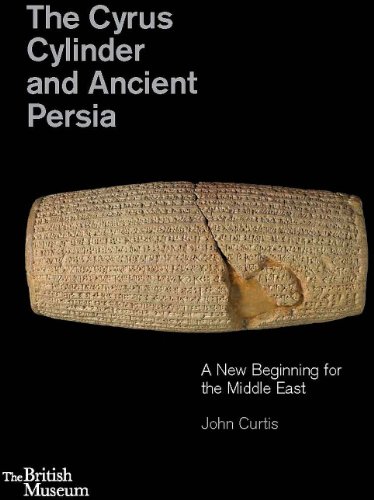
The Cyrus Cylinder is a baked clay barrel inscribed in Babylonian cuneiform, recording Cyrus's conquest of Babylon in 539 BCE and his policies toward the city's gods and peoples. Curtis, a curator at the British Museum where the cylinder is held, provides a full account of the object's discovery, its content, its historical context, and its later appropriation as a symbol of human rights by Cyrus's admirer Reza Shah Pahlavi. The cylinder itself is short; Curtis's surrounding scholarship is indispensable for understanding why a small clay object has generated such intense historical and political debate for nearly 150 years.
The ancient Persian Empire was not the enemy army in a Greek war story. It was a civilization that invented imperial administration, practiced religious tolerance on a scale without precedent in the ancient world, and produced an artistic and literary tradition that shaped every culture from the Mediterranean to Central Asia. These books give you the tools to read that history on its own terms.
Your next good book, in your inbox
We only write when we find a book worth your time. Hand-picked recommendations across history, mythology, true crime and more.
Are you an author?
Get your book in front of readers like these, for free.
- Free book listing →Your own book page with an Amazon button
- Author page →Photo, bio and links to your site
- Featured placement →A spot in our best-of lists, from €29
Free tools we recommend
Get free honest reviewsReview exchange on iWrity, free to join
Books You Might Like

It Ends with Us: A Novel
Colleen Hoover

The Seven Husbands of Evelyn Hugo: A Novel
Taylor Jenkins Reid

The Song of Achilles
Madeline Miller

Educated: A Memoir
Tara Westover