Best Books About Cognitive Science (2026)
PICTURE THIS: a field that tries to explain why you forget your keys, why you fall for the same marketing tricks every single time, and what it even means to "experience" the color red. Cognitive science pulls together psychology, neuroscience, linguistics, and philosophy to answer those questions, and the books below are the ones that actually make the research stick. Some are decades old and still hold up, others are recent and reflect where the field has moved. All seven are written by scientists who can also write.
1. Thinking, Fast and Slow by Daniel Kahneman

Kahneman spent his career studying how people make decisions, and this book distills that work into two systems: System 1, fast and intuitive, and System 2, slow and deliberate. He walks through anchoring, loss aversion, the planning fallacy, and the peak-end rule, using decades of experiments he ran with Amos Tversky. The chapters on overconfidence and the "illusion of validity" are especially sharp. Read this if you want the single most influential account of human judgment and bias, written by the person who won a Nobel Prize for it. Find Thinking, Fast and Slow on Amazon.
2. How the Mind Works by Steven Pinker
Pinker takes an evolutionary psychology lens to the whole mind, covering vision, emotion, social relationships, and reasoning in one sweeping book. He argues the brain is a collection of specialized modules shaped by natural selection, not a blank slate or a single general processor. The chapter on vision alone is worth the price, breaking down how your brain reconstructs a 3D world from flat retinal images. This is the right pick for readers who want one big, ambitious book that connects biology to everyday behavior, from humor to love to art. Find How the Mind Works on Amazon.
3. The Man Who Mistook His Wife for a Hat by Oliver Sacks
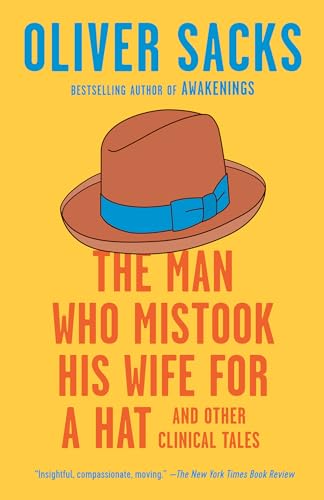
Sacks was a neurologist, and this collection of case studies looks at what happens to the mind when the brain breaks in specific, strange ways. You meet a man who cannot recognize faces or objects, a woman who loses all sense of her own body, and patients with phantom limbs and musical hallucinations. Each case teaches you something about how a healthy brain normally does its job, by showing what's missing when it doesn't. Pick this up if you want cognitive science through real human stories rather than lab charts. Find The Man Who Mistook His Wife for a Hat on Amazon.
4. Being You by Anil Seth
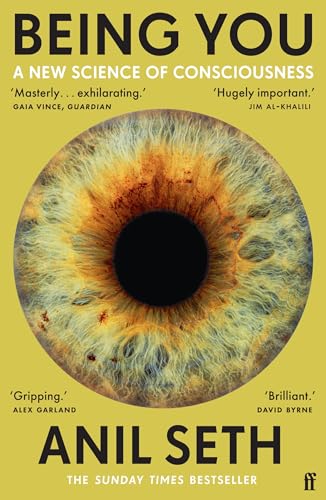
Seth, a neuroscientist at the University of Sussex, tackles consciousness directly and argues your perception of reality is not a passive recording but an active, predictive construction your brain generates and constantly corrects. He draws on his own research on interoception, the sense of your body's internal states, and connects it to mood, selfhood, and even the feeling of free will. The book stays grounded in actual lab findings rather than speculation. This one suits readers who want the most current, serious attempt to explain consciousness without resorting to mysticism. Find Being You on Amazon.
5. Metaphors We Live By by George Lakoff and Mark Johnson
This short, dense book argues that metaphor is not just a literary device but the basic structure of how humans think. Lakoff and Johnson show how everyday phrases like "time is money" or "argument is war" shape reasoning in ways most people never notice. The book founded an entire subfield of cognitive linguistics and still gets cited constantly in work on framing and persuasion. Read it if you care about language and want to see how deeply metaphor is wired into categories, logic, and even politics. Find Metaphors We Live By on Amazon.
6. Gödel, Escher, Bach by Douglas Hofstadter
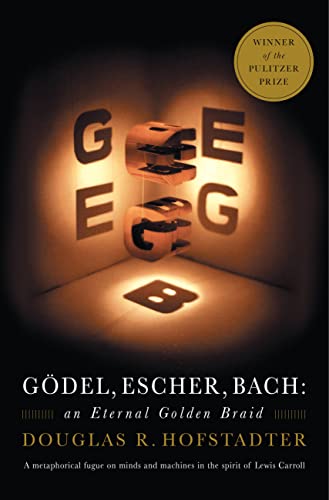
Hofstadter's sprawling, playful book uses mathematician Kurt Gödel's incompleteness theorems, the art of M.C. Escher, and the music of Johann Sebastian Bach to explore self-reference, recursion, and how meaning emerges from simple rules. It's part cognitive science, part math, part philosophy, structured as a series of dialogues between fictional characters that mirror the ideas being discussed. This is a long, demanding read, not something to finish in a weekend. Pick it up if you already have some footing in cognitive science and want the book that tries to explain how minds and symbols can arise from mere mechanism. Find Gödel, Escher, Bach on Amazon.
7. Consciousness Explained by Daniel Dennett
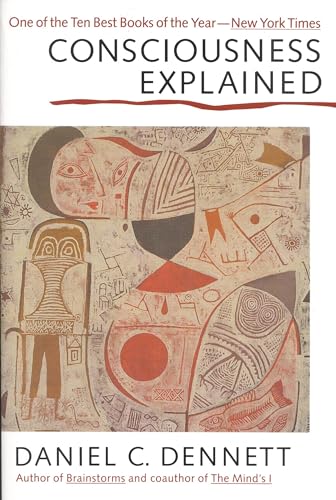
Dennett, a philosopher who worked closely with cognitive scientists, lays out his "multiple drafts" model of consciousness, arguing against the idea of a single place in the brain where experience "comes together." He takes apart what he calls the Cartesian theater, the intuitive but mistaken picture of a little screen in your head where a homunculus watches the show. The book is argumentative and sometimes combative, taking on rival theories by name. This is a demanding but rewarding read for anyone who wants the philosophical side of cognitive science laid out with real teeth. Find Consciousness Explained on Amazon.
Where to Start
Start with Thinking, Fast and Slow. It covers ground that touches every other book on this list, from perception to language to decision-making, and it does it with clear examples you can test on yourself as you read. Once you have Kahneman's framework for how judgment actually works, the deeper books from Seth, Hofstadter, and Dennett will make a lot more sense.
Your next good book, in your inbox
We only write when we find a book worth your time. Hand-picked recommendations across history, mythology, true crime and more.
Are you an author?
Get your book in front of readers like these, for free.
- Free book listing →Your own book page with an Amazon button
- Author page →Photo, bio and links to your site
- Featured placement →A spot in our best-of lists, from €29
Free tools we recommend
Get free honest reviewsReview exchange on iWrity, free to join
Books You Might Like

It Ends with Us: A Novel
Colleen Hoover

The Seven Husbands of Evelyn Hugo: A Novel
Taylor Jenkins Reid

The Song of Achilles
Madeline Miller

Educated: A Memoir
Tara Westover