Best Popular Mathematics Books (2026)
PICTURE THIS: a subject most people swore off in high school turns out to be full of strange loops, prime number mysteries, and ideas that quietly run your phone, your vote, and your bank account. Good popular math books do not dumb anything down, they just show you why mathematicians find this stuff thrilling in the first place. Here are seven books that open that door, whether you want a breezy read or something that will keep you up at night.
1. How Not to Be Wrong by Jordan Ellenberg
Ellenberg takes everyday arguments, lottery odds, election polling, medical statistics, and shows the math quietly running underneath them. He moves through linearity, probability, regression, and inference without ever feeling like a textbook, using stories about a Massachusetts lottery scheme or Abraham Wald's bullet holes to make the ideas stick. The writing is funny and sharp, and the book never loses sight of its real goal: training you to spot bad reasoning in the news and in your own head. Anyone who wants math that pays off in daily life should start here. Find How Not to Be Wrong on Amazon.
2. Fermat's Enigma by Simon Singh
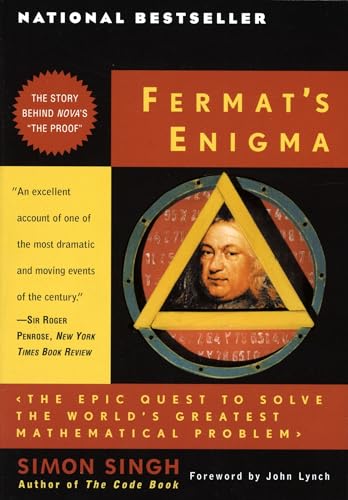
Singh tells the story of Andrew Wiles spending seven years in secret to prove a problem that had sat unsolved for 350 years. Along the way you get Pythagoras, Euler, Sophie Germain, and the strange detour through Japanese modular forms that finally cracked the case. It reads like a detective story, with real suspense about whether the proof will hold up under scrutiny. You do not need any background in number theory to follow it. This is the book to hand someone who thinks math history cannot be gripping. Find Fermat's Enigma on Amazon.
3. The Joy of X by Steven Strogatz
Strogatz, a Cornell mathematician, built this book from a New York Times series explaining math concept by concept, from basic arithmetic up through calculus and infinity. Each short chapter stands on its own, so you can read about negative numbers one night and group theory the next without losing the thread. He uses everyday comparisons, cutting a bagel, running late for a flight, to make abstract ideas land. It works well as a bedside book you dip into rather than read straight through. Ideal for readers who want a gentle, chapter-sized reintroduction to math. Find The Joy of X on Amazon.
4. Infinite Powers by Steven Strogatz
Here Strogatz goes deeper into one subject: calculus, and makes the case that it is the most important idea humans ever had. He traces it from Archimedes slicing circles into infinite triangles through Newton and Leibniz racing to formalize it, and on to its role in GPS, medical imaging, and modeling pandemics. The explanations of limits and infinitesimals are patient and visual, built for readers who never quite got calculus the first time around. It rewards a slower read than his other book but pays off with real understanding, not just appreciation. Find Infinite Powers on Amazon.
5. Gödel, Escher, Bach by Douglas Hofstadter
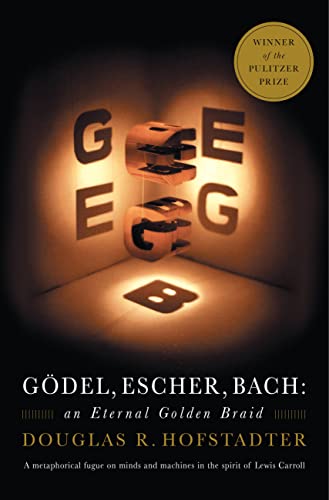
This is the deep end of the list, a sprawling, playful exploration of self-reference and formal systems that weaves together Gödel's incompleteness theorems, Escher's impossible drawings, and Bach's musical canons. Hofstadter builds toward big questions about consciousness and artificial intelligence through dialogues, puzzles, and wordplay, not straight exposition. It demands patience and rereading, and some chapters work better as puzzles to sit with than facts to absorb. Readers who already like math and want something that argues with philosophy and cognitive science too should set aside real time for this one. Find Gödel, Escher, Bach on Amazon.
6. Prime Obsession by John Derbyshire
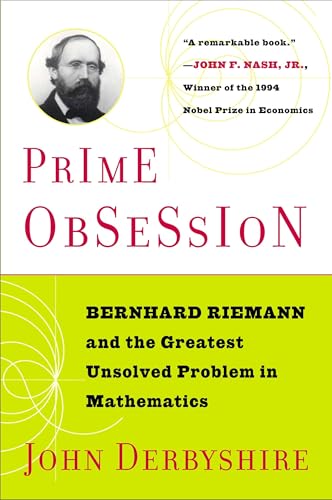
Derbyshire tackles the Riemann Hypothesis, one of the most famous unsolved problems in mathematics, by alternating chapters of history with chapters of actual math. You follow Riemann's life and the slow accumulation of work by Euler, Gauss, and later number theorists, while the odd-numbered chapters walk through the zeta function and why its zeros matter so much. It asks more of the reader than most books on this list, including some comfort with equations, but it never pretends the problem is simple. Readers who want to understand what mathematicians are actually chasing, not just hear about it, will get the most out of this. Find Prime Obsession on Amazon.
7. A Mathematician's Apology by G.H. Hardy
Hardy wrote this short, personal essay near the end of his career, defending pure mathematics as worth doing for its own beauty rather than its usefulness. He is blunt about aging, about which of his own results he thinks will last, and about what separates real mathematical talent from mere cleverness. C.P. Snow's introduction adds useful context about Hardy's partnership with Ramanujan and his life at Cambridge. It is barely over a hundred pages, but it gives you a rare, candid look at how a serious mathematician thought about his own work and its worth. Read it for the voice as much as the argument. Find A Mathematician's Apology on Amazon.
Where to Start
Start with How Not to Be Wrong. It asks nothing of you beyond curiosity, pays off immediately in how you read the news and think about risk, and gives you a real feel for what mathematical thinking looks like outside the classroom. From there, Fermat's Enigma or The Joy of X make good next steps depending on whether you want a story or a set of concepts, and the rest of the list is there once you are ready to go deeper.
Your next good book, in your inbox
We only write when we find a book worth your time. Hand-picked recommendations across history, mythology, true crime and more.
Are you an author?
Get your book in front of readers like these, for free.
- Free book listing →Your own book page with an Amazon button
- Author page →Photo, bio and links to your site
- Featured placement →A spot in our best-of lists, from €29
Free tools we recommend
Get free honest reviewsReview exchange on iWrity, free to join
Books You Might Like

It Ends with Us: A Novel
Colleen Hoover

The Seven Husbands of Evelyn Hugo: A Novel
Taylor Jenkins Reid

The Song of Achilles
Madeline Miller

Educated: A Memoir
Tara Westover