Best Books About Norse Mythology: A Reading Guide That Actually Works
Norse mythology is one of those subjects where the wrong starting point ruins it. Jump straight into the original texts and you will spend an hour untangling footnotes before you meet a single god. Start with a badly organized survey and you will close the book with a vague idea that Odin had one eye and that something bad happened at Ragnarok.
This guide cuts through the noise. It covers the books that give you a real understanding of Norse mythology, starting with the best entry point for most readers and working toward primary sources and specialist territory. There are also a few recommendations for readers who want to understand how the Vikings themselves thought about death, fate, and heroism — which is a different kind of book altogether.
Start Here: Neil Gaiman's Norse Mythology
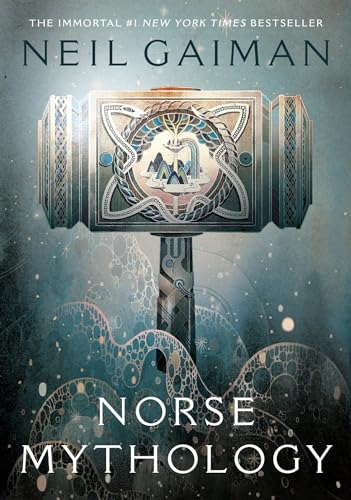
Neil Gaiman's Norse Mythology (2017) is the single best starting point for most readers. Gaiman works directly from the Prose Edda and Poetic Edda, selects the strongest stories, and arranges them in roughly chronological order from the creation of the nine worlds to Ragnarok. The writing is clean, the characterization is sharp, and nothing gets in the way of the actual myths.
What Gaiman gets right that most retellings miss: he preserves the dark comedy that runs through Norse mythology. Odin disguising himself to steal mead from a giant. Thor cross-dressing to retrieve his hammer. Loki being the most useful and the most destructive force in every story he appears in. The myths are genuinely funny in parts, and Gaiman does not iron that out.
Read this first. Come back to the original sources after.
The Original Source: Snorri Sturluson's Prose Edda
Everything modern writers know about Norse mythology comes, directly or indirectly, from two sources: the Prose Edda and the Poetic Edda. The Prose Edda was written in Iceland around 1220 AD by a Christian scholar named Snorri Sturluson, who was trying to preserve the old poetic tradition for younger writers who no longer understood the mythological references.
Snorri was writing about religion that most Icelanders had abandoned two centuries earlier. He was meticulous and knowledgeable, but he was also working from memory and from earlier written sources that no longer survive. The Prose Edda is thus both the best source we have and an imperfect one.
The best English translation is Anthony Faulkes's translation for Penguin Classics. It is scholarly without being impenetrable. Read Gaiman first, then come to this. The myths will be familiar enough that the older, sparser language will not confuse you.
The Scholarly Retelling: Kevin Crossley-Holland's The Norse Myths
Kevin Crossley-Holland's The Norse Myths sits between Gaiman's accessibility and the directness of the original texts. Crossley-Holland is a poet and translator, and his retelling preserves more of the original texture than Gaiman's. The myths feel slightly older, slightly stranger.
The book includes detailed notes for each myth explaining what the original sources say, where scholars disagree, and what parts Crossley-Holland has reconstructed from partial evidence. For readers who want more than a retelling but are not ready to dig into academic commentary, this is the right level.
It covers a wider range of myths than Gaiman does, including some of the eddic poetry that Gaiman left out. Read this after Gaiman if you want more depth before moving to primary sources.
The Academic Introduction: John Lindow's Norse Mythology
John Lindow's Norse Mythology: A Guide to the Gods, Heroes, Rituals, and Beliefs is a reference work structured as an encyclopedia. You look up Odin, Freyr, Yggdrasil, or Ragnarok and get a scholarly entry that synthesizes what the sources say, how scholars interpret it, and what remains contested.
This is not a book you read cover to cover. You use it alongside the primary texts to check what you just read. When the Prose Edda mentions something in passing and you want to know whether that reference is consistent across sources, Lindow is where you check. It is dense but genuinely useful for anyone who wants to take the mythology seriously rather than just enjoying it.
The Viking Mindset: Tom Shippey's Laughing Shall I Die
Tom Shippey's Laughing Shall I Die: Lives and Deaths of the Great Vikings is a different kind of book. It does not retell myths. It asks why the Vikings believed what they believed about fate, courage, and how you die.
The central argument: Viking heroism was built around a concept of defiant laughter in the face of inevitable death. The hero who dies well, who refuses to beg or break, who can find something darkly funny even at the moment of killing or being killed, was celebrated in Norse culture in a way that has no real equivalent in other traditions.
Shippey draws on the sagas, eddic poetry, and archaeological evidence to show how this ideology worked in practice and how it shaped both the myths and the historical behavior of people who actually believed in Odin and Valhalla. If you want to understand Norse mythology rather than just know the stories, this book is essential.
The Translation Project: Jackson Crawford
Jackson Crawford is a Norse scholar who has spent the last decade producing direct, modern-English translations of the primary sources. His translations of the Poetic Edda, the Prose Edda, and several of the sagas are the most readable versions currently available in English.
Crawford is unusual among academics in that he explains his translation choices in plain language, runs a YouTube channel where he discusses Old Norse grammar and mythology, and writes for readers rather than for other scholars. His version of the Poetic Edda is the one to read if you want to engage with the original poems without learning Old Norse yourself.
Start with Crawford's Poetic Edda after reading Gaiman and Crossley-Holland. By then you will already know most of the figures and events, and the stripped-down poetry of the original will land harder for it.
Reading Order That Works
If you want a clear path through these books:
- Neil Gaiman's Norse Mythology — orientation and enjoyment
- Kevin Crossley-Holland's The Norse Myths — more stories, more texture
- Snorri Sturluson's Prose Edda (Faulkes translation) — the main primary source
- Jackson Crawford's Poetic Edda — the poetry behind the myths
- Tom Shippey's Laughing Shall I Die — the Viking worldview behind the mythology
- John Lindow's Norse Mythology — reference for ongoing reading
You do not need to read all of them. Gaiman alone is enough to enjoy the stories. But each book in this list opens up something the previous ones left closed. The mythology rewards that kind of sustained attention. The people who created these stories were trying to explain something real about how to live and die, and the more closely you look, the more interesting that project becomes.
Your next good book, in your inbox
We only write when we find a book worth your time. Hand-picked recommendations across history, mythology, true crime and more.
Are you an author?
Get your book in front of readers like these, for free.
- Free book listing →Your own book page with an Amazon button
- Author page →Photo, bio and links to your site
- Featured placement →A spot in our best-of lists, from €29
Free tools we recommend
Get free honest reviewsReview exchange on iWrity, free to join
Books You Might Like

The Song of Achilles
Madeline Miller

Circe
Madeline Miller
Norse Mythology
Neil Gaiman

Heroes
Unknown Author