Best Books About the Roman Empire (2026)
PICTURE THIS: a city-state of farmers and traders grows into an empire that stretches from Scotland to the Sahara, run by men who were sometimes brilliant and sometimes insane. Few subjects have produced as much great writing as Rome, because the story has everything, politics, war, betrayal, engineering, and a slow unraveling that still gets argued about today. Here are seven books that will give you a real feel for how it worked, how it broke, and why it still matters.
1. SPQR: A History of Ancient Rome by Mary Beard

Beard covers nearly a thousand years, from Rome's murky founding myths to the early empire under Caracalla, but she spends most of her energy on the Republic and the tensions that eventually broke it. She is less interested in emperors and battles than in how ordinary Romans lived, voted, and argued, and she is upfront about what we simply cannot know. The writing is sharp, funny in places, and never condescending. This is the best single book to start with if you want the full sweep of Roman history from a historian who respects the evidence. Find SPQR: A History of Ancient Rome on Amazon.
2. Rubicon: The Last Years of the Roman Republic by Tom Holland

Holland zooms in on the last century of the Republic, roughly 133 to 27 BC, when men like Marius, Sulla, Pompey, Caesar, and Cicero tore the old system apart through ambition and civil war. He writes like a novelist, building tension scene by scene, but he sticks closely to the sources and footnotes his claims. You get a vivid sense of how a political culture built on honor and competition finally cannibalized itself. Read this if you want the Republic's collapse to feel as dramatic as it actually was. Find Rubicon: The Last Years of the Roman Republic on Amazon.
3. The Storm Before the Storm by Mike Duncan
Duncan looks at the generation before Holland's book, the Gracchi brothers, the Jugurthine War, and the rise of Marius and Sulla, roughly 146 to 78 BC. His argument is that the Republic's real wounds opened decades before Caesar, when political violence first became normal and the Senate started treating rivals as enemies rather than opponents. It is short, clear, and written for people with no background in Roman history. Pair it with Rubicon for the full story, or read it alone if you just want to understand why the Republic was doomed long before Caesar crossed any river. Find The Storm Before the Storm on Amazon.
4. Augustus: First Emperor of Rome by Adrian Goldsworthy
Goldsworthy tracks Octavian's transformation from a teenage heir with no legal standing into Augustus, the man who ended a century of civil war and built the imperial system that lasted for centuries. He is especially good on the practical side, how Augustus rebuilt the army, reshaped the Senate, and sold his new order to a population exhausted by bloodshed. The book is dense with detail but never dry, and it corrects the myth of Augustus as a quiet reformer rather than a ruthless survivor. Good for readers who want to understand power, not just personality. Find Augustus: First Emperor of Rome on Amazon.
5. The Twelve Caesars by Suetonius
This is the original gossip column of Roman history, written around 120 AD, covering Julius Caesar through Domitian. Suetonius mixes real political detail with scandal, rumor, and outright invention, and that mix is exactly why the book has lasted. You get Caligula's cruelty, Nero's theatrics, and Claudius stumbling into power, all told with a biographer's eye for the telling detail rather than the big picture. Read it after a modern overview so you can separate fact from legend, and read it for the sheer entertainment of it. Find The Twelve Caesars on Amazon.
6. The Fall of the Roman Empire by Peter Heather

Heather argues against the old idea that Rome simply rotted from within, and instead makes the case that outside pressure, especially from the Huns pushing Germanic groups into Roman territory, did most of the damage in the fourth and fifth centuries. He walks through the Gothic wars, the sack of Rome in 410, and the slow loss of the western provinces with real narrative drive, backed by solid use of archaeological and documentary evidence. This is a serious, researched argument, not just a retelling, and it works well for readers who already know the basic outline and want a sharper explanation. Find The Fall of the Roman Empire on Amazon.
7. The History of the Decline and Fall of the Roman Empire by Edward Gibbon
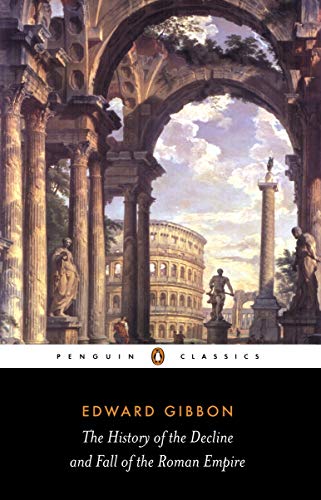
First published between 1776 and 1789, Gibbon's history runs from the second century AD all the way to the fall of Constantinople in 1453, and it remains one of the great works of English prose as much as a history book. His famous argument that Christianity weakened Roman civic virtue is now mostly rejected by historians, but the writing itself, dry, ironic, endlessly quotable, still holds up. Nobody needs to read all six volumes cover to cover. Pick an abridged edition or dip into the chapters on specific emperors, and treat it as a monument of historical writing rather than a textbook. Find The History of the Decline and Fall of the Roman Empire on Amazon.
Where to Start
Start with Mary Beard's SPQR. It gives you the full timeline without assuming you know anything already, and it sets you up to understand why the other six books focus where they do, whether that is the Republic's collapse, an emperor's rise, or the empire's long goodbye in the west.
Your next good book, in your inbox
We only write when we find a book worth your time. Hand-picked recommendations across history, mythology, true crime and more.
Are you an author?
Get your book in front of readers like these, for free.
- Free book listing →Your own book page with an Amazon button
- Author page →Photo, bio and links to your site
- Featured placement →A spot in our best-of lists, from €29
Free tools we recommend
Get free honest reviewsReview exchange on iWrity, free to join
Books You Might Like

It Ends with Us: A Novel
Colleen Hoover

The Seven Husbands of Evelyn Hugo: A Novel
Taylor Jenkins Reid

The Song of Achilles
Madeline Miller

Educated: A Memoir
Tara Westover