Best Books About the Roman Empire: Seven Essential Reads
Rome built the world's most copied political system, a legal framework that still shapes European law today, and a military machine that held together 50 million people across three continents for centuries. It also collapsed. Both facts are worth understanding, and the books on this list make sure you do.
Whether you want the political drama of the late Republic, a ground-level view of ordinary Romans, or a hard look at how an empire unravels, these seven books cover the full picture.
Top Picks
1. SPQR: A History of Ancient Rome by Mary Beard
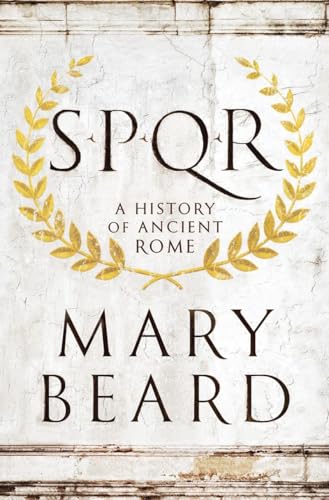
Beard is a classicist at Cambridge, and this book shows it. She does not retell the familiar triumphs-and-emperors story. Instead, she asks harder questions: who actually counted as Roman, how did citizenship get extended, and what did most people's lives look like when they were not fighting wars or attending Senate debates?
The result is a history of Rome built from the bottom up as much as the top down. Beard is also quietly funny, which helps when the material is dense.
2. Rubicon: The Last Years of the Roman Republic by Tom Holland
If SPQR is the long view, Rubicon is the thriller. Holland covers the final decades of the Republic, from Sulla's dictatorship through the careers of Pompey, Cicero, Crassus, and Julius Caesar, ending with the assassination in 44 BC.
The writing is tight and the characters feel real. Holland does not simplify the politics, but he explains them clearly enough that you never lose the thread. If you want to understand why a 500-year-old republic came apart in a single generation, this is the book.
3. The Decline and Fall of the Roman Empire by Edward Gibbon
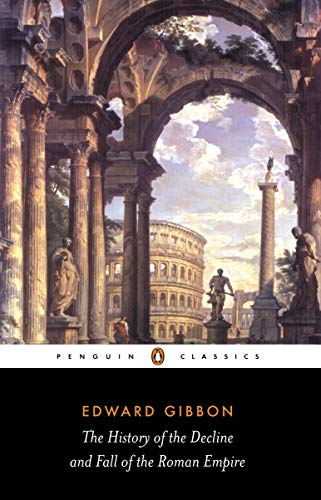
No list of Roman history books skips Gibbon. Written in the 18th century, it covers roughly 1,400 years from the height of imperial power to the fall of Constantinople in 1453. Modern historians have challenged many of his interpretations, particularly his emphasis on Christianity and what he called the loss of civic virtue. But no one has matched the scope, and his prose is still genuinely good.
Read it as the classic it is: essential for context, not the final word on anything.
4. Caesar by Adrian Goldsworthy

Goldsworthy has written extensively on Rome's military history, and his biography of Caesar benefits from that background. The book covers Caesar's full life, from his early political maneuvering through the Gallic Wars to the civil war and assassination, and it treats the military campaigns with the same seriousness as the political career.
What makes this biography worth reading over the many alternatives is the precision. Goldsworthy checks the ancient sources carefully and is honest about what can and cannot be known. You come away with a clear picture of how Caesar actually operated, not just the legend.
5. Augustus: First Emperor of Rome by Anthony Everitt
Caesar's great-nephew turned adopted son became Rome's first emperor, held power for 44 years, and built the structures that kept the empire functioning for another two centuries. How he managed all of that, and how he sold autocracy to a population that had just killed a man for reaching for it, is the subject of this biography.
Everitt writes narrative history that reads quickly, and he is good at explaining the political calculations behind every public gesture Augustus made. The relationship with Agrippa, the awkward succession question, the complicated marriages: it is all here without getting bogged down in academic debate.
6. The Real Lives of Roman Britain by Guy de la Bedoyere
Most Roman history focuses on Italy, and especially on Rome itself. De la Bedoyere shifts the angle entirely: this is Roman Britain from the conquest under Claudius in 43 AD to the withdrawal of Roman troops around 410 AD, told through the people who actually lived there.
He draws on archaeological evidence, inscriptions, graffiti, coins, and burial records to reconstruct individual lives. A soldier from North Africa stationed on Hadrian's Wall. A merchant whose tombstone survives in York. A freedman who made money in the tile trade. It is a reminder that the empire was not an abstraction. It was a system that millions of ordinary people lived inside, adapted to, and sometimes resisted.
7. The Storm Before the Storm by Mike Duncan
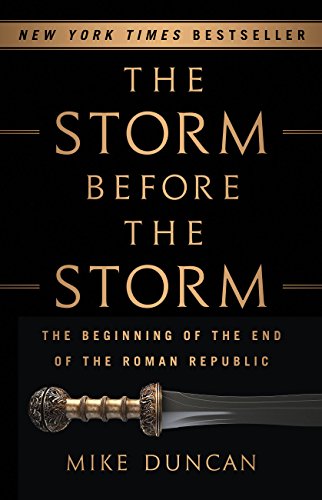
Duncan created the History of Rome podcast, and this book focuses on the generation before Caesar: Marius, Sulla, the Gracchi, and the breakdown of Republican norms that made Caesar's rise possible.
The thesis is directly relevant today. Duncan shows how constitutional guardrails do not break all at once. They erode gradually, as each side normalizes tactics that would have been unthinkable a decade earlier. By the time Caesar crossed the Rubicon, most of what made the Republic work had already been hollowed out by people who believed the rules applied to their enemies, not to themselves.
How to Read These Together
If you are starting from scratch, begin with Rubicon for the drama, then read SPQR for the longer structural view. Augustus fits naturally after both, because you will already understand what he was reacting to. Caesar by Goldsworthy works as a companion to Rubicon, covering the same period in more depth.
De la Bedoyere and Duncan are both excellent when you want to move beyond Rome itself, either geographically or thematically. Gibbon you return to for the sheer sweep of it, ideally after you already have some grounding in the period.
Seven books is enough to give you a serious foundation in Roman history. After that, the rabbit hole goes as deep as you want it to.
Your next good book, in your inbox
We only write when we find a book worth your time. Hand-picked recommendations across history, mythology, true crime and more.
Are you an author?
Get your book in front of readers like these, for free.
- Free book listing →Your own book page with an Amazon button
- Author page →Photo, bio and links to your site
- Featured placement →A spot in our best-of lists, from €29
Free tools we recommend
Get free honest reviewsReview exchange on iWrity, free to join
Books You Might Like

It Ends with Us: A Novel
Colleen Hoover

The Seven Husbands of Evelyn Hugo: A Novel
Taylor Jenkins Reid

The Song of Achilles
Madeline Miller

Educated: A Memoir
Tara Westover