Best Books About the Aztec Empire in 2026: Conquest, Culture, and the World Before Cortes
EVER WONDER what the Spanish actually found when they arrived in central Mexico in 1519? Not a scattered tribe, not a primitive settlement, but a city larger than any in Europe at the time, connected by causeways, fed by aqueducts, organized by a system of laws and religion that had evolved over centuries.
The Aztec Empire is one of history's most misunderstood civilizations -- reduced in popular imagination to human sacrifice and gold, when the reality was a sophisticated world with markets, schools, poets, and a cosmology as elaborate as anything in the ancient world.
These books give you the real picture.
--- ◆ ---
The Essential Anthropological Account
Aztecs by Inga Clendinnen (1991) is the book that changes how you see everything else you read about the Aztec world. Clendinnen was an anthropologist, and she approaches Aztec civilization from inside the culture rather than from the outside looking in. How did the Aztecs experience time? What did the sacrificial rituals mean to the people who performed them, not just to the people who witnessed them? What was the relationship between the warrior ideal and the ordinary farmer? Clendinnen reconstructs the Aztec mental world with rigor and care, drawing on the codices, the Spanish friars' ethnographic records, and archaeological evidence. It is scholarly but not dry. Nothing else quite prepares you to understand what Tenochtitlan was. Find Aztecs on Amazon.
--- ◆ ---
The Eyewitness Account
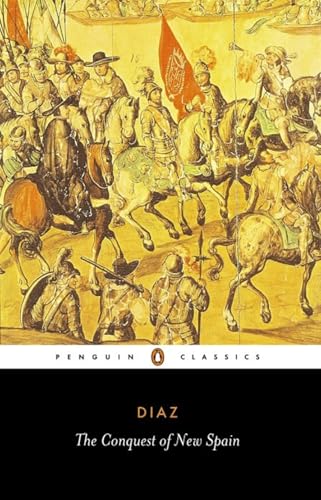 The Conquest of New Spain by Bernal Diaz del Castillo is an extraordinary document. Diaz was one of Cortes's soldiers -- he fought in the campaigns, was there for the Noche Triste, and was present when Tenochtitlan finally fell. He wrote his account late in life, partly as a response to more flattering accounts of Cortes that he felt had erased the ordinary soldiers. His prose is immediate and personal. He describes entering Tenochtitlan for the first time with the same awe that a soldier would feel entering a dream city. He also describes the violence, the betrayals, and the complexity of what actually happened. Find The Conquest of New Spain on Amazon.
Read this alongside the modern histories rather than instead of them -- Diaz had his own biases and gaps -- but as a primary source it is irreplaceable.
--- ◆ ---
Rethinking the Pre-Columbian World
 1491 by Charles C. Mann is not specifically about the Aztecs, but the chapters on Mesoamerica and Tenochtitlan reframe the entire context. Mann synthesizes recent archaeological and historical research to argue that the pre-Columbian Americas were far more populous, more sophisticated, and more ecologically managed than the "wilderness" narrative of European discovery suggested. The chapter describing Tenochtitlan through the eyes of the first Spanish scouts arriving at the causeways is one of the best passages of popular history writing in recent decades. If you have always wondered how a few hundred Spaniards could have conquered an empire, this book is the essential preparation. Find 1491 on Amazon.
Conquistadors by Michael Wood (companion to the BBC series) is a narrative account of multiple conquest expeditions written for general readers. Wood gives you the full sweep of events with good pacing and solid sourcing. Find Conquistadors on Amazon.
--- ◆ ---
Everyday Aztec Life
For readers who want to understand how ordinary people actually lived in the empire -- not the warriors and priests but the farmers, merchants, and craftspeople -- Daily Life of the Aztecs by Jacques Soustelle is the standard reference. Soustelle covers markets, food, education, social classes, gender roles, and the calendar system with the thoroughness of a scholar who spent decades in the sources. It is older (1961) but the material it covers has not been superseded. Find Daily Life of the Aztecs on Amazon.
--- ◆ ---
Historical Fiction
Aztec by Gary Jennings is a sprawling historical novel told by an elderly Aztec man recounting his life across the empire. Jennings spent years in Mexico researching and the detail is extraordinary -- markets, rituals, dialects, geography, food. The novel is also extremely explicit (violence and sex alike) and not for every reader. But if you want a novelistic immersion in the Aztec world that feels lived-in rather than reconstructed, nothing else compares. Find Aztec on Amazon.
--- ◆ ---
Chapter Resources
- Clendinnen, Inga. Aztecs: An Interpretation. Cambridge University Press, 1991.
- Diaz del Castillo, Bernal. The Conquest of New Spain. (Trans. J.M. Cohen.) Penguin Classics, 1963.
- Jennings, Gary. Aztec. Atheneum, 1980.
- Mann, Charles C. 1491: New Revelations of the Americas Before Columbus. Knopf, 2005.
- Soustelle, Jacques. Daily Life of the Aztecs. (Trans. Patrick O'Brian.) Stanford University Press, 1961.
- Wood, Michael. Conquistadors. BBC Books, 2000.
Your next good book, in your inbox
We only write when we find a book worth your time. Hand-picked recommendations across history, mythology, true crime and more.
Are you an author?
Get your book in front of readers like these, for free.
- Free book listing →Your own book page with an Amazon button
- Author page →Photo, bio and links to your site
- Featured placement →A spot in our best-of lists, from €29
Free tools we recommend
Get free honest reviewsReview exchange on iWrity, free to join
Books You Might Like

It Ends with Us: A Novel
Colleen Hoover

The Seven Husbands of Evelyn Hugo: A Novel
Taylor Jenkins Reid

The Song of Achilles
Madeline Miller

Educated: A Memoir
Tara Westover