Best Books About the Black Death in 2026: Plague, Survival, and the World It Left Behind
PICTURE THIS: one in two people you know, dead within three years. Not from war, not from famine, but from a disease that arrived with merchant ships and spread faster than any authority could track it. That was Europe in 1347.
The Black Death killed more people, as a share of the population, than any event in human history. It reshaped everything: the labor market, the church, the way people thought about death and God and the meaning of suffering. To understand Europe's transformation from the medieval to the modern world, you have to understand the plague.
These books will take you there.
--- ◆ ---
The Essential Starting Point
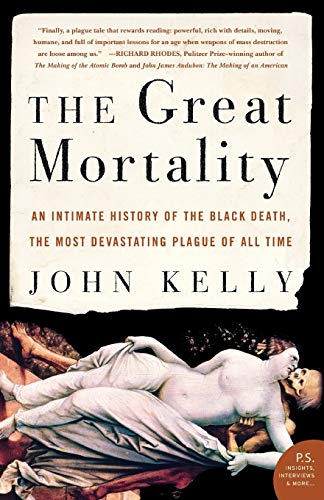 The Great Mortality by John Kelly (2005) is the book most historians recommend to general readers. Kelly spent years in archives from Avignon to Almeria and traces the plague's path from Central Asia to the Atlantic with novelistic precision. He gives you not just the death counts but the human texture: the bodies piled in churchyards too full to accept more, the ships arriving in Messina with crews already dying, the priests who fled their parishes and the ones who stayed. It is deeply sourced but reads like a thriller. Find The Great Mortality on Amazon.
If you want the classic, The Black Death by Philip Ziegler (1969, updated) remains essential. Ziegler's coverage is comprehensive -- he follows the plague across England, France, Germany, and Scandinavia -- and his prose is clear and confident. Published before some of the more recent DNA evidence confirmed Yersinia pestis, but the historical narrative holds up. Find The Black Death on Amazon.
--- ◆ ---
The Scholarly Standard
The Black Death by Ole Benedictow (2004) is the definitive academic treatment of mortality statistics. Benedictow spent decades reconstructing death tolls from parish records, tax rolls, and monastic chronicles across every European country. His conclusion -- that approximately 50% of Europe's population died -- is higher than older estimates and has largely been accepted by the field.
It is not light reading, but if you want to understand the demographic evidence and the scholarly arguments about regional variation in mortality, there is nothing comparable. Benedictow also traces the geographic spread of the plague with precision that earlier works lacked.
--- ◆ ---
The Aftermath: What the Plague Changed
The Black Death did not just kill half of Europe. It broke institutions, rewired social relationships, and accelerated changes that defined the following two centuries.
In the Wake of the Plague by Norman F. Cantor focuses specifically on this transformation. Cantor argues that the plague was not just a demographic catastrophe but a civilizational turning point: it broke the feudal system (when a third of the labor force dies, surviving peasants gain bargaining power), undermined the Church's moral authority (clergy died in droves; the institutional Church had no answer for the suffering), and changed art, literature, and philosophy. Cantor writes with strong opinions and occasionally loose sourcing, but as an argument for why the Black Death matters beyond the death toll, it is compelling. Find In the Wake of the Plague on Amazon.
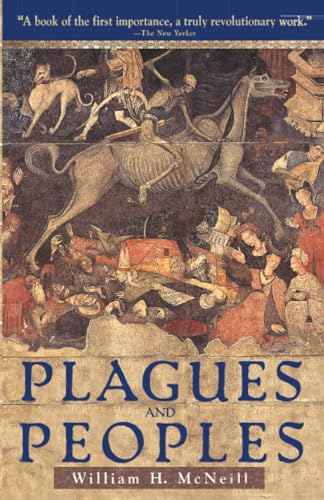 Plagues and Peoples by William McNeill (1976) broadens the lens to epidemic disease throughout human history. McNeill was the first historian to systematically argue that disease shapes history as much as military conquest -- a thesis that feels obvious now but was genuinely radical in 1976. The Black Death gets a central chapter, but the book's value is in understanding how diseases interact with civilizations over the long arc. Find Plagues and Peoples on Amazon.
--- ◆ ---
Eyewitness and Primary Sources
For readers who want to hear the 14th century itself, Giovanni Boccaccio's introduction to the Decameron (written in 1353) is the most vivid contemporary account of the plague in Florence. Boccaccio watched it happen. His description of the buboes, the rapid death, the social breakdown, and the perverse gallows humor some survivors adopted reads with the immediacy of a dispatch from inside the disaster. The rest of the Decameron -- a hundred stories told by ten Florentines who have fled the city into the countryside -- is the escapist literature that plague survivors actually read to get through it.
The Black Death by Rosemary Horrox (1994) is a collection of primary sources in translation -- chronicles, letters, medical treatises, municipal records. Indispensable for understanding how 14th-century people themselves experienced and interpreted the catastrophe.
--- ◆ ---
Chapter Resources
- Benedictow, Ole J. The Black Death 1346-1353: The Complete History. Boydell Press, 2004.
- Boccaccio, Giovanni. The Decameron. (Introduction, 1353). Multiple modern translations available.
- Cantor, Norman F. In the Wake of the Plague: The Black Death and the World It Made. Free Press, 2001.
- Horrox, Rosemary (ed.). The Black Death. Manchester University Press, 1994.
- Kelly, John. The Great Mortality: An Intimate History of the Black Death. HarperCollins, 2005.
- McNeill, William H. Plagues and Peoples. Anchor Books, 1976.
- Ziegler, Philip. The Black Death. Collins, 1969. (Revised edition, Stroud: Sutton Publishing, 2003.)
Your next good book, in your inbox
We only write when we find a book worth your time. Hand-picked recommendations across history, mythology, true crime and more.
Are you an author?
Get your book in front of readers like these, for free.
- Free book listing →Your own book page with an Amazon button
- Author page →Photo, bio and links to your site
- Featured placement →A spot in our best-of lists, from €29
Free tools we recommend
Get free honest reviewsReview exchange on iWrity, free to join
Books You Might Like

It Ends with Us: A Novel
Colleen Hoover

The Seven Husbands of Evelyn Hugo: A Novel
Taylor Jenkins Reid

The Song of Achilles
Madeline Miller

Educated: A Memoir
Tara Westover