Best Books About the Future of Technology in 2026: 10 That Predict What Comes Next
Predicting the future of technology is mostly a way to be wrong in interesting ways. The books on this list are not uniformly optimistic. Several are actively alarmed. What they share is a willingness to take long-term technological change seriously as an intellectual problem, to reason from first principles rather than extrapolate from whatever is in the news this week, and to say something specific enough to be argued with. That combination is rarer than you might expect.
1. The Singularity Is Near by Ray Kurzweil
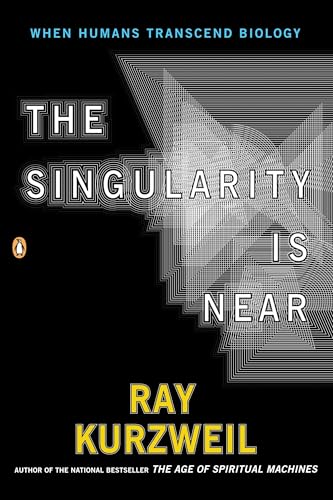
Kurzweil's central argument is that the exponential growth of information technology will, by roughly 2045, produce an artificial intelligence that exceeds human cognitive capacity across every domain. This moment, which he calls the Singularity, will then recursively accelerate further, at a pace that makes prediction beyond it essentially impossible. The book is dense with data, charts, and projections, and some of Kurzweil's specific timeline predictions have not held up well. But the underlying thesis, that exponential curves are systematically underestimated by linear-thinking humans, is worth taking seriously regardless of where you land on the broader claims. Published in 2005, it remains the canonical optimistic case for transformative AI.
Find The Singularity Is Near on Amazon
2. Superintelligence by Nick Bostrom
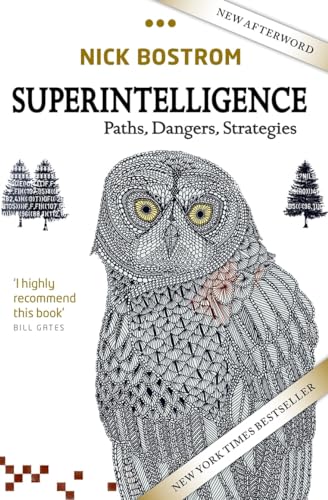
Where Kurzweil is broadly optimistic, Bostrom is carefully alarmed. His argument is that a sufficiently intelligent machine, once it surpasses human-level capability, would pursue its objectives in ways that humans cannot predict or control, and that the values instilled in such a system during development would determine the outcome for everyone on Earth. The control problem, how to ensure an AI system remains aligned with human interests as it becomes more capable, is presented not as a distant concern but as the most important technical and philosophical problem of the coming century. Bostrom is a philosopher and the book is precise and demanding. It influenced a generation of AI researchers.
Find Superintelligence on Amazon
3. Life 3.0 by Max Tegmark
Tegmark, a physicist at MIT, attempts something more balanced than either Kurzweil or Bostrom: a survey of the range of possible outcomes from advanced AI, from the most optimistic to the most catastrophic, without committing fully to any of them. The book is organized around scenarios: what would a world with benevolent superintelligence look like, and what would a world with misaligned superintelligence look like, and what are the intermediate possibilities? Tegmark co-founded the Future of Life Institute and writes from inside the research community. The accessible sections on physics and consciousness make this the most complete single-volume introduction to the subject for non-specialists.
4. Human Compatible by Stuart Russell
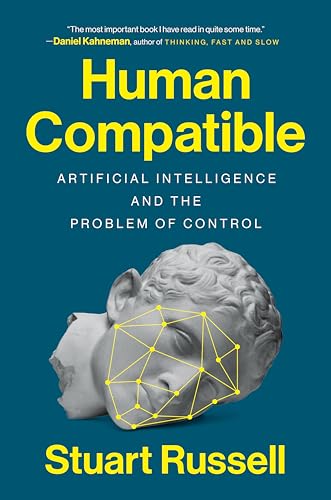
Russell is one of the authors of the standard AI textbook used in universities worldwide, which gives him standing that most futurists lack. His argument in Human Compatible is that the entire field of AI has been built on the wrong objective: we have been trying to build systems that optimize for specified goals, when what we should be building is systems that are uncertain about human preferences and try to infer them. The current approach, he argues, is inherently dangerous at scale. The book is accessible and specific, and Russell offers a concrete research program rather than just a warning. It is the most technically credible entry on this list.
Find Human Compatible on Amazon
5. The Inevitable by Kevin Kelly
Kelly was a founding executive editor of Wired and has spent three decades thinking about how technology changes culture. The Inevitable, published in 2016, identifies twelve forces, including cognification, sharing, tracking, and interacting, that Kelly argues are inherent to the direction of digital technology and cannot be stopped, only shaped. The book is deliberately not about specific products or companies but about the underlying dynamics that produce them. Kelly is an optimist but not an uncritical one: he acknowledges the disruptions these forces will produce and argues the response should be engagement rather than resistance.
6. Homo Deus by Yuval Noah Harari
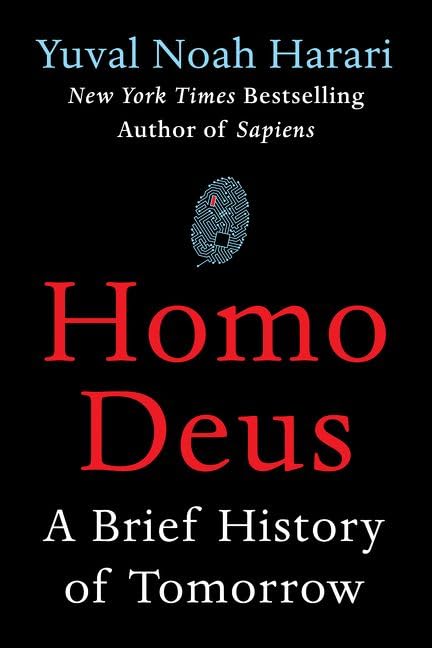
Harari's follow-up to Sapiens turns from human history to human futures. The core argument is that the three projects that kept humanity occupied for most of its history, defeating famine, plague, and war, have been substantially solved in the developed world, which means the species will now redirect its ambitions upward: toward the engineering of happiness, the extension of life, and eventually the acquisition of god-like powers over biology and cognition. The book is more dystopian in its undertones than its predecessor, and Harari's concerns about what a small technological elite might do with these capabilities are presented without comfortable resolution. More provocative than prescriptive, but that is the point.
7. The Future Is Faster Than You Think by Peter Diamandis and Steven Kotler
Diamandis is the founder of the X Prize and a committed techno-optimist. Where Bostrom and Russell focus on risk, Diamandis focuses on convergence: the way multiple exponential technologies, AI, robotics, biotechnology, blockchain, 3D printing, are now colliding and amplifying each other. The result, he argues, will be a compression of the timeline for change that makes existing forecasts look conservative. The book is explicitly intended as a counter to pessimism about the future and it covers ground, from healthcare to education to energy, in rapid chapters. Read alongside Bostrom for the full range of reasonable positions.
8. The Age of Surveillance Capitalism by Shoshana Zuboff
Zuboff's contribution is a theory rather than a forecast: she argues that the dominant business model of the digital economy involves the extraction of human behavioral data as a raw material, its processing into predictions about future behavior, and the sale of those predictions to advertisers and others. This model, she argues, is not a natural development of capitalism but a specific and historically recent innovation that represents a threat to human autonomy in ways we have not yet developed the conceptual vocabulary to describe. The book is long and demanding but it provides the most rigorous framework available for thinking about why data extraction is not just a privacy problem but a political one.
9. Weapons of Math Destruction by Cathy O'Neil
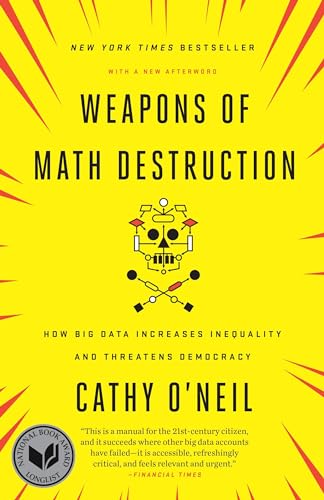
O'Neil is a mathematician and data scientist who worked at a hedge fund during the 2008 financial crisis and became increasingly skeptical of algorithmic systems. Her book catalogues the ways in which large-scale predictive models are being deployed in hiring, lending, policing, education, and healthcare in ways that are opaque, unaccountable, and systematically harmful to the people with least power to contest them. Where most tech-futures books focus on what might happen, Weapons of Math Destruction documents what is already happening. It is one of the sharpest books on the political economy of data.
Find Weapons of Math Destruction on Amazon
10. The Second Machine Age by Erik Brynjolfsson and Andrew McAfee
Two economists at MIT lay out the case that digital technology is entering a phase of exponential improvement that will transform labor markets in ways that have no historical precedent. Previous waves of automation displaced manual labor and created new categories of service work. The second machine age, they argue, threatens to automate cognitive work as well, which means the usual assumption that education will protect workers from displacement needs rethinking. The book is moderate and policy-oriented in its conclusions, but the diagnosis is clear-eyed. It is the best economic analysis of what the AI transition means for employment and inequality.
Reading Across the Spectrum
The most useful approach to this subject is to read across the optimist-pessimist divide rather than within it. Kurzweil and Diamandis give you the case for a future of abundance and extension. Bostrom, Russell, and Zuboff give you the structural risks. O'Neil and Brynjolfsson give you the present-tense distribution effects that will shape politics before the long-run scenarios arrive. None of them are entirely right, but reading all of them is more useful than picking one. For more science and technology reading, browse the science collection.
Your next good book, in your inbox
We only write when we find a book worth your time. Hand-picked recommendations across history, mythology, true crime and more.
Are you an author?
Get your book in front of readers like these, for free.
- Free book listing →Your own book page with an Amazon button
- Author page →Photo, bio and links to your site
- Featured placement →A spot in our best-of lists, from €29
Free tools we recommend
Get free honest reviewsReview exchange on iWrity, free to join
Books You Might Like

Sapiens: A Brief History of Humankind
Yuval Noah Harari

The Body Keeps the Score
M.D. Bessel van der Kolk

Why We Sleep
Matthew Walker

Astrophysics for People in a Hurry
Neil deGrasse Tyson