Best Books About the Holy Roman Empire: 10 That Explain a Thousand-Year Puzzle
Voltaire famously noted that the Holy Roman Empire was neither holy, nor Roman, nor an empire. He was being clever, but the joke obscures something genuinely fascinating: this peculiar political structure survived for over a thousand years, shaping German, Italian, and Central European history in ways that still reverberate today. These ten books cut through the confusion.
1. The Holy Roman Empire: A Thousand Years of Europe's History by Peter H. Wilson
Wilson's 2016 work is now the definitive English-language history of the Empire. It runs to nearly 1,000 pages and covers everything from Charlemagne's coronation in 800 to Napoleon's forced dissolution in 1806. Wilson argues against the traditional view that the Empire was inherently dysfunctional. He sees it instead as a deliberately decentralized political system that worked for the communities it governed. Essential reading.
2. The Holy Roman Empire by Friedrich Heer
Heer's shorter survey, published in 1968, remains useful as an introduction. It is more accessible than Wilson and gives a strong sense of the cultural and intellectual dimensions of the Empire alongside the political history. Its coverage of the Reformation period is particularly good.
3. Germany: Memories of a Nation by Neil MacGregor
MacGregor was director of the British Museum, and this book grew out of a radio series. It uses objects, artworks, and places to tell the story of German history, with the Holy Roman Empire as a recurring backdrop. The chapter on the imperial regalia held in Vienna and Nuremberg is one of the best introductions to what the Empire meant symbolically to its contemporaries.
4. The Reformation by Diarmaid MacCulloch
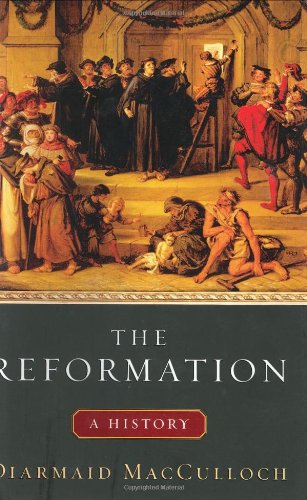
The Protestant Reformation happened almost entirely within the Holy Roman Empire and fundamentally changed it. MacCulloch's comprehensive history of the Reformation covers the political context in the Empire, the role of the princes, the Diet of Worms, and the wars of religion that followed. You cannot understand the Empire without the Reformation, and this is the best book on the Reformation.
5. Maximilian I by Christine Shaw
Maximilian I (1459-1519) tried harder than any other emperor to reform and modernize the Empire's institutions. He partially succeeded and largely failed, but his reign is the key moment when the Empire's structural limitations became fully apparent. This biography gives a clear account of what Maximilian attempted and why it mattered.
6. The Thirty Years' War by C.V. Wedgwood
The Thirty Years' War (1618-1648) was the most destructive conflict in European history before the 20th century, fought primarily in the Empire and killing perhaps a third of the population of the German territories. Wedgwood's classic account, first published in 1938, is still the most readable narrative history of the conflict. It covers the military campaigns, the diplomacy, and the devastating human cost.
7. Charles V by Karl Brandi
Charles V (1500-1558) ruled an empire that included Spain, the Americas, the Low Countries, Italy, and the Holy Roman Empire. His reign was the high-water mark of Habsburg power and the moment when the Empire's religious unity broke apart. Brandi's biography, though older, remains a careful account of Charles's impossible governing challenge.
8. The Habsburg Empire: A New History by Pieter Judson
The Habsburg dynasty became synonymous with the Holy Roman Empire from the 15th century onward. Judson's history of the Habsburg Empire covers the period after the Holy Roman Empire ended in 1806, tracing how Habsburg rule adapted and eventually collapsed in 1918. For readers who want to follow the Habsburg story beyond the Empire, this is the natural continuation.
9. Blood and Iron: The Rise and Fall of the German Empire 1871-1918 by Katja Hoyer
Hoyer traces the Wilhelmine German Empire, which presented itself as a successor to the Holy Roman tradition. The continuities and contrasts with the medieval Empire illuminate both. Her readable narrative covers Bismarck, Wilhelm II, and the path to the First World War in a way that connects to the longer arc of German political culture.
10. The German Genius by Peter Watson
Watson's sweeping history of German intellectual and cultural achievement runs from the Reformation through the 20th century. The Holy Roman Empire forms the political backdrop for the early chapters, but the book's value is in showing how the decentralized political culture of the Empire produced an unusually rich intellectual life: the profusion of courts, universities, and cities created space for experiment that more centralized states did not allow.
The Holy Roman Empire lasted longer than any other political institution in European history. These ten books explain how it worked, why it mattered, and what its legacy is for modern Europe.
Your next good book, in your inbox
We only write when we find a book worth your time. Hand-picked recommendations across history, mythology, true crime and more.
Are you an author?
Get your book in front of readers like these, for free.
- Free book listing →Your own book page with an Amazon button
- Author page →Photo, bio and links to your site
- Featured placement →A spot in our best-of lists, from €29
Free tools we recommend
Get free honest reviewsReview exchange on iWrity, free to join
Books You Might Like

It Ends with Us: A Novel
Colleen Hoover

The Seven Husbands of Evelyn Hugo: A Novel
Taylor Jenkins Reid

The Song of Achilles
Madeline Miller

Educated: A Memoir
Tara Westover