Best Books About the Korean War: 10 That Tell the Forgotten Story
THE KOREAN WAR killed more Americans in three years than Vietnam did in more than a decade. It ended without a peace treaty: the armistice signed in 1953 is technically still in effect today, which means the Korean War never officially ended. These books explain why it happened, how it was fought, and why it remains the least understood major conflict of the 20th century.
What Makes a Good Korean War Book?
The Korean War has three distinct phases: the initial North Korean invasion and US collapse (June-September 1950), the dramatic reversal after Inchon and the advance toward China (September-November 1950), and the brutal attritional war that followed China's entry and lasted until the armistice (1951-1953).
A good book on the subject usually focuses on one of these phases, or on a specific engagement. The best books also address the political dimension: MacArthur's insubordination, the fear of nuclear escalation, and the Truman administration's decision to fight a limited war when limited wars were still a new concept.
10 Best Books About the Korean War
1. The Coldest Winter: America and the Korean War — David Halberstam
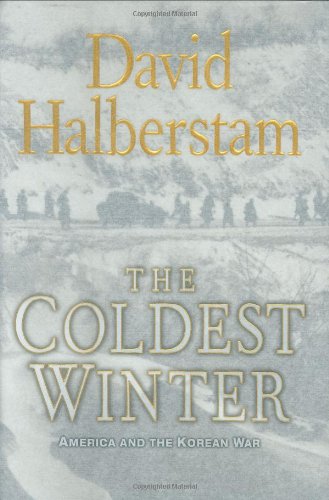
The definitive single-volume account. Halberstam, who won the Pulitzer Prize for his Vietnam reporting, spent the last years of his life writing this 700-page masterwork on Korea. He covers three tracks simultaneously: the political decisions in Washington (Truman, MacArthur's insubordination, the Joint Chiefs), the military operations from Pusan to Chosin to the armistice negotiations, and the experience of individual soldiers on the ground.
What makes this book essential: Halberstam explains why the war ended in stalemate by tracing the cumulative decisions that made stalemate unavoidable. MacArthur's refusal to accept intelligence about Chinese intervention, the political constraints on bombing, and the eventual decision to limit war aims all connect into a coherent account of why the most powerful military in the world fought to a draw against a country with no air force and limited industry.
2. On Desperate Ground: The Marines at the Reservoir — Hampton Sides
The Chosin Reservoir, November-December 1950. Thirty thousand American soldiers and Marines, surrounded by 120,000 Chinese troops, in temperatures that dropped to -35°F (-37°C). Equipment froze. Morphine Syrettes froze. Blood plasma froze. Men froze to death in their fighting positions.
Sides, author of Ghost Soldiers, does for Chosin what he did for the Bataan rescue: he takes a catastrophic military situation and makes it viscerally present through individual stories. The Marines who fought their way out of the Chosin encirclement over 17 days, taking their dead and wounded with them, produced one of the most remarkable fighting retreats in military history. This book makes you understand why.
3. The Bridge at No Gun Ri — Charles J. Hanley, Sang-Hun Choe, Martha Mendoza
AP reporters broke this story in 1999: in late July 1950, US soldiers machine-gunned hundreds of Korean refugees, including women and children, sheltering under a railway bridge at No Gun Ri. The Pulitzer Prize-winning investigation forced a US Army review and partial acknowledgment of the incident.
This is not a comfortable book. It is an investigation into a war crime committed by American soldiers under orders and the five-decade cover-up that followed. The book distinguishes between the specific soldiers who opened fire under panicked conditions and the command decisions that created those conditions. Essential reading for understanding the Korean War's moral complexity.
4. This Kind of War: The Classic Korean War History — T.R. Fehrenbach
First published in 1963, still the best operational military history of the war. Fehrenbach was a combat veteran of Korea and writes with authority about what the fighting was actually like: the tactical decisions, the terrain, the equipment, and the specific ways that American military doctrine (optimized for mobile European warfare with air support) was poorly suited to the Korean peninsula's mountains in winter.
Fehrenbach's central argument shaped US military thinking for decades: citizen-soldiers, trained for brief wartime mobilization, are not adequate for the kind of sustained limited conflict that Korea represented. The Army needed to think differently about how it trained and organized its forces. The book was required reading at West Point for thirty years.
5. Soldier: The Life of Colin Powell — Karen DeYoung
An indirect entry on the list, but essential context. Colin Powell served in Korea as a young officer and the experience shaped his entire military and political career. DeYoung's biography is rigorous and fair, covering Powell's Korean service, his Vietnam tours, his rise through the Cold War Army, and his role as National Security Advisor and Secretary of State.
Reading Powell's biography alongside a Korean War history shows how that conflict shaped American military thinking for the rest of the 20th century. The Powell Doctrine (go in with overwhelming force and a clear exit strategy) was a direct response to the Korean and Vietnam experiences.
6. Korea: The Untold Story of the War — Joseph C. Goulden
Published in 1982, before the wave of revisionist Korean War scholarship, Goulden's book remains valuable for its political and diplomatic history. He covers the UN Security Council vote that authorized the war (only possible because the Soviet Union was boycotting the session), the MacArthur-Truman conflict, and the two years of armistice negotiations at Panmunjom.
The armistice negotiations chapter is particularly valuable: two years of haggling over prisoner exchange procedures, where both sides understood that the fighting would continue as long as talks stalled, and each side used combat operations as bargaining leverage. A grim portrait of war as diplomacy by other means.
7. The Korean War: A History — Bruce Cumings
Cumings is the leading American academic historian of Korea, and this short book is his accessible overview. He takes a different perspective from most American accounts: he places the Korean War in the context of Korean history, Japanese colonial rule, and the civil war dynamic between North and South that predated the June 1950 invasion.
His argument: the Korean War was not simply a Cold War proxy conflict but a Korean civil war into which the United States intervened. This framing changes how you read the military history. The ferocity of the fighting, the atrocities on both sides, and the refusal of either Korean state to accept a permanent partition all make more sense in this context.
8. Inchon Landing: MacArthur's Last Triumph — Edwin Hoyt
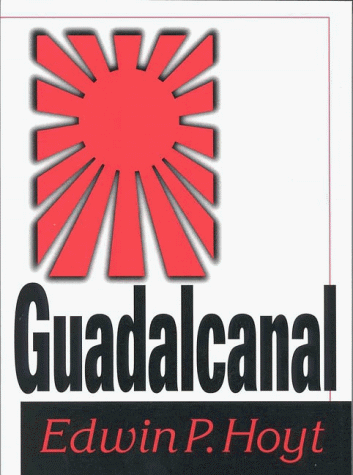
The Inchon landing (September 15, 1950) was MacArthur's masterstroke: an amphibious assault at a port with extreme tides, heavily defended, that almost every military expert said was impossible. It worked, cut off the North Korean forces besieging Pusan, and reversed the entire course of the war in three weeks.
Hoyt's book is the best account of the planning and execution of Inchon. It also covers the decision-making in Tokyo and Washington, where MacArthur overrode nearly unanimous skepticism from the Joint Chiefs. The victory at Inchon gave MacArthur the authority and confidence to dismiss subsequent intelligence about Chinese intervention — a connection this book makes clearly.
9. The Manchurian Candidate — Richard Condon
A novel, and the most influential fictional account of the Korean War. Published in 1959, it follows an American POW who has been brainwashed by Chinese and Soviet handlers to become an assassin. The book invented the concept of the Manchurian candidate, which has been part of American political vocabulary ever since.
Read as a cultural artifact: The Manchurian Candidate captured American anxieties about POW collaboration, communist brainwashing (a real phenomenon studied after Korea), and the reliability of anyone who had been in Chinese captivity. The 1962 film version with Frank Sinatra and Angela Lansbury is equally worth your time.
10. Still Time to Die — John Osborne (War Correspondent, 1950)
Not a book but a series of dispatches published in Life magazine in 1950, collected in various anthologies. Osborne was one of the first American journalists in Korea and wrote with unusual frankness about what he saw: the chaos of the early retreats, the shooting of civilians as a precaution, the inadequacy of American equipment and training, and the specific brutality of this war.
His reports were criticized at the time for being too negative about American military performance. They were accurate. Finding his collected dispatches requires some searching, but they are essential primary-source material for understanding what the war looked and felt like in its desperate early weeks.
Where to Start
If you want the full picture: start with Halberstam's The Coldest Winter. It covers the politics and the military history in one volume.
If you want the ground-level combat experience: Hampton Sides's On Desperate Ground captures the human reality of the war better than any other book on this list.
If you want the historical context: Cumings's A History places the war in Korea's longer story and challenges the standard American interpretation.
Browse more history reading lists or go to best books about the Cold War for the broader geopolitical context.
Your next good book, in your inbox
We only write when we find a book worth your time. Hand-picked recommendations across history, mythology, true crime and more.
Are you an author?
Get your book in front of readers like these, for free.
- Free book listing →Your own book page with an Amazon button
- Author page →Photo, bio and links to your site
- Featured placement →A spot in our best-of lists, from €29
Free tools we recommend
Get free honest reviewsReview exchange on iWrity, free to join
Books You Might Like

It Ends with Us: A Novel
Colleen Hoover

The Seven Husbands of Evelyn Hugo: A Novel
Taylor Jenkins Reid

The Song of Achilles
Madeline Miller

Educated: A Memoir
Tara Westover