Best Books About the Renaissance: 10 That Actually Explain the Era
THE RENAISSANCE changed everything: how Europeans thought about the human body, about individual achievement, about the relationship between faith and reason. It gave us Leonardo, Michelangelo, Machiavelli, Copernicus, and Gutenberg. These books explain how that happened and why it matters.
What Makes a Good Renaissance History Book?
The Renaissance lasted roughly 200 years (circa 1300-1600) and was different in Florence than in Venice, different in Italy than in northern Europe. A good book on the subject picks a focus and goes deep rather than trying to cover everything at 30,000 feet.
The best books on this list do one of three things: explain the political and economic forces behind the cultural explosion (Medici money, city-state rivalries), profile the individuals who defined the era (Da Vinci, Machiavelli, Erasmus), or trace a specific transformation: art, science, religion, or politics.
10 Best Books About the Renaissance
1. Leonardo da Vinci — Walter Isaacson

The most readable major biography of the Renaissance's most famous figure. Isaacson worked directly from Da Vinci's notebooks, which contain 7,200 surviving pages of drawings, scientific observations, and random thoughts. The result is a portrait of a man defined by insatiable curiosity rather than genius alone.
What makes this biography stand out: Isaacson shows Da Vinci's unfinished projects not as failures but as evidence of how his mind worked. The Sforzas horse, the aerial screw, the flying machines: Da Vinci stopped them because he got interested in something else. The book makes you understand the Renaissance not as a period of confident completion but as an era of restless exploration.
2. The Medici: Godfathers of the Renaissance — Paul Strathern
The best single book on the family that essentially funded the Italian Renaissance. The Medici banking dynasty controlled Florence for most of the 15th century and used that power to patronize Botticelli, Michelangelo, Da Vinci, and dozens of other artists. Without Medici money, most of what we call the Renaissance does not happen.
Strathern covers the full dynasty from Giovanni di Bicci to the later Medicis who became popes, writing it as a family saga with political intrigue, assassination attempts, exile, and eventual decline. The 1478 Pazzi Conspiracy chapter, where rivals tried to assassinate Lorenzo de' Medici during Easter Mass at the Florence Cathedral, reads like something from a thriller.
3. The Prince — Niccolo Machiavelli

Written in 1513, still read today. Machiavelli's short treatise on political power is the most influential political text of the Renaissance and one of the most misunderstood. He was not advising rulers to be cruel for cruelty's sake. He was describing the mechanics of political power as they actually worked, not as moral philosophy said they should work.
Read alongside a good biography of the Borgias (Cesare Borgia was Machiavelli's model prince) and the book transforms from a cynical guide into a precise analysis of Renaissance Italian politics.
4. Michelangelo and the Pope's Ceiling — Ross King
The story of how Michelangelo painted the Sistine Chapel ceiling between 1508 and 1512. What sounds like an art history book is actually a political drama. Pope Julius II was a warrior pope who wanted a monument to his own greatness. Michelangelo was a sculptor who had never painted a large fresco and did not want the commission. The four years between their first meeting and the unveiling were a constant struggle between patron and artist.
King writes it as narrative history, bringing in the competing artists (Raphael was working in the Vatican at the same time), the papal politics, and the technical challenges of painting 5,000 square feet of ceiling on scaffolding 60 feet above the floor.
5. The Swerve: How the World Became Modern — Stephen Greenblatt
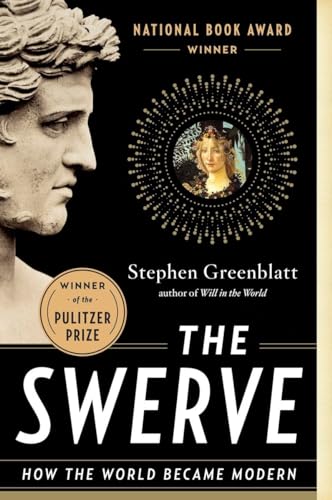
Winner of the Pulitzer Prize. Greenblatt's argument: a single ancient text, rediscovered in a German monastery in 1417, changed the course of Western civilization. The text was Lucretius's 'On the Nature of Things,' a 1st-century BC Latin poem arguing that the universe is made of atoms, that the soul dies with the body, and that the pursuit of pleasure is a legitimate human goal.
These ideas, completely alien to medieval Christian thought, were absorbed by Renaissance humanists and eventually fed into the Enlightenment. The book weaves between ancient Rome and 15th-century Florence, explaining how classical texts were preserved, lost, and rediscovered. Excellent reading for anyone interested in how ideas spread across centuries.
6. Heretic Queen: Queen Elizabeth I and the Wars of Religion — Susan Ronald
Focuses on the English Reformation rather than the Italian Renaissance, but essential for understanding how Renaissance ideas transformed Northern Europe. Elizabeth I inherited a kingdom divided by religious conflict between Catholics and Protestants, both armed and both connected to foreign powers who wanted England.
Ronald's biography of Elizabeth is primarily about foreign policy and religious war rather than court intrigue. It situates England within the broader European conflict between Catholic Habsburg Spain and the Protestant north that defined the late 16th century.
7. Erasmus of Rotterdam — Stefan Zweig
Zweig's short biography of Desiderius Erasmus, the Dutch humanist scholar who tried to reform the Catholic Church from within while Luther tried to destroy it from without. Erasmus represents the Renaissance intellectual at its most cosmopolitan: he wrote in Latin for an international audience, corresponded with kings and popes, and tried to hold the center as Europe tore itself apart over religion.
Zweig wrote it in 1934, partly as a reflection on his own situation as a moderate intellectual watching the extremes take over in Germany. The parallels give the book an unusual urgency for a biography of a 16th-century scholar.
8. The Borgias: The Hidden History — G.J. Meyer
The Borgia family are the Renaissance's most notorious dynasty: a Spanish pope who publicly acknowledged his illegitimate children, a son who became the model for Machiavelli's Prince, and a daughter who was married off three times for political advantage. Meyer's book separates the documented history from the legendary villainy.
Much of the Borgia reputation, including the poisoning stories, was invented by their enemies and amplified by later propagandists. The real story is compelling enough: ruthless political maneuvering, genuine patronage of the arts, and a family that understood power without apology.
9. The Storm Before the Storm — Mike Duncan
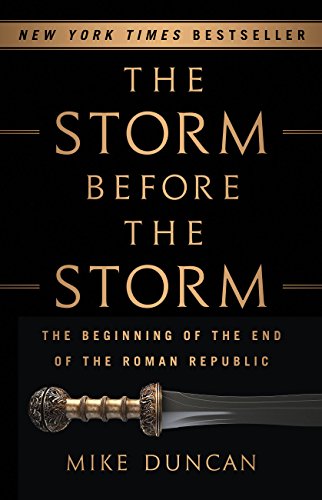
Technically about the fall of the Roman Republic rather than the Renaissance, but essential context for understanding Renaissance humanism. Renaissance scholars were obsessed with Rome. They read Cicero, Caesar, and Livy and believed they were living in a new Rome. Understanding what those Roman models actually were is necessary for understanding what the Renaissance was trying to revive.
Duncan is the host of the History of Rome podcast and writes with the same narrative clarity. The parallels he draws between the late Republic and modern politics make this one of the most widely read history books of the last decade.
10. Renaissance — Paul Johnson
The most accessible overview of the entire period. Johnson covers art, architecture, literature, science, religion, and politics in roughly 200 pages, with the kind of confident synthesis that only historians who have spent decades in the material can write. It is not the place to go for deep scholarship on any one topic, but it is the best starting point for readers new to the period.
Johnson's perspective is that the Renaissance was fundamentally about the recovery of classical knowledge and its combination with Christian humanism. He argues against interpretations that see the Renaissance as anti-religious and makes a compelling case that Michelangelo and Leonardo were as deeply Christian as their work suggests.
Where to Start
If you know nothing about the Renaissance: start with Paul Johnson's overview, then move to Strathern's Medici book for the political context.
If you want to understand a specific figure: Isaacson on Da Vinci, King on Michelangelo, Zweig on Erasmus.
If you want the darker side of Renaissance power: The Borgias or April Blood (Lauro Martines on the Pazzi Conspiracy).
Browse more history reading lists or go straight to the best books about ancient Rome if you want the civilization the Renaissance was trying to revive.
Your next good book, in your inbox
We only write when we find a book worth your time. Hand-picked recommendations across history, mythology, true crime and more.
Are you an author?
Get your book in front of readers like these, for free.
- Free book listing →Your own book page with an Amazon button
- Author page →Photo, bio and links to your site
- Featured placement →A spot in our best-of lists, from €29
Free tools we recommend
Get free honest reviewsReview exchange on iWrity, free to join
Books You Might Like

It Ends with Us: A Novel
Colleen Hoover

The Seven Husbands of Evelyn Hugo: A Novel
Taylor Jenkins Reid

The Song of Achilles
Madeline Miller

Educated: A Memoir
Tara Westover