Best Dystopian Novels of All Time: 10 That Warned Us About the Future
The best dystopian novels are not predictions. They are arguments. Each one takes a present-day tendency, strips away the softening layers of polite society, and shows you what happens when that tendency wins completely. Orwell was not writing science fiction when he published Nineteen Eighty-Four in 1949. He was writing about Stalinist bureaucracy, wartime propaganda, and the specific terror of a system that required citizens to lie to themselves. The future date was camouflage.
That is what unites every book on this list. The nightmare is always recognizable. The best dystopian fiction works because the reader can trace the path from here to there without too many implausible jumps. This guide covers 10 novels that hold up as literature, as political argument, and as reading experiences that stay with you.
Where to Start
If you have read none of these, start with Nineteen Eighty-Four. It is the anchor for everything else on this list. Then read Brave New World immediately after, because the two books diagnose opposite tyrannies and reading them back to back is genuinely illuminating. From there, let your interests guide you: totalitarian politics toward Zamyatin and Dick, reproductive control and theocracy toward Atwood, near-future collapse toward Butler.
George Orwell, Nineteen Eighty-Four (1949)
The foundational text of Western dystopian fiction. Winston Smith lives in Oceania, a superstate locked in permanent war, where the Party rewrites history daily and the Thought Police monitor every expression of dissent. Orwell's specific insight was not that governments lie, but that a system built on lies requires citizens to know the truth and deny it simultaneously. He called this doublethink. The Ministry of Love tortures people not to extract information, but to produce genuine belief.
What makes it still uncomfortable reading is not the surveillance, which was theoretical in 1949 and is now ordinary. It is the complete destruction of interiority. Winston has no private thoughts. The book's final line has ended countless discussions about whether resistance is ever possible inside a total system.
 Nineteen Eighty-Four by George Orwell on Amazon
Aldous Huxley, Brave New World (1932)
Where Orwell feared a boot stamping on a human face forever, Huxley feared something quieter: a world so comfortable that nobody would want to resist. The World State conditions its citizens from birth, engineers happiness through genetic caste systems and soma (a drug with no side effects), and eliminates suffering by eliminating depth. Bernard Marx and John the Savage are unsettled by pleasures that feel like chains. Nobody else is.
Huxley's dystopia is the one that gets cited more in tech criticism now than Orwell's, because it describes addiction and distraction more precisely than surveillance and control. The argument that pleasure can be as totalizing as fear has only become more relevant.
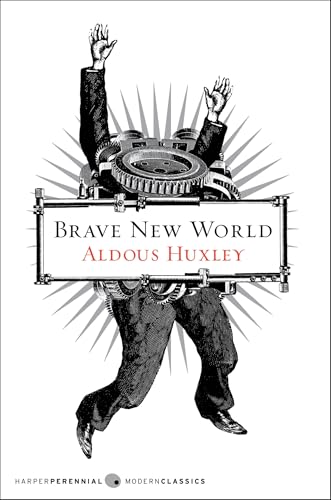 Brave New World by Aldous Huxley on Amazon
Margaret Atwood, The Handmaid's Tale (1985)
The Republic of Gilead seized power in the United States after a coup justified by a fertility crisis. Women have been sorted by function: Wives, Marthas, Aunts, and Handmaids, who are assigned to powerful men as reproductive vessels. Offred is a Handmaid. The novel is her account.
Atwood's specific contribution to the genre was to source every element of the regime from historical record. Every ritual, every punishment, every piece of gendered ideology she describes had been practiced somewhere at some point. The horror is not that someone invented it, but that nobody had to. The book's sequel, The Testaments, won the Booker Prize in 2019 and answers questions the original left open, but the first novel stands alone as the sharper piece of work.
 The Handmaid's Tale by Margaret Atwood on Amazon
Ray Bradbury, Fahrenheit 451 (1953)
Guy Montag is a fireman. In this future, firemen burn books rather than fight fires, because books make people unhappy. What Bradbury understood was that censorship rarely needs enforcement when people have been trained to prefer distraction. The citizens of Montag's society live inside their television walls and race their cars fast enough that nothing outside registers. Nobody demanded this. People chose it incrementally.
The book is shorter and more lyrical than the other titles here. Bradbury was a prose stylist before he was a political thinker, and the novel's images are striking in a way that most dystopian fiction does not attempt. The burning books, the mechanical hound, the book people memorizing texts in the wilderness, all land as images before they land as arguments.
Yevgeny Zamyatin, We (1924)
The book Orwell admitted he had read before writing Nineteen Eighty-Four. Zamyatin wrote it in Soviet Russia in 1920 and 1921, drawing on his experience as a Bolshevik who had become disillusioned. The One State governs through mathematics, transparency, and the elimination of individual desire. Citizens live in glass apartments, have numbers not names, and follow a schedule called the Table. D-503, the narrator, is a mathematician who begins to develop an irrational emotion, a woman called I-330, and cannot process what is happening to him.
It is the oldest truly modern dystopian novel and the least widely read of these ten. That is a gap worth closing. Zamyatin invented the genre's grammar and his version of the totalitarian nightmare remains the most formally rigorous.
Philip K. Dick, The Man in the High Castle (1962)
An alternate history in which Germany and Japan won the Second World War and divided the United States between them. The Pacific States of America, occupied by Japan, retain more cultural latitude than the German-occupied East, where the Holocaust has been extended to Africa. Dick's novel follows several characters across this divided America, including a jeweler, an artist, and a Japanese trade minister.
The central formal trick is a novel within the novel, The Grasshopper Lies Heavy, which imagines a world in which the Allies won. What makes it dystopian rather than merely counterfactual is Dick's examination of how people construct meaning, identity, and resistance inside systems they did not choose and cannot fully see. The I Ching, which Dick used to make actual plot decisions, runs through the text as an image of meaning that cannot be verified.
Octavia Butler, Parable of the Sower (1993)
Lauren Olamina is fifteen years old, living behind a walled community in a near-future California that has collapsed into climate breakdown, privatized police, and water scarcity. She has hyperempathy, a condition that makes her feel others' pain as her own. When the walls come down, she walks north with a group of survivors, developing a new philosophy she calls Earthseed.
Butler was writing in 1993 about conditions that had not fully arrived yet. The water scarcity, the gated communities as fortresses, the corporate company towns, the breakdown of public institutions: Parable of the Sower now reads as near-present rather than near-future. It is also the most character-centered novel on this list. The dystopia is the setting. The story is about what one person decides to do inside it.
Parable of the Sower by Octavia Butler on Amazon
Anthony Burgess, A Clockwork Orange (1962)
Alex is a teenager who commits ultraviolent crimes in a near-future Britain while listening to Beethoven. The state eventually captures and conditions him through the Ludovico Technique, a form of aversion therapy that destroys his capacity for violence by destroying his free will. The novel's argument is that a human being incapable of choosing evil is not good, only broken.
Burgess wrote nadsat, a teenage slang mixing Russian and English, which forces the reader to work for comprehension. By the end, you understand it effortlessly. This was intentional. You have been conditioned just as Alex has been, through repetition rather than choice.
Kazuo Ishiguro, Never Let Me Go (2005)
Three friends grow up together at Hailsham, an English boarding school that is not quite what it appears. The novel withholds the full truth long enough that when it arrives, the horror is not in what is revealed but in how calmly the characters have accepted it. Kathy, Tommy, and Ruth know what they are and what their futures hold. They make small resistances, form relationships, hold onto objects and memories. They do not revolt.
Ishiguro's dystopia is the quietest one here and possibly the most disturbing, because the system is sustained not by force but by learned acceptance. The question the novel asks, but does not answer, is whether the three friends' passivity is a failure or a form of dignity.
Ursula K. Le Guin, The Dispossessed (1974)
An ambiguous utopia as Le Guin herself subtitled it. Shevek is a physicist from Anarres, a resource-poor anarchist moon, who travels to the wealthy capitalist planet Urras. The novel alternates between his childhood on Anarres and his experience on Urras, each world revealing the limits of the other. Neither society is presented as the answer. The anarchist moon has developed its own informal coercions. The capitalist planet has produced beauty, abundance, and systematic injustice.
Le Guin is the only author on this list whose primary goal was not warning but genuine inquiry. She was asking what freedom costs and what equality costs, without a predetermined answer. It is the most intellectually challenging book here and the one most likely to change how you think rather than simply unsettle you.
Three Reads to Add to Your Queue
If you want concrete starting points with high availability on Amazon today:
- Nineteen Eighty-Four by George Orwell. The essential starting point for anyone who has not read it. More precise and more disturbing than the cultural reputation suggests.
- The Handmaid's Tale by Margaret Atwood. The strongest single novel on reproductive control and ideological capture, and one of the few on this list with a fully realized narrative arc.
- Parable of the Sower by Octavia Butler. The most urgent and most contemporary of the post-Orwell titles. Read this one soon.
What the Best Dystopian Novels Have in Common
Every book on this list derives its power from specificity. The surveillance in Nineteen Eighty-Four is not abstract. The conditioning in Brave New World is biological before it is philosophical. Atwood sourced Gilead from history. Butler grounded her collapse in 1993 California. The lesson for readers is that dystopian fiction works when it is grounded in the world you already recognize, not in a world invented purely for shock.
The list also skews toward characters who do not win. Winston breaks. Offred survives but not on her own terms. D-503 is unmade. Lauren Olamina makes progress, but at cost. The genre is not optimistic, and its best examples do not pretend to be. What they offer instead is clarity about what is at stake and why it matters that you pay attention now, before the Table is printed and the Thought Police have a name.
For related reading lists, see our guide to the best World War 2 books, which covers the historical context behind many of these novels, and the best books about cults for the psychology of ideological capture that dystopian fiction makes structural.
Your next good book, in your inbox
We only write when we find a book worth your time. Hand-picked recommendations across history, mythology, true crime and more.
Are you an author?
Get your book in front of readers like these, for free.
- Free book listing →Your own book page with an Amazon button
- Author page →Photo, bio and links to your site
- Featured placement →A spot in our best-of lists, from €29
Free tools we recommend
Get free honest reviewsReview exchange on iWrity, free to join
Books You Might Like

It Ends with Us: A Novel
Colleen Hoover

The Seven Husbands of Evelyn Hugo: A Novel
Taylor Jenkins Reid

The Song of Achilles
Madeline Miller
