Best Graphic Novels of 2026: Stories Told in Pictures and Words
{
  "@context": "https://schema.org",
  "@type": "Article",
  "headline": "Best Graphic Novels of 2026: Stories Told in Pictures and Words",
  "author": {
    "@type": "Organization",
    "name": "Skriuwer"
  },
  "datePublished": "2026-06-12",
  "description": "Discover the greatest graphic novels where sequential art meets literature."
}
{
  "@context": "https://schema.org",
  "@type": "FAQPage",
  "mainEntity": [
    {
      "@type": "Question",
      "name": "What's the difference between graphic novels and comic books?",
      "acceptedAnswer": {
        "@type": "Answer",
        "text": "Comic books are typically periodical publications with continuing narratives. Graphic novels are complete narratives in book form. The distinction is about format and completion rather than quality or seriousness. A graphic novel tells a full story. A comic book is an installment in an ongoing story. Many of the greatest comics are collected into graphic novel form."
      }
    },
    {
      "@type": "Question",
      "name": "Why should you read graphic novels if you love literature?",
      "acceptedAnswer": {
        "@type": "Answer",
        "text": "Graphic novels are literature. They use words and images together to create meaning that neither could create alone. The rhythm of panels, the use of space, the relationship between image and text all contribute to storytelling. Great graphic novelists are as sophisticated as any literary author. The form opens possibilities for narrative that prose alone cannot achieve."
      }
    },
    {
      "@type": "Question",
      "name": "What are the main types of graphic novels?",
      "acceptedAnswer": {
        "@type": "Answer",
        "text": "Superhero comics dominate mainstream publishing. Literary comics explore character and psychology. Memoir graphic novels tell true stories. Science fiction comics explore speculative ideas. Horror comics create atmospheric fear. Historical comics examine past events. Crime and noir comics explore morality and violence. Different graphic novels appeal to different interests."
      }
    }
  ]
}
Graphic novels are literature told through the marriage of word and image. In the best graphic novels, neither the text nor the pictures could work alone. The meaning emerges from their interaction. A panel of words with no pictures means one thing. The same words with a different image mean something entirely different.
Graphic novels have been dismissed as less serious than prose fiction. This is a failure of imagination. The greatest graphic novels contain psychological depth, formal sophistication, and thematic complexity equal to any literary novel. They simply tell their stories differently.
The form has unique advantages. Time moves differently in comics. You can show simultaneity. You can control pacing through panel size and layout. You can use visual metaphor. You can show the passage of emotion through image in ways that prose requires paragraphs to achieve.
1. Watchmen by Alan Moore and Dave Gibbons
Alan Moore and Dave Gibbons' Watchmen is the most important superhero comic ever published. It is set in an alternate 1985 where superheroes exist but are aging and broken and no longer serving the public good. The story begins with the murder of a retired superhero.
Moore writes Watchmen as a deconstruction of superhero mythology. He asks what real people would be like if they had superpowers. He asks whether costumed vigilantes are heroes or narcissists or traumatized people acting out. He asks what violence does to the person who commits it.
Gibbons' artwork is precise and controlled. He uses the structure of the page and the rhythm of panels to control how you experience the story. The doomsday clock that appears throughout the book creates a sense of building toward catastrophe.
Watchmen is a masterpiece of the form. It showed that comics could be sophisticated and ambitious. It changed what comics could attempt.
2. Maus by Art Spiegelman
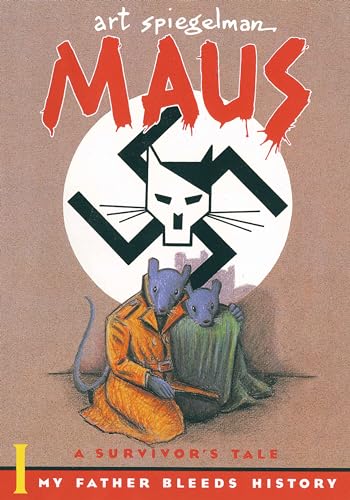
Art Spiegelman's Maus is a memoir about the author's father, a Holocaust survivor, and about the author's attempt to understand his father's experience and his own identity as the son of a survivor.
Spiegelman uses mice to represent Jews, cats to represent Nazis, and pigs to represent Poles. This is a deliberately crude visual shorthand. The crude symbols force you to think about stereotypes and how prejudice simplifies people into types. But as the story develops, Spiegelman's father becomes a specific individual, not a mouse-type.
The narrative moves between the father's recounting of his experience and the author's attempt to write the book. The emotional work of the book is the author understanding his father and his father understanding his son. The Holocaust forms the background but the foreground is about family and love and communication.
Maus won the Pulitzer Prize and became the first graphic novel to achieve mainstream literary recognition. Available on Amazon.
3. Persepolis by Marjane Satrapi
Marjane Satrapi's Persepolis is a memoir of growing up in Iran during and after the Islamic Revolution. Satrapi shows her childhood in a country transformed by revolution. She shows the impact of political upheaval on individual lives, particularly on young people trying to navigate adolescence amid religious police and political upheaval.
Satrapi's drawing is simple and direct in black and white. The simplicity makes the emotional content more direct. You are not distracted by visual complexity. The focus is on faces and relationships and small details of daily life under revolution.
The book is funny and sad and angry and full of love. Satrapi shows her mother and her grandmother as complex people. She shows how political ideology impacts family relationships. She shows the ways that young people resist authority.
Persepolis is an important work of political memoir that only works in comics form. The interaction of word and image creates effects that prose or straight photography could not achieve. Available on Amazon.
4. Fun Home by Alison Bechdel
Alison Bechdel's Fun Home is a memoir about the author's father, her sexual identity, and the possibility that her father was gay or bisexual. The book uses the Sophocles play The Bacchae as a framework for understanding her father and herself.
Bechdel's artwork is detailed and careful. She fills panels with text about literary references and family history. The density of the work makes reading it an active and engaged process. You are inside the author's mind as she tries to piece together the meaning of her father's life and his relationship to his identity and to her.
The book is about family secrets and self-discovery and how literature helps us understand our lives. It is about queerness and identity and the relationship between parent and child. It is formally ambitious in its use of literary allusion and visual notation.
Fun Home showed that comics could be as complex and literary as any experimental fiction. The form allows Bechdel to show thinking and interpretation in ways that prose requires more explanation to achieve.
5. Ghost World by Daniel Clowes
Daniel Clowes' Ghost World is a coming-of-age story about two teenage girls in the last year of high school facing the transition to adulthood. The girls are cynical and judgmental and wise and vulnerable. They navigate relationships and identity and the fear of growing up.
Clowes uses a clear line drawing style. The characters are expressive. The world of the comic is specific and detailed. Clowes shows the mundane details of teenage life in a way that makes it feel important and true.
The narrative does not resolve neatly. The girls change. They grow. The ending is ambiguous in a way that feels true. The book captures something about adolescence and the specific friendships that sustain us through it.
Ghost World shows that comics can be literary and character-driven without relying on spectacle or plot mechanics.
6. Sandman by Neil Gaiman and various artists
Neil Gaiman's Sandman is a comic book series that ran for 75 issues. It follows Dream, also known as Morpheus, one of the Endless (powerful beings who are both ancient and eternal). Sandman is epic fantasy told in comic form.
Gaiman writes Sandman as a series of interlocking stories. Some issues are standalone stories within the larger narrative. Some follow the main characters through mythology and across centuries. The series quotes from literature and draws on mythology and creates a complex universe of gods and dreams and nightmares.
The medium of comics allows Gaiman to create visual representations of dreams and nightmares that prose fiction can only describe. Different artists contribute to Sandman and their different styles create the effect of different worlds and different narrative registers.
Sandman showed that comics could be as narratively ambitious as novels. It created a devoted audience for sophisticated comics storytelling.
7. Blankets by Craig Thompson
Craig Thompson's Blankets is a memoir of childhood and faith and family and first love. Thompson uses a simple but expressive drawing style. He fills pages with his observations about his family and his religious upbringing and his confusion and his growing questioning of his faith.
The book is intimate and detailed. Thompson shows his internal life through image and reflection. The form allows him to show thought and emotion directly. You are not reading about how he felt. You are experiencing it alongside him through the visual language of the comic.
Blankets is a book about growing up and learning to see yourself as separate from your family. It is about love and sexuality and identity and faith. It is beautifully drawn and emotionally honest.
Comics as Literature
The best graphic novels use the unique possibilities of sequential art to tell stories that only work in that form. They use panel layout and visual metaphor and the rhythm of panels to create meaning. They show that the marriage of word and image can create art as serious and as moving as any other literary form. When you close a great graphic novel, you have been inside another person's mind and heart. That is what all great art does.
Your next good book, in your inbox
We only write when we find a book worth your time. Hand-picked recommendations across history, mythology, true crime and more.
Are you an author?
Get your book in front of readers like these, for free.
- Free book listing →Your own book page with an Amazon button
- Author page →Photo, bio and links to your site
- Featured placement →A spot in our best-of lists, from €29
Free tools we recommend
Get free honest reviewsReview exchange on iWrity, free to join
Books You Might Like

It Ends with Us: A Novel
Colleen Hoover

The Seven Husbands of Evelyn Hugo: A Novel
Taylor Jenkins Reid

The Song of Achilles
Madeline Miller

Educated: A Memoir
Tara Westover