Best Leadership Development Books for 2026
Good leaders aren't born. They're built. Leadership is a skill, and like any skill, it improves with study and practice. These books teach the fundamentals: decision-making, communication, emotional intelligence, and how to bring out the best in others. They're written by CEOs, military leaders, and researchers who've studied what works.
The Effective Executive: The Definitive Guide to Getting the Right Things Done by Peter Drucker
Drucker is the grandfather of modern management. This book is short but dense. He argues that an executive's job isn't to be busy. It's to be effective, which means getting the right things done. He covers five practices: knowing your time, defining your contribution, managing by strengths, deciding what matters most, and asking the right questions.
The book teaches that most people are trapped in reactive work. A real executive steps back, identifies what only they can do, protects that time, and executes relentlessly on it. Drucker's framework works for CEOs and individual contributors. If you feel perpetually busy but never accomplish what matters, this book diagnoses why.
Link: The Effective Executive on Amazon
Radical Candor: Be a Kick-Ass Boss Without Losing Your Humanity by Kim Scott
Scott worked at Google and Apple. She noticed that many leaders avoid conflict to seem nice. They praise weakness, avoid critique, and hire "easy" people. The result is teams that never improve. Radical Candor is the opposite: care personally while challenging directly.
The book teaches that good feedback requires two things: you must genuinely care about the person, and you must be willing to criticize their work. Scott shows how to deliver hard truths with humanity. She covers how to praise (be specific, tied to impact), criticize (focus on the behavior, not the person), and avoid the traps of ruinous empathy (caring without challenging) and obnoxious aggression (challenging without caring). Leaders who master this build trust and drive results.
Link: Radical Candor on Amazon
Leaders Eat Last: Why Some Teams Pull Together and Others Don't by Simon Sinek
Sinek studies why some teams are loyal, motivated, and creative while others struggle despite talent. His answer: it's about how the leader treats people. A leader who says "I'm here to serve you" builds a culture where people feel safe. A leader who says "I'm here to win" builds a culture of fear.
The book covers the biology of trust (oxytocin, cortisol), how military units become unbreakable, and why Google's perks don't create loyalty (culture does). Sinek argues that your job as a leader is to create a safe environment where people can do their best work. It sounds soft, but Sinek backs it with neuroscience and real-world examples. Companies with this culture outperform competitors.
Link: Leaders Eat Last on Amazon
Crucial Conversations: Tools for Talking When Stakes Are High by Kerry Patterson, Joseph Grenny, Ron McMillan, Al Switzler
Most people avoid difficult conversations. They stay quiet, harbor resentment, and let problems fester. This book teaches how to handle conversations where stakes are high, opinions differ, and emotions run strong. Crucial Conversations shows that these conversations are where leadership happens.
The authors cover a seven-step framework: start with heart (get clear on what you want), notice when you're in a crucial conversation (your emotions change), get safe (make it clear you care about the other person), listen before you advocate, explore opposing views, and move to action. The book is practical, with real scripts. If you're leading people, you'll face crucial conversations. This prepares you.
Link: Crucial Conversations on Amazon
The Five Dysfunctions of a Team: A Leadership Fable by Patrick Lencioni
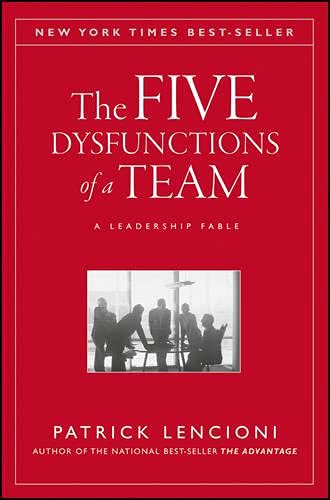
Lencioni explains why some teams fail despite having talented people. His model lists five dysfunctions that build on each other: absence of trust (people fear judgment), fear of conflict (teams avoid confrontation), lack of commitment (decisions don't stick), avoidance of accountability (no one speaks up), and inattention to results (personal agendas trump team goals).
The book is written as a fable, making it engaging. A new CEO joins a failing company and builds trust by being vulnerable, encourages debate to build buy-in, locks in decisions, holds people accountable, and focuses everyone on results. The framework is simple enough to remember and apply. If your team feels stuck, check which dysfunction is the root.
Link: The Five Dysfunctions of a Team on Amazon
The Scout Mindset: Why Some People See Things Clearly and Others Don't by Julia Galef
Galef teaches two ways of thinking: the "soldier" mindset (defend your position, win the argument) and the "scout" mindset (explore the territory, see it clearly). Most people are soldiers. Good leaders are scouts. They want to see reality, not defend their existing beliefs.
The book covers cognitive biases, how to question your assumptions, and how to think like an explorer. Galef shows why conviction is dangerous without calibration (humility about what you don't know). She teaches how to disagree without being disagreeable, how to interpret evidence fairly, and how to change your mind when the facts change. Leaders who adopt this mindset make better decisions and learn faster.
Link: The Scout Mindset on Amazon
Thinking, Fast and Slow by Daniel Kahneman

Kahneman won the Nobel Prize for his work on decision-making under uncertainty. This book reveals how your mind works. You have two systems: System 1 is fast, intuitive, and emotional. System 2 is slow, deliberate, and logical. Most decisions are made by System 1, but System 1 is vulnerable to biases.
As a leader, you make decisions about hiring, strategy, and resource allocation. Understanding your biases helps you avoid costly mistakes. Kahneman covers anchoring (the first number you hear shapes all subsequent judgments), the representativeness heuristic (we judge probability by how similar something is to a stereotype), and overconfidence (we overestimate our knowledge). Reading this book makes you a better decision-maker.
Link: Thinking, Fast and Slow on Amazon
Leadership is about bringing out the best in people while making sound decisions. These books are your toolkit. Read them, apply them, and watch your impact grow.
Your next good book, in your inbox
We only write when we find a book worth your time. Hand-picked recommendations across history, mythology, true crime and more.
Are you an author?
Get your book in front of readers like these, for free.
- Free book listing →Your own book page with an Amazon button
- Author page →Photo, bio and links to your site
- Featured placement →A spot in our best-of lists, from €29
Free tools we recommend
Get free honest reviewsReview exchange on iWrity, free to join
Books You Might Like

It Ends with Us: A Novel
Colleen Hoover

The Seven Husbands of Evelyn Hugo: A Novel
Taylor Jenkins Reid

The Song of Achilles
Madeline Miller

Educated: A Memoir
Tara Westover