Best Mathematics Books for Non-Mathematicians in 2026: 12 That Make You Actually Love Numbers
Most people who say they hate math had it taught to them as a series of procedures to memorize and rules to follow, with no explanation of what any of it meant or why anyone would care. That version of mathematics is genuinely joyless. But it is not mathematics. Mathematics, as practiced by the people who actually do it, is an investigation into the structure of reality, full of mystery, surprise, and occasional moments of beauty that stop you cold.
The books below were chosen because they demonstrate this. Each one takes a piece of mathematics that sounds forbidding on paper and makes it feel alive. The range is wide: number theory, chaos, probability, logic, infinity, error, geometry. What they share is that the author genuinely loves the subject and has found a way to make that love contagious.
1. Fermat's Last Theorem by Simon Singh
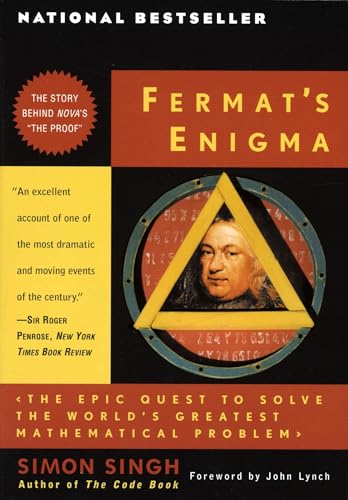
In 1637, Pierre de Fermat wrote in the margin of a book that he had found a "truly wonderful proof" that no three positive integers can satisfy the equation x^n + y^n = z^n for any n greater than 2, but that the margin was too small to contain it. The proof, if it ever existed, was lost. It took mathematicians 358 years and a seven-year obsession by Andrew Wiles to finally prove Fermat right. Singh tells this story with the pacing of a thriller and the mathematical depth of someone who did the work to understand what Wiles actually did. One of the best popular science books ever written.
2. The Music of the Primes by Marcus du Sautoy
The Riemann Hypothesis, one of the seven Millennium Prize Problems with a $1 million bounty for a proof, asks whether there is a pattern underlying the distribution of prime numbers. Du Sautoy, a professor of mathematics at Oxford, explains what the hypothesis actually says and why it matters, then traces the history of attempts to prove it from Riemann in the nineteenth century to the present. The mathematics is real but the explanations are clear, and du Sautoy's own passion for prime numbers comes through on every page.
3. Humble Pi: When Math Goes Wrong in the Real World by Matt Parker
Parker, a former math teacher turned comedian and YouTuber, collects real-world disasters caused by mathematical errors: bridges that collapsed, rockets that missed their targets, elections that went wrong, and a Pepsi promotional contest that accidentally offered anyone who collected 7 million Pepsi points a Harrier jump jet. The book is very funny, but it is also a serious examination of how mathematical reasoning fails under pressure and why numerical literacy matters. By the end, you understand math better by seeing how it breaks.
4. How Not to Be Wrong: The Power of Mathematical Thinking by Jordan Ellenberg
Ellenberg is a professor of mathematics at Wisconsin and a genuinely gifted explainer. His central argument is that mathematical thinking, meaning the application of rigorous logical reasoning to real-world problems, is a learnable skill that most educated people already use informally, and that being explicit about it dramatically improves decision-making. He covers statistics, probability, regression to the mean, expected value, and geometric thinking, illustrating each with examples drawn from politics, finance, medicine, and everyday life.
5. Does God Play Dice? The New Mathematics of Chaos by Ian Stewart
Stewart's book is the best popular introduction to chaos theory: the study of deterministic systems that are nevertheless impossible to predict over long time horizons because they are exquisitely sensitive to initial conditions. He explains what chaos actually means mathematically (it is not the same as randomness), why weather forecasting is fundamentally limited, how chaos appears in population biology, electrical circuits, and fluid dynamics, and what the discovery of chaos did to the Newtonian worldview. Clear, thorough, and more relevant now than when it was first published.
6. The Emperor's New Mind by Roger Penrose
Penrose, a Nobel laureate physicist and mathematician, argues that human consciousness cannot be explained by any algorithm, and therefore that artificial intelligence can never replicate human thought. The argument is controversial, and many philosophers and computer scientists dispute it. But the book contains the best popular explanation of Gödel's incompleteness theorems, the nature of algorithms, quantum mechanics, and the relationship between mathematics and physical reality that exists in the English language. Even readers who reject Penrose's conclusion will emerge with a vastly better understanding of the mathematics.
7. The Joy of x: A Guided Tour of Math, from One to Infinity by Steven Strogatz
Strogatz, a mathematician at Cornell, wrote a series of columns for the New York Times about mathematics for non-specialists, and this book collects and expands them. Each chapter covers a different area of mathematics, from basic arithmetic through calculus, topology, and the mathematics of infinity, in about ten pages. The tone is warm and conversational. Strogatz assumes no background and asks only that you are willing to think carefully for a few minutes at a time. It is the most accessible book on this list.
8. How to Bake Pi: An Edible Exploration of the Mathematics of Mathematics by Eugenia Cheng
Cheng, a mathematician and amateur chef, uses recipes as a way of introducing category theory, one of the most abstract and powerful branches of modern mathematics. Each chapter begins with a recipe and then uses the recipe to illustrate a mathematical concept: the way a recipe can be simplified parallels the way mathematics abstracts essential structure from specific cases. The approach sounds gimmicky but works. Cheng is a skilled teacher, and the book genuinely illuminates how mathematicians think about abstraction, which is the core of the discipline.
9. Alex's Adventures in Numberland by Alex Bellos
Bellos traveled the world to find people with unusual relationships to numbers and mathematics, and this book is his account of what he found. He interviews a man in Papua New Guinea whose language has only two number words, a Brazilian lottery mathematician who has developed elaborate systems for predicting winning numbers, and working mathematicians trying to explain their research to a curious generalist. The result is an unusually human portrait of mathematics, grounded in the lives of real people rather than abstract principles.
10. Gödel, Escher, Bach: An Eternal Golden Braid by Douglas Hofstadter
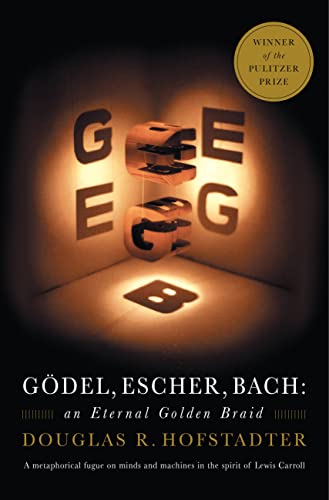
Hofstadter's 1979 Pulitzer Prize-winning book is unlike anything else on this list. It is an extended meditation on self-reference, recursion, and the nature of consciousness, woven through three interlocking threads: the incompleteness theorems of Kurt Gödel, the visual paradoxes of M.C. Escher, and the musical structures of J.S. Bach. It is long, demanding, and occasionally maddening. It is also one of the most original works of popular intellectual writing ever published, and the readers who connect with it tend to describe it as one of the most significant books they have ever read.
11. Innumeracy: Mathematical Illiteracy and Its Consequences by John Allen Paulos
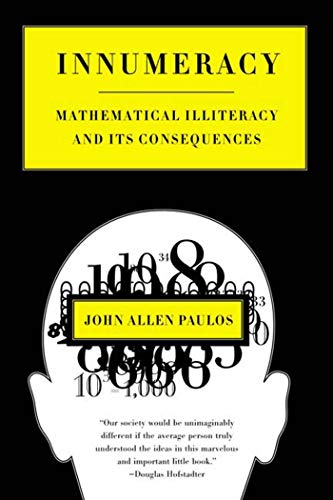
Paulos published this in 1988, and it identified a problem that has only become more acute since: most educated adults are functionally illiterate when it comes to large numbers, probability, and statistical reasoning, and this illiteracy has real consequences for democracy, public health, financial decision-making, and everyday life. The book is short and reads in an afternoon. It is more polemic than tutorial, but its argument is sound, its examples are well-chosen, and reading it is genuinely clarifying.
Math anxiety is real, but its causes are mostly educational, not intellectual. Most people who think they cannot do mathematics were simply never shown why it matters or made to feel that confusion was a normal part of learning it rather than a signal to stop. The books above will not make you a mathematician. But they will show you what mathematics actually is, and for most readers who discover this late, the reaction is some version of: "Why did nobody tell me this before?"
Your next good book, in your inbox
We only write when we find a book worth your time. Hand-picked recommendations across history, mythology, true crime and more.
Are you an author?
Get your book in front of readers like these, for free.
- Free book listing →Your own book page with an Amazon button
- Author page →Photo, bio and links to your site
- Featured placement →A spot in our best-of lists, from €29
Free tools we recommend
Get free honest reviewsReview exchange on iWrity, free to join
Books You Might Like

It Ends with Us: A Novel
Colleen Hoover

The Seven Husbands of Evelyn Hugo: A Novel
Taylor Jenkins Reid

The Song of Achilles
Madeline Miller

Educated: A Memoir
Tara Westover