Best Modernist Literature in 2026: 12 Novels That Broke Every Rule and Invented New Ones
Modernist literature emerged from a specific rupture in history: the First World War and the industrial transformation that preceded it had changed what human consciousness was, and the old forms of the novel could not contain it. Modernist writers broke the rules not for novelty but because the old rules were inadequate to the task of describing what it felt like to be alive in the 1920s. Stream of consciousness, unreliable narrators, fragmented time, non-linear narrative: these were not difficulties for their own sake. They were attempts to make fiction adequate to experience.
The twelve books below show why modernism mattered and why it still matters. The formal innovations they pioneered are now so familiar that we forget how radical they were.
1. Ulysses by James Joyce (1922)

Joyce's Ulysses is the Everest of modernist literature: 700+ pages following Leopold Bloom through Dublin on a single day in June 1904. Nothing happens in the conventional sense. A man eats breakfast, talks with friends, attends a funeral, visits a library and a hospital, and wanders through the city. But Joyce's method captures the full texture of consciousness: digression, memory, word association, thought interrupting thought. Stream of consciousness as a technique was not invented by Joyce, but he perfected it and made it the dominant tool of 20th-century literature.
Ulysses is intimidating because it asks the reader to do work. You do not passively receive the story. You build it, interpret it, navigate the digressions. But that difficulty is the point. The novel's form mirrors consciousness itself: non-linear, tangential, full of half-formed thoughts and sudden memory. Reading it feels like being inside a mind.
Get it here: Ulysses on Amazon
2. Mrs. Dalloway by Virginia Woolf (1925)
Woolf's novel takes place over the course of a single day in London. Clarissa Dalloway prepares for a party she is giving that evening. That is the plot. But Woolf's method captures something much deeper: the texture of experience, the way a single day is actually a full life. She moves between different characters' perspectives, between past and present, between external action and internal thought. Time stops meaning anything in the conventional sense. A conversation that lasts five minutes might occupy many pages. Years of memory compress into a single moment.
Mrs. Dalloway is one of the most beautiful novels in English. Woolf's prose is precise and lyrical. She understood that the mind does not think in plot points and dramatic moments. It thinks in associations, memories, sensations. Literature should reflect that, or it is not being truthful about what consciousness actually is.
Get it here: Mrs. Dalloway on Amazon
3. To the Lighthouse by Virginia Woolf (1927)
Woolf's second major novel is structured in three parts that cover 10 years but feel timeless. A family plans a trip to a lighthouse but cannot go because of bad weather. A decade passes. They finally make the journey. In between, someone dies (a death reported in brackets, almost parenthetically). The novel is obsessed with time, with loss, with the way life is lived in the spaces between important events. Woolf captures the way experience actually feels: not dramatic, but textured, full of sensation and thought and the presence of other minds.
To the Lighthouse is often cited as Woolf's masterpiece. It is slighter than Mrs. Dalloway in some ways but more ambitious in others. She pushes the formal innovation further. The novel becomes almost abstract: characters are less important than light and time and the landscape itself.
4. The Sound and the Fury by William Faulkner (1929)
Faulkner's novel is structured in four sections, one from each of three brothers and then a final section from an omniscient narrator. The first section is narrated by Benjy, an intellectually disabled man whose consciousness is not linear or rational. Benjy's section is nearly impenetrable: time has no sequence, cause and effect have no meaning, language itself breaks down. What Faulkner is doing is using form to convey consciousness. The reader cannot understand the section easily because Benjy's mind does not work in the way a reader's mind works. You have to learn to read differently.
The Sound and the Fury is set in the American South and follows the decline of the Compson family. But what matters more than plot is Faulkner's commitment to making form mirror consciousness. He is willing to make his novel difficult because accuracy to experience requires it. The second and third sections are still disorienting but more navigable. By the fourth section, conventional narrative resumes. The juxtaposition is jarring on purpose.
Get it here: The Sound and the Fury on Amazon
5. Swann's Way by Marcel Proust (1913)
This is the first volume of In Search of Lost Time, one of the longest novels ever written. Proust is obsessed with memory and how it actually works. The famous scene involves the narrator eating a madeleine cake, which triggers childhood memories. From that small moment, an entire past floods back. Proust builds outward from sensory experience, from the way a smell or a taste can unlock years of memory. Time in Proust is not linear. The past and present are always collapsing into each other.
Proust's method is digressive. He will spend 50 pages describing a moment of social awkwardness or the interior of a drawing room. But the digression is the point. Life is texture. It is accumulation. Proust refuses to compress or simplify. He trusts the reader to sit with his prose and let it work.
6. The Waste Land by T.S. Eliot (1922)
Eliot's poem is only 434 lines long but it feels monumental. It is fragmented, polyphonic, full of allusions to classical literature and world mythology. The poem deals with post-war London, the spiritual emptiness of modern life, the search for meaning in a fractured world. Eliot uses multiple voices, multiple time periods, multiple languages (English, French, German, Sanskrit, Italian). The form mirrors the content: a fractured world is represented through fractured form.
The Waste Land is notoriously difficult. Readers at the time were baffled. But Eliot's difficulty is intentional. He is trying to capture the experience of modern consciousness: fragmented, allusive, unable to settle into a single meaning. The poem should feel disorienting because life, in Eliot's view, is disorienting.
7. Waiting for Godot by Samuel Beckett (1953)
Beckett's play has two acts. Two men wait for someone named Godot, who never comes. They wait again the next day, and Godot still does not come. That is the entire plot. But in that repetition and emptiness, Beckett captures something essential about human existence: the passing of time, the search for meaning, the way we fill silence with speech and action and the illusion of progress. Waiting for Godot is comic and heartbreaking. It is also a perfect distillation of modernist technique: maximum meaning extracted from minimum material.
8. Women in Love by D.H. Lawrence (1920)
Lawrence's novel follows two couples and their relationships as England approaches the edge of modernity and the brink of war. But Women in Love is not primarily about plot. It is about sexuality, class, consciousness, and the way people are trapped in social forms that do not contain them. Lawrence's prose is intense and sometimes overwrought. He is interested in the body, in physical sensation, in sex as a form of knowledge. His characters are caught between convention and desire, and desire wins.
Women in Love is difficult in a different way than Joyce or Faulkner. Lawrence's difficulty is emotional and spiritual rather than formal. He is asking questions about what intimacy actually means, what two people can know of each other, what commitment and sacrifice entail.
9. The Autobiography of Alice B. Toklas by Gertrude Stein (1933)
Stein's memoir is narrated in Alice B. Toklas's voice, but it is Stein's own autobiography. The conceit is playful and allows Stein to write about herself and her relationship with Alice while maintaining a kind of ironic distance. The book is a portrait of the Paris art world during the early decades of the twentieth century, filled with appearances by Picasso, Matisse, Hemingway, and others. Stein's prose style is her own: repetitive, associative, breaking down the normal rules of syntax. She was interested in words as objects, in the way repetition changes meaning, in the possibility of literature that does not convey meaning in the traditional sense but creates meaning through rhythm and accumulation.
10. The Sun Also Rises by Ernest Hemingway (1926)
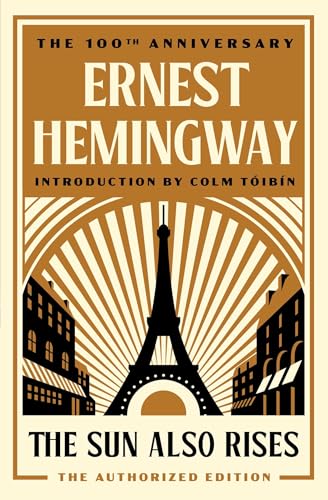
Hemingway's first novel is about the Lost Generation: veterans and expatriates in Paris and Spain after the First World War. They drift, they drink, they pursue various romantic entanglements that do not resolve. The plot is minimal. But Hemingway's innovation was stylistic. He stripped fiction of excessive description and psychological interiority. He believed in showing, not telling. The result is a prose that feels sparse and precise, almost like journalism, but carries tremendous emotional weight beneath the surface.
The Sun Also Rises helped define a generation. It captured something about post-war disillusionment and the way trauma can manifest as aimlessness. The novel's famous line, "Isn't it pretty to think so?", captures the way hope and resignation can occupy the same moment.
Get it here: The Sun Also Rises on Amazon
11. In the Penal Colony by Franz Kafka (1919)
Kafka's short novel (it qualifies as both story and novella) is a nightmare of procedure and justice. An explorer arrives on a remote island where a prisoner is being executed by an elaborate machine. The officer operating the machine believes the machine is just, precise, elegant. The condemned man is guilty of disobeying an order. The punishment is inscribed directly onto the body by the machine. The machine breaks down during the execution, and the officer, facing his own obsolescence, chooses death. Kafka uses the machine as metaphor for bureaucratic power, for the way systems can be beautiful and horrifying simultaneously.
12. A Portrait of the Artist as a Young Man by James Joyce (1916)
Joyce's earlier novel, written before Ulysses, follows Stephen Dedalus through childhood, adolescence, and young adulthood in Dublin. The novel is structured through key moments rather than conventional plot. Joyce uses interior monologue, memory, and digression. As Stephen grows older, the narrative becomes more complex and experimental. The language itself evolves to reflect Stephen's consciousness at different ages. By the end, the prose has become almost Joycean in its density and difficulty. A Portrait charts the development of an artistic consciousness, the way a mind learns to perceive and make sense of experience.
Why Modernism Matters
Modernist literature was not difficult for difficulty's sake. It was the result of writers trying to make fiction adequate to a changed consciousness. The industrialization, mechanization, and industrialized warfare of the early twentieth century had fractured human experience. The old forms were not truthful anymore. Modernist writers broke those forms because fidelity to experience required it. They invented new techniques because the new techniques were necessary. What they did still influences literature now, even when contemporary writers are not directly imitating modernist forms. They established that literature could be experimental, that form and meaning were inseparable, that difficulty could be a sign of authenticity rather than a flaw.
Your next good book, in your inbox
We only write when we find a book worth your time. Hand-picked recommendations across history, mythology, true crime and more.
Are you an author?
Get your book in front of readers like these, for free.
- Free book listing →Your own book page with an Amazon button
- Author page →Photo, bio and links to your site
- Featured placement →A spot in our best-of lists, from €29
Free tools we recommend
Get free honest reviewsReview exchange on iWrity, free to join
Books You Might Like

It Ends with Us: A Novel
Colleen Hoover

The Seven Husbands of Evelyn Hugo: A Novel
Taylor Jenkins Reid

The Song of Achilles
Madeline Miller

Educated: A Memoir
Tara Westover