Best Neuroscience and Brain Books in 2026: 12 That Reveal the Three-Pound Universe Inside Your Head
Most popular science books about the brain make the same promise: you will understand yourself better when you finish. Most of them do not keep it. They describe findings without explaining what the findings mean, or they explain what the findings mean without giving you any way to check whether the explanation holds. The books below are the ones that actually deliver on the premise, the ones that change how you understand why you do what you do, feel what you feel, and remember what you remember.
The field of neuroscience has moved fast enough in the past thirty years that some older titles in this list have been partly revised by subsequent research. That is noted where relevant. But a book can still be essential reading even when some of its specific claims have been updated; the frameworks and the way of thinking about the brain remain valuable long after the particular experiments have been superseded.
The Classic Cases: Neuroscience Through Individual Patients
The oldest and still most powerful method in neuropsychology is the case study: what the breakdown of one function in one person reveals about how that function normally works. These books are built on that method.
1. The Man Who Mistook His Wife for a Hat by Oliver Sacks
Sacks's 1985 collection of neurological case studies is still the most widely read book in the history of popular neuroscience. The patients in these stories have conditions that reveal, by their absence or distortion, what the brain normally does so automatically that we do not notice it: recognise faces, orient to space, maintain a continuous sense of self, process music, remember the present. Sacks wrote about his patients with a novelist's attention to the texture of their experience, and the book changed what popular science writing about the brain could be.
Best for: Every reader. Start here if you have not read popular neuroscience before.
2. Phantoms in the Brain by V.S. Ramachandran
Ramachandran's book on phantom limbs, mirror neurons, and the neurology of self is the most genuinely exciting piece of neuroscience writing since Sacks. Ramachandran is a working neuroscientist and an extraordinary explainer of the implications of neurological findings. His mirror-box treatment for phantom limb pain, described here, became a standard clinical intervention. His chapters on Capgras syndrome (the belief that a family member has been replaced by an impostor) and Cotard syndrome (the belief that one is dead) are among the best explanations of what the sense of self actually is in neuroscientific terms.
3. In Search of Memory by Eric Kandel
Kandel won the Nobel Prize in Physiology or Medicine in 2000 for his work on the cellular mechanisms of memory. His memoir weaves his own story (Vienna in the 1930s, flight from the Nazis, a career built at Columbia) together with the science of how memories are encoded at the level of individual synapses. It is both the best autobiography written by a working neuroscientist and the most accessible account of how long-term memory actually works at the cellular level.
How the Brain Makes You: Behaviour, Emotion, and the Social Brain
4. Behave: The Biology of Humans at Our Best and Worst by Robert Sapolsky
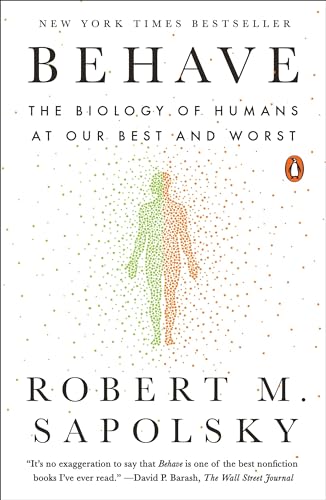
Sapolsky's 2017 book is the most comprehensive single account of the biological underpinnings of human behaviour available for general readers. He works backwards from a single act of behaviour, asking what happened in the second before, the minute before, the hour before, the day before, the year before, the childhood before, the evolution before. The result is a 700-page integration of neuroscience, endocrinology, evolutionary biology, and social psychology that takes seriously the idea that biology and culture are not separate explanations for human behaviour but the same explanation at different levels of analysis.
Best for: Readers who want the complete picture of how biology shapes behaviour, not just the neuroscience part of it.
5. Descartes' Error by Antonio Damasio
Damasio's 1994 book overturned the assumption that rational decision-making and emotion are separate systems, with rationality being the important one. His study of patients with damage to the ventromedial prefrontal cortex showed that people who had lost the ability to experience emotion also lost the ability to make good decisions. The implication is that emotion is not the enemy of reason; it is required for it. The book introduced the somatic marker hypothesis, which remains one of the most influential frameworks in affective neuroscience.
6. How Emotions Are Made by Lisa Feldman Barrett
Barrett's 2017 book challenges the classical theory of emotion that has dominated popular and scientific thinking for a century: the idea that emotions are universal, hard-wired responses to stimuli, the same in every human across every culture. Her counter-argument, built on two decades of research, is that emotions are constructed by the brain, that they are predictions about what the body's internal sensations mean, and that they are shaped by culture, context, and prior experience. The book is a significant scientific argument that also has direct implications for how you understand your own emotional life.
Plasticity, Trauma, and What the Brain Can Change
7. The Brain That Changes Itself by Norman Doidge

Doidge's 2007 book was the popular account that introduced the concept of neuroplasticity to a wide audience. Before this book, the standard neuroscience view was that the adult brain was essentially fixed: neurons died, and new connections did not form in their place. Doidge profiles researchers and patients who demonstrated that this was wrong, that the adult brain can and does reorganise itself in response to experience, injury, and training. Some of the specific cases have been subject to debate since publication, but the core argument has held up.
8. The Body Keeps the Score by Bessel van der Kolk

Van der Kolk's book on trauma and the body has sold more than two million copies and been on the New York Times bestseller list for years. It is the account of how traumatic experience is stored not just in memory but in the body itself, in the nervous system's persistent state of alert, and why talking therapies alone are often insufficient for treating severe trauma. Van der Kolk is a clinician, and the book is grounded in decades of work with trauma patients. It is also the most widely read book on trauma neuroscience ever published for general readers.
Consciousness, Identity, and the Architecture of the Self
9. Incognito: The Secret Lives of the Brain by David Eagleman

Eagleman's argument is that conscious awareness is a very small part of what the brain does, that most of the processing that determines behaviour, judgment, and preference happens below conscious access, and that this has significant implications for how we understand free will, moral responsibility, and criminal justice. The book is written with a clarity and wit that make it the most accessible of the consciousness-focused neuroscience books.
10. Connectome: How the Brain's Wiring Makes Us Who We Are by Sebastian Seung
Seung's book makes the case that identity resides not in the brain's neurons but in the specific pattern of connections between them, the "connectome." He covers the current state of connectomics research, the technical challenges of mapping neural connections at scale, and the philosophical implications of the possibility that complete connectome mapping might allow a kind of preservation or reconstruction of individual identity. It is the best popular account of where neuroscience is going, rather than just where it has been.
Music, the Senses, and the Brain
11. This Is Your Brain on Music by Daniel Levitin
Levitin is a music producer turned neuroscientist, and his book covers how the brain processes music, why music produces emotion, why we remember song lyrics we have not heard in decades, and what music reveals about the evolution of human social bonding. It is the most accessible account of the neuroscience of music available, and it works as a book about both music and neuroscience for readers who are primarily interested in either.
12. The Tell-Tale Brain by V.S. Ramachandran
Ramachandran's follow-up to Phantoms in the Brain extends his case-study approach to questions of art, language, and self-awareness. His chapters on synesthesia, on the neurology of aesthetic experience, and on what mirror neurons might tell us about the origins of language are the most thought-provoking recent work on the connection between neuroscience and human culture.
Three Neuroscience Books Worth Buying Today
These three titles appear at the top of their categories by verified Amazon review count and are the ones readers consistently return to.
- The Man Who Mistook His Wife for a Hat by Oliver Sacks, the book that defined popular neuroscience writing and still the best starting point for readers new to the field.
- Behave: The Biology of Humans at Our Best and Worst by Robert Sapolsky, the most comprehensive single account of the biology of human behaviour available to general readers.
- The Body Keeps the Score by Bessel van der Kolk, the most widely read account of trauma neuroscience and its clinical implications.
For the full ranked reading list by review count, see the science books category on Skriuwer. If you want to continue into the psychology of decision-making and irrational behaviour, our best books about manipulation covers the social psychology side of how minds are influenced. For the broader question of what consciousness is and whether the physical brain fully explains it, Seung's Connectome is the best current popular account of where neuroscience is heading.
Your next good book, in your inbox
We only write when we find a book worth your time. Hand-picked recommendations across history, mythology, true crime and more.
Are you an author?
Get your book in front of readers like these, for free.
- Free book listing →Your own book page with an Amazon button
- Author page →Photo, bio and links to your site
- Featured placement →A spot in our best-of lists, from €29
Free tools we recommend
Get free honest reviewsReview exchange on iWrity, free to join
Books You Might Like
The Psychology of Money
Morgan Housel

Sapiens: A Brief History of Humankind
Yuval Noah Harari

Thinking, Fast and Slow
Daniel Kahneman

Man's Search for Meaning
Viktor E. Frankl