Best Neuroscience Books in 2026: 12 That Reveal the Most Complex Object in the Known Universe
Every neuroscience book eventually arrives at the same vertiginous observation: the brain is the organ that is trying to understand itself. This is either impossible or the most interesting thing in the universe, depending on your tolerance for the recursive. What makes contemporary neuroscience extraordinary is how much ground it has covered despite that constraint. We now know how memories are stored at the synaptic level, why emotion is essential to rational decision-making rather than opposed to it, how consciousness might be generated by the predictive activity of the cortex, and how a person can lose the ability to recognize faces while retaining everything else, suggesting that face recognition is a distinct cognitive system with its own neural substrate.
The twelve books on this list represent the range of this knowledge, from Oliver Sacks's clinical narratives that made brain science accessible to a general audience to Anil Seth's current-frontier account of consciousness as controlled hallucination. They vary in technical depth, but all of them are written for readers who do not need a neuroscience background to follow the argument.
The Book That Started It All
The Man Who Mistook His Wife for a Hat by Oliver Sacks
Sacks was a clinical neurologist who treated patients with extraordinary disorders of brain function, and his gift was seeing these patients as complete human beings rather than case studies. The title patient, Dr. P, had lost the ability to recognize objects and faces but retained his musical memory intact, so he navigated daily life by singing everything: getting dressed was accompanied by dressing songs, eating by eating songs. Sacks describes watching him reach for his wife's head to put on as a hat and feel no distress at all. The visual recognition system that would have triggered the correction was simply absent.
Published in 1985, this collection of case studies opened clinical neurology to a general audience and established Sacks as the writer who could make the brain's complexity vivid without distorting it. Every book on this list is in some sense in his tradition.
Emotion, Reason, and the Body
Descartes' Error by Antonio Damasio
The central argument of this book overturned a philosophical assumption that had been held since Descartes: that reason and emotion are opposed faculties, and that reason is best exercised when emotion is suppressed. Damasio's somatic marker hypothesis, developed through studying patients with damage to the ventromedial prefrontal cortex, showed the opposite. These patients scored normally on intelligence tests, could reason fluently, and passed tests of social judgment in the abstract. But they made disastrous decisions in real life, because they lacked the emotional "gut feeling" that normal people use to rapidly evaluate options before deliberate reasoning begins.
Emotion, Damasio argues, is not the enemy of rational decision-making. It is a prerequisite for it. The brain uses somatic signals, bodily states associated with past outcomes, to flag options as good or bad before the deliberate reasoning system even engages. Destroy that system, and you get a person who can reason perfectly and decide catastrophically.
How Emotions Are Made by Lisa Feldman Barrett
Barrett's book is a direct challenge to the standard model of emotion that most people hold intuitively: that emotions are universal, hard-wired, triggered by external events, and expressed in recognizable facial expressions that anyone can read. Her thesis is that emotions are constructed, not triggered. The brain is a prediction machine that constantly generates models of what is happening and what should happen, and emotions are one of the tools it uses to categorize and give meaning to ambiguous bodily states.
This is controversial. Paul Ekman's theory of basic universal emotions, with distinct facial expressions that can be read across cultures, has been the dominant model in psychology for fifty years. Barrett's challenge has generated a genuine empirical dispute, with evidence on both sides. The book is worth reading not just for the thesis but for what the dispute reveals about how neuroscience deals with contested evidence.
The Unconscious Brain
Incognito by David Eagleman

Eagleman's central question is: who is making your decisions? His answer is that "you" are a much smaller fraction of the cognitive process than you believe. The vast majority of brain activity that drives your behavior, your biases, your preferences, your impulses, happens below the threshold of conscious awareness and never reaches deliberate reflection. The conscious "you" that feels like the author of your thoughts and actions is largely a narrator constructing a story after the fact.
The legal implications Eagleman draws from this are genuinely interesting. If behavior is substantially determined by biology, upbringing, and neural architecture rather than pure free will, what does criminal responsibility actually mean? He does not use this to argue against consequences but for a neuroscience-informed approach to rehabilitation and sentencing that treats the brain as the system to be changed rather than the person to be punished.
Consciousness and the Brain by Stanislas Dehaene
Dehaene is one of the world's leading cognitive neuroscientists, and this book presents his global workspace theory of consciousness: the idea that a conscious thought is one that has been broadcast widely across the brain's networks, becoming available to a range of cognitive systems simultaneously, whereas an unconscious process stays local and fast. The difference between seeing something consciously and processing it unconsciously is not in the quality of the processing but in whether the information gets globally broadcast.
The experimental evidence Dehaene draws on is meticulous and the theory is genuinely testable in ways that many theories of consciousness are not. The book is more technically demanding than most on this list, but it gives you the clearest available account of what the empirical science of consciousness currently looks like.
The Complete Picture: Behavior and Biology
Behave by Robert Sapolsky
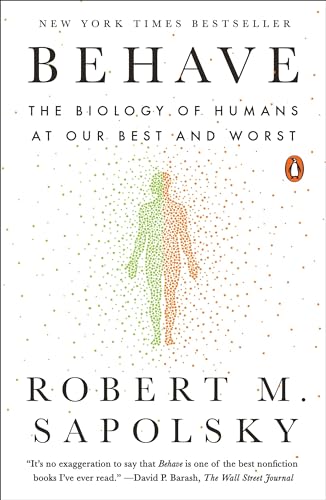
The most comprehensive single book on human behavior currently available. Sapolsky's approach is to take a single human action, a kind gesture, a violent act, and ask what caused it, then work backward through every level of causation: the milliseconds before the behavior (what neurons fired), the seconds before (what hormones were circulating), the hours before (what had the person experienced), the years before (what was their developmental history), the decades before (what was their evolutionary inheritance). The result is a picture of human behavior as the product of interlocking biological systems operating at timescales from milliseconds to millions of years.
Sapolsky writes with more humor than any neuroscientist has a right to, and the range of the book is genuinely extraordinary. By the final chapter, you have traveled through amygdala function, testosterone and cortisol dynamics, the effects of poverty on brain development, comparative primate behavior, the evolution of cooperation, and the neuroscience of in-group and out-group thinking. It is the book to read if you want the full biological context for everything else on this list.
Phantoms in the Brain by V.S. Ramachandran
Ramachandran is the neurologist who used a mirror box to treat phantom limb pain, one of the most elegant low-tech solutions in the history of medicine. Patients who had lost arms often felt excruciating pain in the missing limb because the brain continued to generate motor commands that received no sensory feedback, creating a kind of neural feedback loop of unresolvable tension. By having them place the remaining arm in a mirror box so that its reflection appeared to be the missing arm, the visual system could generate the feedback the brain needed, and the phantom pain resolved.
The book is full of cases like this, each one using a neurological anomaly to illuminate normal brain function. Capgras syndrome (the belief that close relatives have been replaced by impostors), synesthesia (seeing numbers as colors), and anosognosia (the failure to recognize that you are paralyzed) each reveal something specific about how the brain constructs its model of the self and the world.
Memory, Language, and Split Minds
In Search of Memory by Eric Kandel
Kandel won the 2000 Nobel Prize in Physiology or Medicine for his work on the molecular basis of memory. The book is partly memoir, the story of a Viennese Jewish child who fled the Nazis and became one of the most important neuroscientists of the twentieth century, and partly a rigorous account of how memories are actually stored and retrieved at the level of synaptic connections between neurons. The two strands are deliberately intertwined: the book is itself an argument that memory, both personal and scientific, is inseparable from identity.
The science is clearly explained without being simplified. You finish understanding what long-term potentiation actually is, how it differs from short-term memory formation, and why the humble sea slug Aplysia became, in Kandel's hands, the model organism that cracked the molecular code of learning.
Tales from Both Sides of the Brain by Michael Gazzaniga
Gazzaniga worked with Roger Sperry on the split-brain patients in the 1960s: people who had had their corpus callosum severed to treat severe epilepsy, which had the effect of largely disconnecting the two cerebral hemispheres. What they discovered was that the two hemispheres have genuinely different capabilities and, in a real sense, different cognitive styles. The left hemisphere is the language system and the "interpreter," the part that constructs narrative explanations for behavior. The right hemisphere is more visually and spatially capable but cannot speak.
When they showed images to only the right visual field (processed by the left hemisphere) or the left visual field (processed by the right hemisphere), the two hemispheres would produce different responses, with the left hemisphere inventing plausible explanations for behaviors it had not actually caused. The interpreter module, the part that tells us why we did what we did, is, it turns out, largely a confabulation machine. Gazzaniga's book is the first-person account of discovering this.
Language and Consciousness at the Frontier
The Language Instinct by Steven Pinker

Pinker's argument is that language is a biological adaptation, a product of natural selection like the eye or the hand, not a cultural invention that humans learn from scratch each generation. The evidence he marshals is substantial: the universality of language across all human cultures, the fact that children acquire it on a predictable developmental timetable without formal instruction, the existence of creole languages that spontaneously develop complex grammar from mixed pidgins, and the specific patterns of language breakdown in aphasia that reveal its underlying neural architecture.
The book is in dialogue with Chomsky throughout, accepting the core insight that humans have an innate language faculty while pushing back against Chomsky's increasingly formalist linguistics. Written in 1994, it remains the clearest account of what the biological approach to language actually claims and why it matters.
Being You by Anil Seth
The most current book on this list and the one that represents where the science is going. Seth's "controlled hallucination" theory of consciousness argues that the brain does not passively receive sensory information and construct a picture of reality from it. It generates a continuous prediction of what the sensory input should be, and consciousness is the experience of that prediction. What you experience as "seeing" is mostly your brain's model of what it expects to see, corrected by incoming sensory data where necessary.
This is a testable, scientifically grounded version of a philosophical insight that goes back to Kant: that we never have direct access to the world, only to our brain's model of it. Seth pushes it further, arguing that the self itself, the sense of being a continuous person with a body and a perspective, is also a controlled hallucination generated by the brain to help it regulate itself. The book is demanding but not impenetrable, and it represents the best available synthesis of where consciousness science currently stands.
Where to Start
Begin with Sacks's The Man Who Mistook His Wife for a Hat for the clinical vividness that makes brain science feel human. Move to Sapolsky's Behave for the broadest possible context: every biological system that shapes human behavior, laid out clearly and completely. Then Damasio's Descartes' Error if you want the argument about emotion and reason, or Eagleman's Incognito if you want the argument about consciousness and the unconscious. Seth's Being You is the endpoint: the current frontier of the question the entire list is circling. What is it, exactly, that is doing the reading?
Your next good book, in your inbox
We only write when we find a book worth your time. Hand-picked recommendations across history, mythology, true crime and more.
Are you an author?
Get your book in front of readers like these, for free.
- Free book listing →Your own book page with an Amazon button
- Author page →Photo, bio and links to your site
- Featured placement →A spot in our best-of lists, from €29
Free tools we recommend
Get free honest reviewsReview exchange on iWrity, free to join
Books You Might Like
The Psychology of Money
Morgan Housel

Sapiens: A Brief History of Humankind
Yuval Noah Harari

Thinking, Fast and Slow
Daniel Kahneman

Man's Search for Meaning
Viktor E. Frankl