Best Popular Science Books in 2026: 10 That Make Complex Ideas Feel Obvious
Popular science fails in one of two ways: it oversimplifies to the point of distortion, or it preserves so much technical accuracy that it loses the general reader by chapter three. The best popular science books do neither. They find the explanation that is both true and surprising, the framing that makes a difficult concept feel inevitable once you see it. The books on this list all manage that.
This list covers evolution, quantum physics, cosmology, human anatomy, anthropology, neuroscience, and the history of science. Ten books across the disciplines, with direct reading recommendations for each.
The Selfish Gene by Richard Dawkins

Richard Dawkins published The Selfish Gene in 1976, and it remains the clearest single-volume explanation of Darwinian evolution in print. The central reframing, that natural selection operates at the level of the gene rather than the individual or the species, resolves a set of puzzles in evolutionary biology that had seemed intractable, including why animals sometimes behave altruistically toward genetic relatives and why some traits persist even when they seem to harm the organism that carries them.
Dawkins also introduces the concept of the meme in this book: the idea that cultural units of information replicate, compete, and evolve by the same Darwinian logic as genes. Whether or not you accept the meme hypothesis, the gene-centered view of evolution is now mainstream biology, and The Selfish Gene is the place to encounter it in its original and most readable form.
The Selfish Gene by Richard Dawkins is the most influential popular science book in evolutionary biology and one of the best entry points to Darwinian thinking.
The Elegant Universe by Brian Greene
Brian Greene's The Elegant Universe (1999) explains string theory, the attempt to unify quantum mechanics and general relativity under a single theoretical framework, with more clarity and less mathematical intimidation than any other book on the subject. Greene begins with a lucid account of why the two pillars of 20th-century physics, quantum theory and relativity, are fundamentally incompatible with each other at the scales where both should apply, and then traces the development of string theory as the proposed resolution.
String theory remains unverified and contested among physicists, which Greene acknowledges. The value of the book is not in endorsing string theory as correct but in making the conceptual terrain legible: extra dimensions, vibrational modes of strings, supersymmetry, and the eleven-dimensional framework of M-theory are explained through analogies and visualizations that remain among the best in popular physics writing.
Seven Brief Lessons on Physics by Carlo Rovelli
Carlo Rovelli's Seven Brief Lessons on Physics (2014, English translation 2015) is the shortest book on this list and the most beautifully written. Seven essays, each covering a major idea in modern physics: general relativity, quantum mechanics, the architecture of the cosmos, elementary particles, quantum gravity, probability and heat, and what it means to be human in a physical universe. The whole book takes about ninety minutes to read.
Rovelli is a theoretical physicist who writes with genuine literary sensibility. The lesson on general relativity, which explains how Einstein arrived at the idea that space and time are not a fixed stage but a dynamic fabric shaped by mass and energy, is one of the clearest and most elegant short explanations in popular science. Read it twice: once for the content and once for how he structures the argument.
Seven Brief Lessons on Physics by Carlo Rovelli is the best introduction to modern physics for readers who want the ideas without the mathematics.
Stiff: The Curious Lives of Human Cadavers by Mary Roach
Mary Roach's Stiff (2003) is a book about what happens to human bodies after death, and it is one of the funniest science books ever written. Roach investigates the use of cadavers in surgical training, crash testing, forensics, medical history, and tissue donation with the same combination of curiosity, irreverence, and genuine respect for the research that characterizes all her work.
Stiff succeeds because Roach treats a subject most readers bring anxiety to as an opportunity for genuine wonder. The chapter on the history of body snatching and the desperate lengths 19th-century anatomy schools went to in order to obtain specimens is both grimly hilarious and genuinely informative. The chapter on decomposition in forensic body farms is the one most readers cite as the moment they realized popular science could be genuinely pleasurable rather than dutiful.
Sapiens by Yuval Noah Harari

Yuval Noah Harari's Sapiens (2011, English translation 2014) is the most read popular science book of the past decade, having sold over 25 million copies in more than 50 languages. The argument is sweeping: Homo sapiens became the dominant species on Earth not because of physical superiority or individual intelligence but because of a unique cognitive revolution roughly 70,000 years ago that allowed us to believe in shared fictions, religions, nations, corporations, money, and to cooperate in large numbers as a result.
Critics have noted that Harari paints history with a very broad brush and that some of his specific claims about pre-agricultural human life are contested by archaeologists and anthropologists. These are fair criticisms of a book that covers 70,000 years in 400 pages. The framework it provides for thinking about human cooperation and institutional reality is nonetheless one of the most useful in popular non-fiction, and the writing is clear and propulsive throughout.
A Brief History of Time by Stephen Hawking
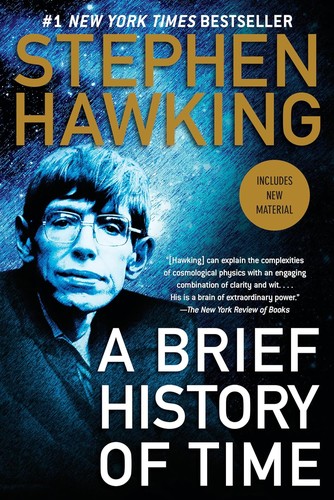
Stephen Hawking's A Brief History of Time (1988) is the book that proved popular science publishing could produce genuine bestsellers. Hawking covers the Big Bang, black holes, the structure of spacetime, quantum mechanics, and the search for a unified theory of everything in a book originally written with the constraint of including only one equation (E=mc2). It sold ten million copies in its first decade and remains the gateway text to cosmology for millions of readers.
The book is harder than its reputation suggests. Hawking assumed a reader who was willing to work through unfamiliar concepts, and some sections, particularly on imaginary time and the no-boundary proposal, require patience. But the section on black holes and the chapter on the arrow of time are among the clearest expositions in popular physics, and the final pages on the nature of a unified theory and what it would mean to "know the mind of God" are as philosophically serious as anything in popular science.
A Brief History of Time by Stephen Hawking is still the standard starting point for anyone who wants to understand how cosmologists think about the universe.
The Man Who Mistook His Wife for a Hat by Oliver Sacks
Oliver Sacks's The Man Who Mistook His Wife for a Hat (1985) is a collection of clinical case studies from his work as a neurologist. Each case illuminates something about how the brain constructs reality, identity, memory, and movement by showing what happens when one component fails. The title case involves a man with visual agnosia who could not recognize objects or faces but could still function through music and other compensatory strategies. Other cases cover phantom limbs, Korsakov's syndrome (the inability to form new memories), Tourette's syndrome, and autism.
Sacks writes with a combination of clinical precision and genuine emotional engagement that makes each case feel like a story rather than a symptom catalogue. The book introduced many general readers to the idea that the self is a construction of neural processes rather than a unitary given, and that examining its failures teaches us more about its normal operation than studying it when intact.
The Gene by Siddhartha Mukherjee

Siddhartha Mukherjee's The Gene (2016) is a history of genetics from Gregor Mendel's pea plants through the Human Genome Project and the CRISPR era. Mukherjee is an oncologist, and his clinical perspective on what genetics means for disease, identity, and human futures gives the book a weight that pure history-of-science accounts lack. He covers the darker episodes, eugenics and forced sterilization programs, as thoroughly as the triumphs.
The chapters on CRISPR and gene editing, written in 2016 when the technology was new, have only grown more relevant. Mukherjee is careful about what current science can and cannot tell us, particularly on the genetics of complex traits like intelligence or personality, and that intellectual honesty makes the more speculative final sections more credible rather than less.
The Disappearing Spoon by Sam Kean
Sam Kean's The Disappearing Spoon (2010) is a history of the periodic table of elements, told through the stories of the scientists who discovered each element and the strange, violent, or comical circumstances in which discoveries were made. The title refers to gallium, a metal that melts at just above room temperature and can be formed into spoons that dissolve in hot tea.
Kean is one of the best popular science writers working, and this is his strongest book. The chapters on the actinides and the political history of plutonium, on the role of specific elements in wars and plagues, and on the scientists whose careers were made or destroyed by their element discoveries are all genuinely engaging. It is the popular science book most likely to make you regret not paying closer attention in chemistry class.
The Order of Time by Carlo Rovelli

Carlo Rovelli appears twice on this list because his second major popular science book, The Order of Time (2017, English 2018), is as good as his first and covers different territory. The subject is the physics of time: why it seems to flow in one direction, why general relativity and quantum mechanics each describe time differently, and what current physics can and cannot tell us about whether time is real or an artifact of our perception.
Rovelli's argument that time as we experience it, a continuous flow from past to future, may be a low-resolution approximation of a deeper reality in which individual events exist without time ordering them, is the kind of claim that sounds mystical but follows directly from current physics. The final section, on what our relationship to time says about consciousness and mortality, is philosophy rather than physics, but Rovelli earns the right to make it by grounding every step of the argument in the science.
Three Popular Science Books to Buy First
- The Selfish Gene by Richard Dawkins. The clearest account of how natural selection actually works. Essential for any serious science reading list and the foundation for understanding most evolutionary biology.
- Seven Brief Lessons on Physics by Carlo Rovelli. Ninety minutes to read, stays with you for years. The best entry point to modern physics for readers who want depth without equations.
- A Brief History of Time by Stephen Hawking. The standard cosmology introduction and one of the most important popular science books ever published. Harder than its reputation, worth the effort.
Reading Order That Works
Start with Seven Brief Lessons on Physics for a fast, high-altitude view of modern physics, then Sapiens for the human story, then The Selfish Gene for evolution as the foundation of biology. A Brief History of Time follows naturally from Seven Brief Lessons for readers who want more depth on cosmology. Stiff and The Man Who Mistook His Wife for a Hat work well as palate cleansers between heavier reads, because both are driven by individual stories rather than cumulative arguments.
Your next good book, in your inbox
We only write when we find a book worth your time. Hand-picked recommendations across history, mythology, true crime and more.
Are you an author?
Get your book in front of readers like these, for free.
- Free book listing →Your own book page with an Amazon button
- Author page →Photo, bio and links to your site
- Featured placement →A spot in our best-of lists, from €29
Free tools we recommend
Get free honest reviewsReview exchange on iWrity, free to join
Books You Might Like
Sapiens: A Brief History of Humankind
Yuval Noah Harari

The Body Keeps the Score
M.D. Bessel van der Kolk

Why We Sleep
Matthew Walker

Astrophysics for People in a Hurry
Neil deGrasse Tyson