Best Spy Fiction Books in 2026: 12 Novels Where Every Ally Is a Suspect and Every Secret Has a Price
Spy fiction contains two completely different arguments about how the world works.
In one version, the world is a place where skilled, loyal agents defend civilization against enemies who want to destroy it. The spy is a hero. The mission has a clear objective. Success is possible and when it comes, it means something.
In the other version, intelligence work is institutionalized deception, and the spy's greatest danger is not the enemy but his own side. The organization is compromised. Loyalty is a mechanism for exploitation. The cold war never ends because the bureaucracy that runs it needs the cold war to justify its own existence.
Ian Fleming built the first version. John le Carré spent his career demolishing it.
Both versions produced great fiction. Here are 12 of the best spy novels, covering both visions and the territory between them.
Le Carré's World
1. Tinker Tailor Soldier Spy by John le Carré
The masterpiece. George Smiley, retired after being forced out of British intelligence, is brought back to investigate a suspicion: there is a Soviet mole at the top of the Circus. The novel is slow, intricate, and emotionally devastating. Le Carré writes about the spy world as a place of institutional decay where every relationship is potentially false and loyalty is the first thing traded away. The plot requires attention, but it pays back every bit of it.
2. The Spy Who Came in from the Cold by John le Carré
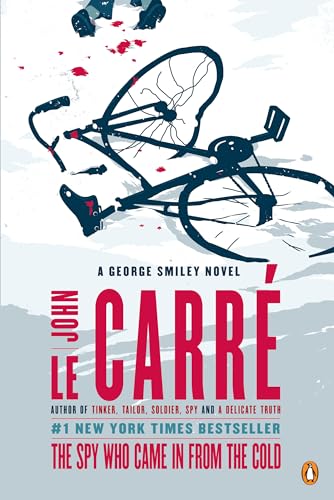
Le Carré's breakthrough novel and still his most purely constructed. A burned-out British agent accepts one last operation: to be fed to the East Germans as a double agent. The ending is one of the best in 20th-century fiction. Where Tinker Tailor is about institutional compromise, this is about what it costs an individual to do what intelligence services require.
The Fleming Tradition
3. Casino Royale by Ian Fleming
The first Bond novel is also the best. Bond is sent to break a Soviet paymaster at baccarat. The premise is absurd, but Fleming's prose is vivid and the novel contains a surprisingly dark ending that the film series largely ignored. Fleming is not trying to be le Carré. He is writing wish fulfillment with real craft: the right car, the right food, the right woman, a clear enemy, and a hero who wins. Casino Royale is the purest expression of that project.
Between the Two Traditions
4. The Quiet American by Graham Greene
Greene's novel is set in Vietnam in the early 1950s, before the American war. The narrator is a British journalist. The title character is a young American idealist working for a CIA predecessor organization. The novel is about what happens when idealism meets the actual consequences of covert action. Prescient, morally complex, and better written than almost anything in the spy genre.
5. The IPCRESS File by Len Deighton
Deighton's unnamed narrator works for a budget intelligence outfit in London and is neither suave nor invincible. The IPCRESS File is a procedural: filing forms, navigating bureaucracy, and doing the unglamorous work of intelligence collection. Deighton writes with wit and a sharp eye for class. The thriller mechanics are excellent and the London atmosphere is definitive.
6. The Tears of Autumn by Charles McCarry
McCarry worked for the CIA for a decade before he wrote fiction. His Paul Christopher novels are the most realistic American spy fiction: operational detail, institutional politics, and moral exhaustion that comes from actual experience rather than research. The Tears of Autumn is the best of them: Christopher investigates the Kennedy assassination and finds a trail that leads to an unexpected place. The ending is not a conspiracy thriller ending. It is something more disturbing.
Historical Espionage
7. Night Soldiers by Alan Furst
Furst's first major novel follows a young Bulgarian man from 1934 through the Second World War, drawn into the Soviet intelligence apparatus and then the French resistance. Furst is the best living writer of WWII-era espionage fiction. He gets the period atmosphere exactly right: the paranoia, the improvisation, the grinding uncertainty of resistance work. Night Soldiers is where to start.
8. The Day of the Jackal by Frederick Forsyth
Forsyth's debut novel is a procedural about an attempt to assassinate Charles de Gaulle, told from both the assassin's perspective and the French investigator pursuing him. The novel's achievement is that it maintains tension despite the reader knowing de Gaulle survived. The operational detail is meticulous and the pace is relentless. A template for every procedural thriller written in the 40 years since.
Modern Espionage
9. Red Sparrow by Jason Matthews
Matthews spent 33 years in the CIA before writing this novel. His protagonist is a Russian SVR officer trained as a sparrow: an agent who uses sexual manipulation as an intelligence tool. The CIA counterpart is her handler. Matthews builds real tradecraft into the narrative, including a recipe section at the end of each chapter (a detail that sounds gimmicky but actually reinforces the novel's themes about cover identities and daily life as performance).
10. The Kill Artist by Daniel Silva
Silva's Gabriel Allon series follows an Israeli art restorer who is also a Mossad assassin. The first novel establishes the character: Allon is called back for one more operation targeting a Palestinian terrorist. Silva writes with real knowledge of Israeli intelligence and Middle Eastern politics. The Allon series spans 20+ novels but The Kill Artist is the clean entry point.
11. American Assassin by Vince Flynn
Flynn's Mitch Rapp is the American counterpart to Allon: a CIA operative trained for targeted assassination. American Assassin is the origin story, showing Rapp's recruitment and early training. Flynn writes pure thriller: fast, violent, ideologically uncomplicated. If le Carré represents one end of the spy fiction spectrum and Fleming another, Flynn is somewhere past Fleming. The appeal is not moral complexity but the fantasy of competence and decisive action.
The One That Defies Category
12. The Infernal Library by Daniel Kalder
Not a thriller but essential context for anyone who wants to understand what intelligence services are actually fighting over. Kalder examines the books written by totalitarian dictators: Lenin, Stalin, Hitler, Mussolini, Mao, and others. The argument is that these texts were tools of power, not just ideology, and that controlling the canonical texts of a movement is itself a form of intelligence operation. Unusual, provocative, and illuminating.
Which Version Do You Want?
Le Carré's world is the more honest one, probably. Real intelligence services are bureaucracies with all the dysfunction that implies, populated by people whose loyalty is divided and whose information is always incomplete.
Fleming's world is more fun. Bond always knows who the enemy is, always has the resources to confront them, and always wins.
Most readers want both at different times. The books on this list cover the full range, from Kalder's cultural analysis to Flynn's straightforward action. Start with Tinker Tailor Soldier Spy if you want to understand why spy fiction matters as literature. Start with Casino Royale if you want to understand why it sells.
Your next good book, in your inbox
We only write when we find a book worth your time. Hand-picked recommendations across history, mythology, true crime and more.
Are you an author?
Get your book in front of readers like these, for free.
- Free book listing →Your own book page with an Amazon button
- Author page →Photo, bio and links to your site
- Featured placement →A spot in our best-of lists, from €29
Free tools we recommend
Get free honest reviewsReview exchange on iWrity, free to join
Books You Might Like

It Ends with Us: A Novel
Colleen Hoover

The Seven Husbands of Evelyn Hugo: A Novel
Taylor Jenkins Reid

The Song of Achilles
Madeline Miller

Educated: A Memoir
Tara Westover