Best War Fiction Books 2026: Stories of Conflict
War fiction doesn't glorify war. The best novels in the genre do the opposite. They show what combat does to people who experience it, how institutions demand sacrifice, and how quickly moral clarity disappears once the shooting starts.
The best war fiction comes from writers who've thought seriously about power, loyalty, and duty. Some have experienced combat. Others have spent years researching it. What unites them is refusal to simplify. War fiction for adults doesn't divide the world into heroes and villains.
What War Fiction Provides
War fiction does things history books can't. It lets you inhabit a soldier's thoughts for hours. It shows you decisions made under incomplete information with lives depending on the outcome. It captures not just the logic of war but its texture, the small exhausting details that shape how people survive it.
Reading war fiction also calibrates your response to actual conflicts. When real wars happen, the narratives offered are often simplified for political purposes. Reading novels that honor complexity gives you resistance to propaganda.
The Best War Fiction Books
All Quiet on the Western Front by Erich Maria Remarque
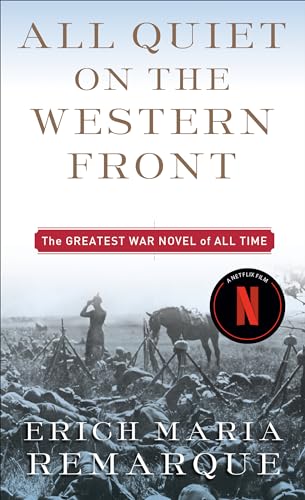
This novel follows a group of German soldiers from 1916 through the end of World War One. Remarque fought in the trenches himself. That experience shows in every scene. The book doesn't attack war through argument. It shows what trench warfare actually is: waiting, cold, noise, sudden death, and the grinding casualty of resources wearing down youth.
What makes this book essential is how it avoids "our side" thinking. These are German soldiers, not villains. They didn't start the war. They're caught in it. By making you care about characters on the "enemy" side, Remarque does something propaganda can't touch. He makes you understand that every human casualty in war matters equally.
The novel predates World War Two but predicted the brutality of mechanized conflict. Read it and you understand why conscription in industrial war became genocide.
Find All Quiet on the Western Front on Amazon
Catch-22 by Joseph Heller
Heller's novel uses dark comedy to capture World War Two from the perspective of American pilots. The genius is how he makes you laugh while describing absurdity that kills people. The rules don't make sense. The enemy is sometimes your own command. Insanity is rewarded and sanity is punished.
The novel's structure circles around a central logical trap (Catch-22 itself) that traps soldiers in impossible dilemmas. Ask for a medical discharge from flying missions and you're proving you're sane enough to fly. The book is both hilarious and devastating because it shows how institutions can become self-perpetuating mechanisms that grind individual lives into nothing.
Heller didn't write this as social commentary. He wrote it as testimony. Catch-22 showed readers what it felt like to be trapped in a war machine's logic.
Maus by Art Spiegelman
Maus is a graphic novel, not traditional fiction, but it deserves inclusion because it's one of the most powerful war narratives ever created. Spiegelman documents his father's experience as a Polish Jew during the Holocaust. The book moves between the father's wartime testimony and the son's present-day struggle to understand it.
What makes Maus essential is how it refuses to distance the reader from horror. The comics form brings you into the experience directly. You're not reading about atrocity. You're watching it unfold.
The book is also proof that war fiction isn't only about conventional combat. The Holocaust was industrial murder, and documenting it requires different narrative structures than trench warfare or air combat. Spiegelman finds that structure.
The Killer Angels by Michael Shaara
Shaara's novel reconstructs the Battle of Gettysburg from multiple perspectives: Union and Confederate officers, enlisted soldiers, support staff. The genius is that he doesn't fake impartiality. These were men fighting for different causes. But they were also men, and Shaara shows you their reasoning, courage, and fear without siding with either.
The book moves slowly, following three days of battle with enormous detail. That pace forces you to experience the strain. You feel the exhaustion because you're living through the same hours the soldiers are.
This novel proves that war fiction doesn't need to attack war. It just needs to show war truthfully. When readers understand what actually happens in battle, they draw their own conclusions.
Find The Killer Angels on Amazon
The Things They Carried by Tim O'Brien

O'Brien's book is fiction shaped like a personal essay collection. The narrator is a Vietnam veteran who may or may not be O'Brien himself. The stories may or may not be "true" in the conventional sense. But they're truthful about what Vietnam did to those who fought in it.
O'Brien blurs the line between fiction and memoir because he's arguing something radical: the emotional truth matters more than factual accuracy. A story that captures how it felt might be more true than a documentary account of what happened.
This book asks readers to think seriously about what fiction is for. It's not a novel, exactly. It's an argument disguised as a fiction in order to make the argument more powerful.
Slaughterhouse-Five by Kurt Vonnegut
Vonnegut's novel follows an American soldier through World War Two, including the bombing of Dresden. The narrative jumps through time, mixing personal history with science fiction, philosophical commentary, and dark comedy. It's a war novel that becomes something larger.
The book's central thesis appears in its famous refrain: "So it goes." After each death, no matter how brief the mention, that phrase appears. By the end, you've read it hundreds of times. Vonnegut is saying something about the accumulation of death, about how casualty statistics numb us.
Slaughterhouse-Five shows that war fiction doesn't have to be realistic to be true. Vonnegut's science fiction elements (the aliens, the time-travel) actually capture something real about how trauma works: your mind doesn't experience events in sequence.
What These Novels Share
The best war fiction has several traits. First, it respects the intelligence of readers and the dignity of soldiers. It doesn't patronize. Second, it acknowledges moral ambiguity. War isn't a simple story of good versus evil. Third, it shows consequences. War doesn't end when the peace treaty is signed.
Fourth, these novels all employ different narrative strategies. There's no single "right" way to tell a war story. Fiction can use comedy, fragmentation, documentation, or realism. Each technique illuminates different aspects of conflict.
Why War Fiction Matters
War feels abstract until you've read fiction that makes it visceral. Abstract harm is easy to ignore. Suffering narrated in detail is harder to dismiss. That's not manipulation. That's the whole point.
Reading war fiction also documents what war actually costs. When politicians discuss military action, they rarely talk about what happens to individual humans involved. War fiction insists on that accounting.
Where to Start
If you haven't read war fiction before, start with Catch-22 or All Quiet on the Western Front. Both are accessible and powerful. If you want something more experimental, try Slaughterhouse-Five or The Things They Carried.
The novels above span a century and multiple conflicts. They disagree about war's meaning. That conversation is worth joining.
Your next good book, in your inbox
We only write when we find a book worth your time. Hand-picked recommendations across history, mythology, true crime and more.
Are you an author?
Get your book in front of readers like these, for free.
- Free book listing →Your own book page with an Amazon button
- Author page →Photo, bio and links to your site
- Featured placement →A spot in our best-of lists, from €29
Free tools we recommend
Get free honest reviewsReview exchange on iWrity, free to join
Books You Might Like

It Ends with Us: A Novel
Colleen Hoover

The Seven Husbands of Evelyn Hugo: A Novel
Taylor Jenkins Reid

The Song of Achilles
Madeline Miller

Educated: A Memoir
Tara Westover