The Dark Psychology of Cults: How They Recruit, Control, and Trap Members (2026)
What Makes a Cult Different From a Religion?
The word "cult" gets thrown around loosely, but psychologists and sociologists use it carefully. The distinction between a high-control group and a legitimate religious movement comes down to a few core elements: isolation, unconditional deference to a leader, suppression of critical thinking, and the systematic use of shame and fear to keep members in line.
Most cults do not announce themselves as cults. They present as communities, spiritual movements, self-improvement programs, or political organizations. The recruitment pitch is almost always built around belonging, purpose, and a promise that the outside world cannot offer what the group can. By the time new members realize what they have joined, the psychological hooks are already deep.
The Recruitment Process
Cult recruitment rarely targets the desperate or the disturbed, despite the popular image. Research consistently shows that highly educated, socially connected, and emotionally intelligent people are just as likely to be recruited. Cults look for people in transition: recent graduates, people who have just moved to a new city, those who have recently lost a relationship or a job.
The first contact is called "love bombing." New recruits are showered with warmth, attention, and validation. They are made to feel uniquely understood. This is not accidental kindness. It is a calculated technique designed to create emotional dependency before any demands are made. Once a recruit feels genuinely loved by the group, they are far more reluctant to leave, even when red flags appear.
After love bombing comes gradual escalation. Requests start small. Attend one more meeting. Read this text. Avoid spending time with people who "don't understand" your new path. Each step feels reasonable in isolation. By the time the demands become extreme, the recruit has already reorganized their life around the group's approval.
Thought Control and Information Management
Sociologist Robert Lifton identified eight criteria for what he called "thought reform" in his landmark 1961 study of Chinese Communist re-education programs. Many of these criteria map directly onto how cults operate.
The most important is milieu control: the systematic management of the environment and communication. Cults control what members read, who they speak to, how much sleep they get, and what language they use. Many high-control groups develop their own vocabulary, a coded language that reinforces group identity and makes outside communication harder. When you can only fully express your thoughts in a language that non-members do not speak, leaving becomes linguistically disorienting as well as emotionally terrifying.
Confession is another tool. Many cults require members to confess doubts, sins, or outside relationships to leaders. This creates a detailed dossier of vulnerabilities that can be used as leverage if a member attempts to leave. It also generates shame, which is one of the most effective control mechanisms in human psychology.
The Role of the Leader
Most destructive cults organize around a single charismatic figure who claims special access to truth, God, or enlightenment. The leader is typically positioned beyond criticism. Any doubt about the leader's judgment is reframed as a personal spiritual failing in the doubter, not evidence of the leader's wrongdoing.
This dynamic has played out repeatedly. Jim Jones convinced over 900 people to die in Jonestown, Guyana in 1978. David Koresh led the Branch Davidians to a catastrophic standoff in Waco, Texas in 1993. Keith Raniere, leader of NXIVM, built a sex trafficking operation disguised as a self-improvement seminar series. In each case, the leader cultivated an atmosphere where questioning them was treated as a form of betrayal or spiritual weakness.
The psychological mechanism here is called "loaded language" combined with "sacred science." The leader's worldview is presented not as one interpretation among many, but as the only correct understanding of reality. Anyone who disagrees is either not yet enlightened or is an enemy of the group. There is no middle ground.
Why Leaving Is So Hard
People outside cults often ask why members do not simply leave. The question misunderstands the psychological situation. By the time someone has been fully integrated into a high-control group, their entire social network is inside it. Their family relationships have often been severed or severely damaged. Their professional identity may be tied to the group. Their sense of meaning, purpose, and self-worth has been reconstructed around the group's narrative.
Leaving means losing everything at once: friends, community, purpose, and often housing and employment. It also means confronting the possibility that months or years of your life were built on a lie, which is one of the most psychologically painful realizations a person can face.
Fear is also a significant factor. Many cults explicitly or implicitly threaten members who leave. The threat may be spiritual (eternal damnation, bad karma), social (members will be instructed to shun you), or in some cases physical. Former members of Scientology, for example, have documented a practice called "fair game" in which critics of the organization are subjected to harassment campaigns.
Recovery After a Cult
Cult recovery is a long process. Therapists who specialize in this area note that former members often experience symptoms similar to PTSD: intrusive memories, difficulty trusting their own judgment, social anxiety, and what some call "floating," where cult-specific thought patterns re-emerge involuntarily during stress.
One of the hardest parts of recovery is rebuilding the capacity for independent thought. Cults systematically undermine this capacity. Members are trained to distrust their own perceptions and defer to the group's interpretation of events. Undoing that training takes time and usually requires professional support.
Support networks of former members have become an important resource. Organizations like Cult Education Institute and the International Cultic Studies Association provide information and community for people trying to understand what happened to them. Peer support from people who have had similar experiences can be uniquely validating in a way that outside therapy sometimes cannot match.
The Cults You Have Never Heard Of
Jonestown and the Branch Davidians dominate public memory, but the landscape of high-control groups is far broader. Many operate quietly for decades without attracting major media attention.
The Word of Faith Fellowship in North Carolina was exposed in 2017 after a decade of investigation. Members reported severe physical abuse of children, forced labor, and the "blasting" ritual in which members would scream at each other to drive out demonic influence. The group had operated openly in a small town for decades with local knowledge of its practices.
The Two by Twos, also known as "The Truth" or "The Way," is a Christian sect with an estimated 100,000 members worldwide. It has no formal name, no published literature, and no online presence by design. Former members describe a high-control environment with significant pressure to remain silent about group practices.
Many corporate environments and multi-level marketing companies have also been analyzed using cult psychology frameworks. The tactics are the same: love bombing during recruitment, isolation from skeptical family members, the use of loaded language, and the suppression of doubt.
What the Research Tells Us
Psychologist Margaret Singer spent decades interviewing former cult members and documenting the patterns of manipulation they experienced. Her work, along with Lifton's, forms the foundation of what we now understand about thought reform and undue influence.
Singer identified a central paradox: the more intelligent and curious a person is, the more susceptible they may be to sophisticated cult recruitment, because they engage more deeply with the intellectual framework the cult provides. Cults often offer elaborate cosmologies, detailed ethical systems, and rich communities of practice. For someone looking for meaning and structure, this can be genuinely compelling before the control mechanisms fully activate.
Understanding cult psychology is not just about protecting yourself from joining one. It is about recognizing how susceptible human beings are to manipulation when our need for belonging, meaning, and certainty is expertly exploited. The mechanisms cults use are not exotic or alien. They are extensions of normal social dynamics, pushed to destructive extremes.
That is what makes them so difficult to see from the inside, and so important to understand from the outside.
Where to Read More
If you want to go deeper into the psychology and sociology of cults, the best books about cults gives a full ranked reading list covering everything from academic psychology (Robert Lifton's Thought Reform) to survivor memoirs (Seductive Poison, Educated). For the manipulation techniques that overlap between cult psychology and everyday life, the best books about manipulation covers the full spectrum from academic social psychology to practical guides to recognizing coercive control. The broader dark psychology cluster, including psychopathy, coercive control, and the science of deception, is covered in the best dark psychology books reading list. Browse the full psychology collection for related reading.
Your next good book, in your inbox
We only write when we find a book worth your time. Hand-picked recommendations across history, mythology, true crime and more.
Books You Might Like
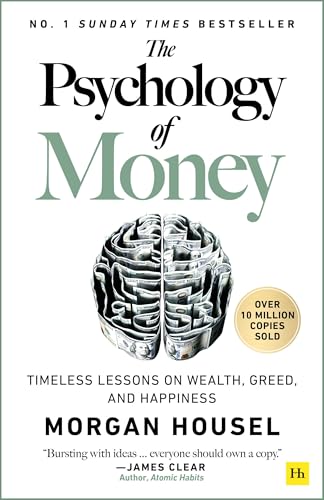
The Psychology of Money
Morgan Housel

Thinking, Fast and Slow
Daniel Kahneman

Man's Search for Meaning
Viktor E. Frankl

The Body Keeps the Score
M.D. Bessel van der Kolk