8 Best Norse Mythology Books for Beginners: The Right Reading Order (2026)
Most people searching for norse mythology books for beginners end up buying one of the Eddas first, give up after twenty pages, and assume the problem is them. It isn't. The Prose Edda and Poetic Edda were written for medieval Icelanders who already knew the stories by heart. They are bad first books for exactly the same reason a sermon is a bad way to learn what a church believes: you need the basics first.
The right reading order starts with a modern retelling, moves through one accessible scholarly overview, and only then opens the medieval sources. Below is a list built around that order. At Skriuwer we rank books by verified Amazon review count, so the titles below are the ones real readers keep buying, not the ones a marketing team pushed in front of a critic. As of May 2026, Neil Gaiman's Norse Mythology has crossed 80,000 Amazon reviews, which makes it by some distance the most-purchased English language Norse mythology title in print, and the strongest single-book starting recommendation. For the full pillar list, see our newer guide to the best Norse mythology books.
Start Here: The Best Modern Retellings
A retelling is a 21st-century author taking the surviving Norse stories and rewriting them in modern English with the gaps filled in. Retellings are not the original myth, but they are by far the easiest way to learn the cast, the cosmology, and the major plot arcs.
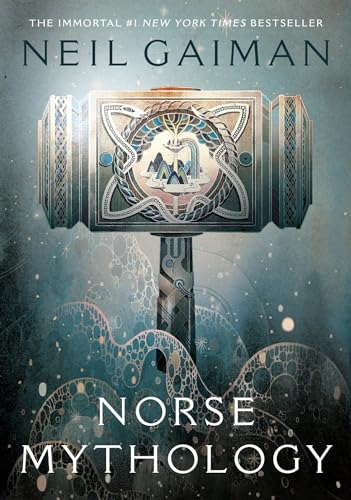
1. Norse Mythology by Neil Gaiman
This is the book that turns more newcomers into Norse mythology readers than any other in print. Gaiman covers the creation of the world, the building of Asgard, the theft of Mjolnir, the death of Baldur, and Ragnarok. He sticks closely to the source material while telling the stories with the pacing of a novelist. If you have only one afternoon, read this.
Best for: Total beginners. Readers who liked American Gods. Anyone who has tried the Eddas and quit.
2. D'Aulaires' Book of Norse Myths
Marketed as a children's book and used in classrooms for decades, the D'Aulaires volume is one of the best illustrated introductions for any age. The drawings show you what the Norse pantheon looks like in a way no text-only book can. Adults end up recommending it as often as parents do.
Best for: Visual learners. Parents reading aloud. Adults who want the entire pantheon mapped in a single weekend.
The Best Scholarly Introductions for Beginners
Once you know the stories, you want context: who actually believed this, when, where, and how do we know? These three books answer that without burying you in citations.
3. The Viking Spirit by Daniel McCoy
McCoy runs the website Norse Mythology for Smart People, and his book is the result of years of writing accessible scholarship for non-specialists. He retells 34 myths and gives you a comprehensive overview of Viking religion as a lived practice, not just a literature. It bridges the gap between Gaiman and the Eddas better than any other single book.
Best for: Readers who finished Gaiman and want to know what the Norse actually believed.
4. Gods and Myths of Northern Europe by H.R. Ellis Davidson
Davidson was one of the foremost 20th-century scholars of Norse and Germanic religion. This 1964 paperback is still in print because nothing has replaced it as a single-volume scholarly introduction. The writing is dense compared to Gaiman, but it remains accessible to a motivated general reader and gives you the historical and archaeological context the retellings skip.
Best for: Readers who want to understand the religion, not just the stories.
5. Norse Mythology: A Guide to Gods, Heroes, Rituals, and Beliefs by John Lindow
Lindow organised this book as an encyclopedia with extended thematic essays. Look up Odin, Loki, or Ragnarok, and you get a multi-page entry with sources. Use it as a reference alongside any of the retellings.
Best for: Readers who want a single reference to keep on the shelf.
The Medieval Sources, in the Translations That Actually Read Well
Eventually you want to read the originals. The trick is picking the right translation. The wrong translation makes Norse mythology sound like a Victorian children's book; the right one preserves the strangeness and the bite.
6. The Poetic Edda, translated by Jackson Crawford
Crawford is the translator most beginners should read first. His version is in plain modern American English, with an introduction that walks you through what you are about to read. The poems are the oldest surviving source for Norse mythology and the foundation for nearly everything else on this list.
Best for: Readers ready for primary sources but not yet ready for academic translations.
7. The Poetic Edda, translated by Carolyne Larrington
The Oxford World's Classics edition. More literal than Crawford, with the most useful set of notes for a beginner. Pick this one if you want scholarly apparatus alongside the text.
Best for: Readers who want footnotes and context with every poem.
8. The Prose Edda, translated by Jesse Byock
The Prose Edda is the textbook Snorri Sturluson wrote in the early 13th century to teach Icelandic poets the old myths. It is short (around 100 pages), readable, and the single most influential source on Norse mythology in print. The Byock Penguin Classics edition is the one most reading lists recommend.
Best for: Readers who want the most quoted source on Norse mythology in a translation that does not get in the way.
How to Read Norse Mythology in the Right Order
- Read Gaiman's Norse Mythology or the D'Aulaires book first. You need the cast.
- Then McCoy's The Viking Spirit for the religious context.
- Then either Crawford or Larrington's Poetic Edda.
- Then Byock's Prose Edda.
- Then branch into Davidson or Lindow depending on whether you want history or reference.
This is the order most experienced readers wish someone had handed them on day one.
Three Norse Mythology Books Worth Buying Today
- Norse Mythology by Neil Gaiman — the modern retelling that has turned more readers into Norse mythology fans than any other book in print.
- The Poetic Edda translated by Jackson Crawford — the most readable English translation of the foundational source text for Norse mythology.
- The Prose Edda translated by Jesse Byock — Snorri Sturluson's 13th-century overview in a Penguin Classics edition designed for general readers.
For the full ranked list of Norse and Viking books by verified Amazon review count, see our mythology books collection. Once you have the basics, our Celtic mythology guide and Greek mythology guide are natural next reads, and our guide to the best Viking books covers the Viking Age that produced these myths.
Your next good book, in your inbox
We only write when we find a book worth your time. Hand-picked recommendations across history, mythology, true crime and more.
Books You Might Like

The Song of Achilles
Madeline Miller

Circe
Madeline Miller
Norse Mythology
Neil Gaiman

Heroes
Unknown Author