Best Banned Books of All Time: 10 Classics That Someone Didn't Want You to Read
A banned book is a document of anxiety. Someone, somewhere, with some kind of authority, decided that this particular text was dangerous enough to suppress. The history of literary censorship is a map of what every era most feared: sexual autonomy, political dissent, religious doubt, uncomfortable truths about how power works. The novels below were all banned, prosecuted, burned, or forcibly suppressed at some point in their histories. Most of them are now considered among the greatest works in their respective languages. That gap between condemnation and canonisation is the thing worth understanding.
At Skriuwer we rank books by verified reader review counts and sustained placement on critical and academic reading lists. These are the banned books that readers keep returning to, not just the ones with the most notorious banning stories. For more on the history and mechanics of literary censorship, our existing guide on why books get banned covers the institutional and political side. For specific examples from history, our most banned books in history article covers the broader list.
The Most Discussed Banned Novel in the English Language
1. Lolita by Vladimir Nabokov
Humbert Humbert, a European intellectual, becomes obsessed with his landlady's twelve-year-old daughter and becomes her stepfather in order to remain close to her. Nabokov wrote the novel in English (his third language), had it rejected by five American publishers, published it with the Olympia Press in Paris in 1955, and watched it become a scandal and then a masterpiece. The novel is disturbing by design: Nabokov gives Humbert the most beautiful prose voice in the novel's world, then carefully undermines him throughout until the final pages force the reader to see exactly what Humbert has done. It is a technically extraordinary book about an unambiguously evil man, and the discomfort of reading it is part of the argument.
Best for: Readers who want to engage with the most argued-over question in twentieth-century literary censorship: can a beautiful novel have an evil narrator, and if so, what is the reader's responsibility?
Lolita by Vladimir Nabokov on Amazon
The Obscenity Trials: Sex and the Law
Several of the most important banned books were banned specifically for sexual content, and their legal trials reshaped what publishers could print in the English-speaking world.
2. Lady Chatterley's Lover by D.H. Lawrence
Constance Chatterley, married to a paralysed aristocrat, has an affair with the gamekeeper Mellors. Lawrence uses the affair as a critique of class, industrialism, and the repression of the body. The novel was privately printed in 1928 and not legally published in the UK until the 1960 obscenity trial, which the prosecution famously lost when E.M. Forster, Rebecca West, and dozens of other writers testified for the defence. The trial effectively ended the prosecution of literary fiction for obscenity in Britain.
Best for: Readers interested in how literary censorship actually gets contested in court. The novel itself is a more serious piece of social criticism than its notoriety suggests.
Lady Chatterley's Lover by D.H. Lawrence on Amazon
3. Tropic of Cancer by Henry Miller
Miller's autobiographical account of being broke, hungry, and intermittently employed in Paris in the early 1930s. The novel was published in Paris in 1934, banned in the United States and Britain for twenty-five years, and finally published in the US by Grove Press in 1961, triggering another string of obscenity prosecutions in individual American states. The Supreme Court ruled in Grove Press's favour in 1964. Miller's prose is raw, funny, and occasionally tedious in the way that the best diary-form writing can be.
Best for: Readers interested in the American expatriate literary tradition and the history of obscenity law in the United States.
4. Howl and Other Poems by Allen Ginsberg
Ginsberg's long poem, first performed in San Francisco in 1955, opens: "I saw the best minds of my generation destroyed by madness, starving hysterical naked." City Lights Books published it in 1956; customs officials seized copies entering the US; the publisher Lawrence Ferlinghetti was arrested for obscenity. The trial acquitted him, established that literary merit was a valid defence against obscenity charges in California, and made the poem one of the most famous in American literature. The poem itself is a genuine literary achievement: a lamentation for a generation that the post-war American settlement had no room for.
Best for: Readers interested in the Beat Generation and the first-amendment literary history of the United States.
Howl and Other Poems by Allen Ginsberg on Amazon
The Political Bans: State Suppression
5. The Satanic Verses by Salman Rushdie
Two Indian actors survive a plane bombing and develop supernatural qualities. Rushdie's fourth novel uses dream sequences to interrogate the origins of Islam and the nature of revelation. Published in 1988, it was banned in India within weeks, then in several other countries with significant Muslim populations. In 1989 the Ayatollah Khomeini issued a fatwa calling for Rushdie's death. Rushdie lived in hiding under police protection for nine years, and several translators and publishers were attacked or killed. In 2022, a man stabbed Rushdie on stage in New York, leaving him partially blind. The novel itself is a major work of postcolonial literature.
Best for: Readers who want to understand the most politically consequential literary banning of the twentieth century. Read alongside Rushdie's memoir Joseph Anton for the personal account of the years in hiding.
The Modernist Difficulties: Form as Transgression
6. Ulysses by James Joyce
Leopold Bloom, his wife Molly, and the young Stephen Dedalus move through Dublin on a single day in June 1904. Joyce maps their day onto Homer's Odyssey, uses every stream-of-consciousness technique then available, and ends with Molly Bloom's 40-page unpunctuated soliloquy, one of the most sustained passages of interior monologue in fiction. Serialised in The Little Review from 1918 and declared obscene by a New York court in 1921, the novel was published in book form in Paris in 1922 by Sylvia Beach and not legally available in the United States until 1934.
Best for: Readers who are willing to work. Ulysses rewards patience; the Molly Bloom chapter alone justifies the effort. Use an annotated edition on first read.
The Nineteenth-Century Prosecutions: Morality and Realism
7. Madame Bovary by Gustave Flaubert
Emma Bovary, a doctor's wife in provincial Normandy, has two affairs and accumulates debts trying to live up to the romantic novels she has consumed all her life. Flaubert and his publisher were prosecuted for obscenity and offence against public morals in 1857, the same year as the prosecution of Baudelaire's Les Fleurs du Mal. Both were acquitted, but the prosecutions confirmed Flaubert's status as an enemy of bourgeois complacency. The novel is the foundational text of literary realism and remains one of the most precisely written novels in any language.
Best for: Readers who want the novel that modern realist fiction is built on. The Geoffrey Wall translation (Penguin Classics) is the standard English-language edition.
Three More Titles Worth Reading
8. The Well of Loneliness by Radclyffe Hall
Published in 1928, banned in Britain immediately. The novel is a sympathetic portrait of a lesbian woman, Stephen Gordon, from childhood through adulthood. It does not contain explicit sex; it was banned because it treated homosexuality as natural rather than deviant. The British ban was overturned in 1949. Radclyffe Hall's book is the founding text of twentieth-century lesbian literature in English.
9. 1984 by George Orwell

Not as widely banned as the others on this list, but consistently challenged, removed from school curricula, and suppressed in authoritarian states. Orwell wrote it in 1948, dying of tuberculosis while he finished it, and it was published in 1949. It has been on challenged-books lists in the United States every decade since. The novel invented the vocabulary of surveillance culture: Big Brother, doublethink, the memory hole, unperson.
10. Brave New World by Aldous Huxley
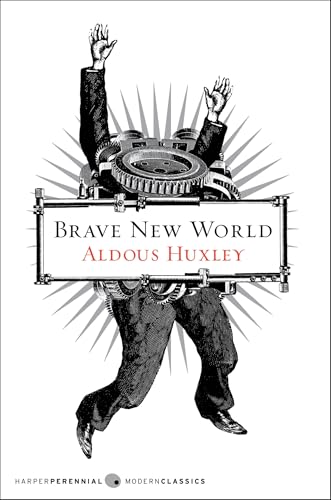
Banned in Ireland on publication in 1932, challenged repeatedly in American schools and libraries ever since. Huxley's dystopia is often paired with 1984 but works differently: where Orwell imagines a society that controls through pain and fear, Huxley imagines one that controls through pleasure and comfort. The question of which is the more accurate prediction has been argued about ever since.
What Banned Books Have in Common
The books on this list were banned for different reasons: sexual content (Lawrence, Miller, Hall), political content (Rushdie, Orwell), religious offence (The Satanic Verses), formal difficulty (Joyce), and the depiction of criminal psychology (Nabokov). What they share is that they all pushed against the boundary of what their era's dominant institutions could tolerate. That is not a coincidence. The best literature tends to go where received wisdom would rather it did not.
Three Banned Classics to Buy Today
- Lolita by Vladimir Nabokov, the most technically accomplished and most argued-about banned novel in English.
- Lady Chatterley's Lover by D.H. Lawrence, the novel whose obscenity trial changed British publishing law.
- Howl and Other Poems by Allen Ginsberg, the poem whose trial set the precedent for literary merit as a defence against obscenity charges in the United States.
For more on how and why books get censored, see our full guide on why books are banned. For the Russian literary tradition that produced Nabokov and Bulgakov, see our guide to the best Russian literature books. For the broader history of ideas that censorship has tried to suppress, browse the Skriuwer history and culture collection.
Your next good book, in your inbox
We only write when we find a book worth your time. Hand-picked recommendations across history, mythology, true crime and more.
Are you an author?
Get your book in front of readers like these, for free.
- Free book listing →Your own book page with an Amazon button
- Author page →Photo, bio and links to your site
- Featured placement →A spot in our best-of lists, from €29
Free tools we recommend
Get free honest reviewsReview exchange on iWrity, free to join
Books You Might Like

It Ends with Us: A Novel
Colleen Hoover

The Seven Husbands of Evelyn Hugo: A Novel
Taylor Jenkins Reid

The Song of Achilles
Madeline Miller
