10 Best Books About MK-Ultra and CIA Mind Control (Ranked by Source Quality, 2026)
The CIA destroyed most of the MK-Ultra files in 1973. What survived is a paper trail of 20,000 financial documents that an FOIA request pulled out of a misfiled archive in 1977. That fragment of evidence is what every serious book on the topic builds from, alongside Senate hearings, court depositions, and the personal testimonies of victims who were dosed with LSD, hypnotized, deprived of sleep, and in at least one documented case, killed.
If you want to understand MK-Ultra without leaning on YouTube speculation, the book-length investigations below are where to start. They share three things: real archival sourcing, named operatives (Sidney Gottlieb, Frank Olson, George Hunter White), and an unwillingness to flinch from what the program actually did. For more in this vein, see our conspiracy book collection or the broader dark history list. If the everyday, interpersonal version of these coercion techniques interests you more than the state-level program, our guide to the best books about manipulation covers how to recognize and defend against it.
1. Poisoner in Chief by Stephen Kinzer
The closest thing to a definitive biography of Sidney Gottlieb, the CIA chemist who ran MK-Ultra from 1953 to 1964. Kinzer worked as a New York Times foreign correspondent for two decades, and that reporting instinct shows on every page. He tracks Gottlieb from the Bronx to Fort Detrick to the rural Virginia farmhouse where Gottlieb retired and grew vegetables after authorizing experiments that broke human minds.
Kinzer is careful: where the evidence runs out, he says so. Where it does not, he is unsparing. The chapter on the death of Frank Olson, a CIA biochemist who fell from a hotel window in 1953 nine days after being secretly dosed with LSD, is one of the most clinical pieces of investigative writing on the program ever published.
2. The Search for the Manchurian Candidate by John Marks
John Marks is the journalist who filed the 1977 FOIA request that surfaced the financial records. His book, published in 1979, is the first full-length account of MK-Ultra written with the original documents in hand. Almost every later book on the topic borrows from his framing.
What makes this book hold up nearly fifty years later is its restraint. Marks does not speculate about whether the CIA succeeded in creating a real-world Manchurian Candidate. He shows what they tried, who they paid, where the money went, and what happened to the test subjects. The full text is also available free online through the CIA's reading room, which is itself an interesting choice of declassification.
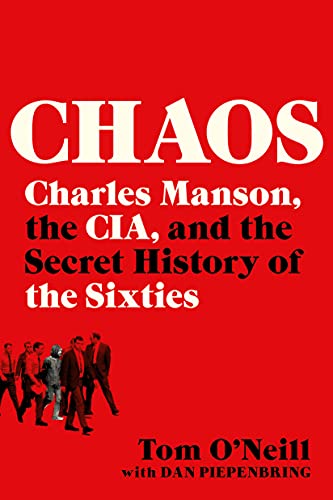
3. Chaos: Charles Manson, the CIA, and the Secret History of the Sixties by Tom O'Neill
Twenty years of reporting compressed into one book. O'Neill set out to write a magazine piece about the Manson murders for the 30th anniversary, got pulled into the gap between the official narrative and the case files, and never came back. Chaos is the result of obsession turning into a methodology.
The MK-Ultra material sits inside a wider argument: that the prosecutor's case at trial was built around a story (Helter Skelter) that did not match the evidence, and that the question of why Manson's parole officer kept letting him violate the terms of his release is one the FBI files never quite answer. O'Neill names names. The book runs to 500 pages and reads like a thriller because the source material is genuinely strange. Readers who finish Chaos almost always move next to the JFK literature, which sits at the same institutional intersection of intelligence and political violence; the ranked best books about the JFK assassination guide sorts that material across every major theory.
4. Acid Dreams by Martin A. Lee and Bruce Shlain
The cultural history of LSD, written from the angle of who paid for the first batches to reach American soil. The answer, repeatedly, is the CIA. Lee and Shlain trace the drug from Sandoz Laboratories in Basel through Operation Midnight Climax, the San Francisco safe house where George Hunter White dosed unwitting men brought home by sex workers on the agency payroll.
Acid Dreams is the book to read if you want to understand how a covert mind-control program shaped the 1960s counterculture it was partly designed to neutralize. The bibliography alone is worth the price of the book.
5. A Terrible Mistake by H. P. Albarelli
The Frank Olson case in 700 pages. Albarelli spent more than a decade on the story, including interviews with the Olson family, retired CIA personnel, and the New York coroner who reopened the case in 1994 and found injuries consistent with being struck on the head before the fall.
This is not a book for casual readers. It is dense, sometimes meandering, and occasionally repetitive. But it remains the single most thorough investigation of Olson's death ever published, and it makes the Senate hearings testimony from 1975 look like a polished cover story.
6. Project Mind Control by John Lisle
A 2025 release that adds something genuinely new to a topic most readers assume is exhausted. Lisle, a historian at Louisiana Tech, dug through Gottlieb's depositions from a 1980s civil suit that almost no one has read. The transcripts contain admissions about specific experiments that contradict what Gottlieb told the Senate.
The result is the most up-to-date scholarly treatment of MK-Ultra in print, and a reminder that the archive on this topic is still actively producing new material almost fifty years after the program was officially terminated.
7. Operation Mind Control by Walter Bowart
The 1978 book that put MK-Ultra in front of a mass-market audience for the first time. Bowart relied heavily on interviews with self-identified victims of the program, which means parts of the book have aged poorly as the line between documented operations and unverifiable personal claims gets blurry.
That said, the early chapters on the institutional structure of the program, the role of Allen Dulles, and the Korean War prisoner-of-war origins of the brainwashing panic are still solid. Read it alongside Marks or Kinzer rather than on its own.
8. Brainwash by Dominic Streatfeild
A British journalist's take, which makes it useful: Streatfeild is not interested in American exceptionalism and treats MK-Ultra as one node in a global network that also includes the Soviet psikhushka system, British military psychology, and Chinese interrogation techniques from the early 1950s. The comparative framing surfaces patterns that single-country accounts miss.
Streatfeild interviewed Gottlieb's widow shortly before her death, which is a piece of access no other writer in the field has matched.
9. The CIA Doctors by Colin A. Ross
Ross is a Canadian psychiatrist who specializes in dissociative disorders, and he wrote this book partly to document the medical professionals who collaborated with MK-Ultra. The book reproduces dozens of declassified memos and contract documents, with full citations.
Some of Ross's clinical interpretations are contested, but the document-reproduction value of the book is high. If you want to see the actual paperwork of the program, this is one of the few places it has been collected in one volume.
10. In the Sleep Room by Anne Collins
The Canadian side of MK-Ultra. Donald Ewen Cameron, a Scottish-American psychiatrist running the Allan Memorial Institute in Montreal, ran a CIA-funded sub-program called MKULTRA Subproject 68. Cameron subjected patients to weeks of induced sleep, massive doses of LSD, and electroconvulsive therapy at thirty to forty times the standard dose.
Collins's book is the most accessible account of what happened to those patients, several of whom later sued the CIA. The 1988 out-of-court settlement is the only formal admission of liability the agency has ever made in connection with MK-Ultra.
What Is New in This Field as of 2026
The MK-Ultra archive is not closed, which is unusual for a program officially shut down in 1973. John Lisle's Project Mind Control, published in 2025, is the clearest sign of that: his use of Sidney Gottlieb's barely-read 1980s civil-suit depositions shows that primary material is still surfacing fifty years on. Through 2025 and into 2026, renewed public interest in declassification, driven partly by document releases tied to other Cold War programs, has pushed researchers back into the FOIA queue for the financial and contract records that escaped the 1973 purge. None of this has overturned the core account that Marks and Kinzer established, but it has sharpened the detail, especially on the medical contractors and the university money trail. The practical takeaway for a reader in 2026 is simple: start with the established narrative, then add Lisle for the most recent documentary findings, and treat any source that claims a dramatic new revelation without a citation with the same suspicion the best authors on this list apply to the program itself.
Where to start if you only read one
For most readers, Poisoner in Chief is the right entry point. Kinzer is a working journalist, the prose is fast, and the book is current enough to incorporate the document releases from the 2010s. Follow it with Marks (free online) and then Chaos if you want the case study that brings the program into contact with a name everyone recognizes.
If you want to keep going past MK-Ultra into the wider literature on government cover-ups, surveillance, and what the CIA did when no one was looking, browse our full conspiracy collection. For broader historical context on suppressed records, our guide to hidden history and conspiracy theory definition are useful next reads. For non-state undue influence at the organisational level, the best books about cults reading order covers the same psychological territory from Jonestown through Scientology to NXIVM, and the best dark psychology books break the same coercion down to the level of the individual manipulator. We rank every book by verified Amazon review count, so the editorial preferences of any one site (including this one) do not push lower-quality titles to the top.
Your next good book, in your inbox
We only write when we find a book worth your time. Hand-picked recommendations across history, mythology, true crime and more.
Books You Might Like


Behold! a Pale Horse
Milton Cooper

Manufacturing Consent: The Political Economy of the Mass Media
Noam Chomsky and Edward S. Herman