Best Books on Decision Making and Rational Thinking
Most people believe they make decisions rationally. They weigh evidence, consider options, and arrive at conclusions through logic. Research shows otherwise. Human judgment is shaped by cognitive biases, emotional shortcuts, and unconscious patterns that systematically distort how we see information. The gap between how we think we decide and how we actually decide is the subject of decades of research in psychology, economics, and neuroscience. This guide ranks the best books that explain this gap and show how to bridge it.
Decision-making science divides roughly into three territories. The first is cognitive bias, the systematic patterns in thinking that lead us astray. The second is behavioral economics, which applies psychological insights to financial and market behavior. The third is applied decision-making, books that show how to actually improve decisions in real situations, from business to medicine to personal life. The strongest books combine all three, but each offers something different.
The Foundations: Understanding Cognitive Bias
Thinking, Fast and Slow by Daniel Kahneman is the essential starting point. Kahneman, a Nobel laureate, summarizes a lifetime of research on judgment and decision-making. He introduces the idea that the mind works in two systems: System 1 is fast, intuitive, and prone to bias; System 2 is slower, more deliberate, and more rational. The book is dense with examples and experiments, and it shows how bias creeps into nearly every kind of judgment. It is long, but reading it is mandatory for anyone who wants to understand decision-making.
Predictably Irrational by Dan Ariely offers a lighter, more entertaining approach to the same terrain. Ariely is a behavioral economist who studies how people actually behave in economic situations, and his book is full of surprising experiments showing irrational choices. He covers loss aversion, anchoring, overconfidence, and the power of social pressure. Where Kahneman is comprehensive, Ariely is fun and readable.
Mistakes Were Made (But Not by Me) by Carol Tavris and Elliot Aronson focuses on one specific bias: the confirmation bias that makes people defend their past decisions even when they were wrong. The book explains how smart people end up believing false things and how they convince themselves they are right. It is short, vivid, and alarming in its implications.
Applied Decision-Making: From Theory to Practice
Decisive by Chip and Dan Heath takes the research on decision-making and turns it into a framework you can actually use. The Heath brothers identify common decision traps and teach specific techniques to avoid them. They cover things like testing assumptions, getting an outside perspective, and checking your reasoning. The book is structured around a problem you are trying to solve, which makes it practical in a way that pure research books cannot be.
The Art of Problem Solving by Russell Ackoff approaches decisions from the systems side. Ackoff argues that most decision-makers misunderstand the problem they are trying to solve. He teaches a disciplined approach to defining the real problem before you try to solve it. This book is less popular than Kahneman or the Heaths, but it is essential for anyone making decisions in complex organizations.
Behavioral Economics and Markets
Misbehaving by Richard Thaler is the autobiography of behavioral economics. Thaler was one of the first economists to take psychological research seriously, and he spent decades fighting conventional economics that assumed people are rational. Misbehaving tells the story of that fight and shows how behavioral economics has begun to reshape policy, from retirement savings design to organ donation rates. The book combines memoir, economics, and practical applications.
The Undoing Project by Michael Lewis tells the story of Daniel Kahneman and Amos Tversky, the two Israeli psychologists who founded the field of behavioral economics. Lewis is a narrative storyteller, and he makes the research come alive through the friendship and competition between Kahneman and Tversky. If you read Thinking, Fast and Slow and want to know the people behind the research, this is the book.
When Decisions Go Wrong: High Stakes Case Studies
Outliers by Malcolm Gladwell looks at decision-making through the lens of success and failure. Gladwell argues that expertise is not innate but built through practice, and he explores how accumulated knowledge shapes judgment. While Gladwell has been criticized for oversimplifying the "10,000-hour rule," the book offers useful insights into how people become expert decision-makers in specific domains.
The Intelligence Trap by David Robson explores a counterintuitive finding: smart people are sometimes worse at decision-making than average people because they are better at rationalizing poor decisions. Robson shows how intelligence can amplify bias rather than correct it, and he offers techniques for escaping the trap. The book is recent and fits well alongside the classic works.
Decision-Making in Uncertainty and Risk
Fooled by Randomness by Nassim Taleb addresses how people struggle with probability and randomness. Taleb argues that most of the variation in life outcomes comes from randomness, not from the decisions we think we are making. The book is provocative and occasionally combative, but it raises important questions about the difference between skill and luck, and how hard it is to tell them apart when outcomes are variable.
Where to Start
If you are reading one book, read Kahneman's Thinking, Fast and Slow, which is the foundation. It is long, but it covers the most important insights and is written clearly enough that a general reader can follow it. If you are reading three, add Ariely's Predictably Irrational for a lighter complement, then Chip and Dan Heath's Decisive to learn practical techniques. If you are reading five, add Thaler's Misbehaving to understand how behavioral economics is reshaping the world, and Michael Lewis's The Undoing Project to meet the people who created the field.
The books above will not make you a perfect decision-maker. Human bias is too deep for that. But they will show you where your thinking is vulnerable, and they will give you tools to reduce the damage. That is the realistic promise of decision-making science: not perfection, but incremental improvement against your own blind spots.
For broader reading on psychology and how the mind works, see the Skriuwer psychology category for ranked reading lists on memory, emotion, social influence, and mental health.
Your next good book, in your inbox
We only write when we find a book worth your time. Hand-picked recommendations across history, mythology, true crime and more.
Books You Might Like
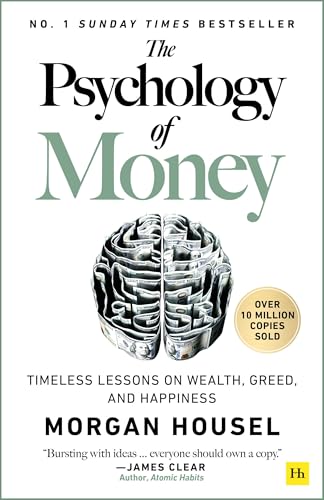
The Psychology of Money
Morgan Housel

Thinking, Fast and Slow
Daniel Kahneman

Man's Search for Meaning
Viktor E. Frankl

The Body Keeps the Score
M.D. Bessel van der Kolk