Best Books on the Psychology of Money: How Emotions Drive Financial Decisions
The conventional story about money is that it is rational. You earn, you spend, you invest, and you accumulate wealth if you make good choices and avoid bad ones. The problem with this story is that almost nobody behaves this way. People with identical incomes end up at opposite financial destinations. People do not save more when interest rates rise. People hold losing stocks out of stubbornness. People spend money to buy status they do not need. This is not irrationality. It is normality. Money is not a mathematical problem. It is a psychological one, and that problem runs deeper than most financial advice acknowledges.
The books on this list do not promise to make you rich. They promise to explain why you do what you do with money, and from that understanding, better choices become possible. Some of these books are about behavioral economics, some about the history of wealth, some about the relationship between money and identity. Together, they show that financial decision-making is shaped by fear, hope, status, trauma, and the stories you tell yourself about what money means.
Where to Start: The Best Books on Money Psychology for Beginners
If you have never read about the psychology of money, start with these two. They are clear, memorable, and will change how you think about your financial choices.
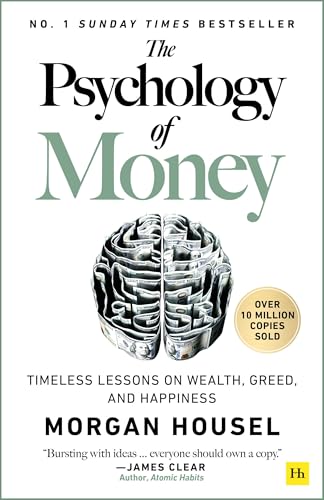
- The Psychology of Money by Morgan Housel: the most accessible book on the list, organized as short essays on different aspects of financial psychology. Housel avoids jargon and uses stories instead. He writes about risk tolerance, the power of compound interest, why people make poor financial decisions, and the way your past shapes your financial future. This is the book to give a friend who thinks all financial advice is boring.
- Thinking Fast and Slow by Daniel Kahneman: Kahneman won the Nobel Prize for his research on how the human mind makes decisions under uncertainty. This book explains two systems of thinking: the fast, intuitive system that makes quick judgments, and the slow, deliberative system that does math. Most financial mistakes come from using the fast system when the slow system is needed. Kahneman shows why this happens and how to recognize it.
Behavioral Economics: Why People Do Not Behave Like Rational Actors
Economics textbooks assume people are rational. Behavioral economics studies what people actually do. The gap between these two is where human nature lives, and it is the gap where wealth and poverty are created.
- Misbehaving: The Making of Behavioral Economics by Richard Thaler: Thaler is the founder of behavioral economics as a field. This book tells the story of his journey from traditional economist to someone who realized people are not rational, and what he did about it. The book covers loss aversion, mental accounting, overconfidence, and the way context shapes choice. Thaler won the Nobel Prize for this work.
- Predictably Irrational by Dan Ariely: Ariely runs experiments to test how people make financial decisions, and the results contradict economic theory repeatedly. People overpay for things because they are familiar. People will accept a bad deal to punish someone who offered it. People value things more highly simply because they own them. These are not glitches in human behavior. They are patterns, and understanding them is key to understanding yourself.
History and Culture: How Money Shapes Society
Money is not universal. It is cultural. What money means, what it is acceptable to do with it, and what it symbolizes all vary across time and place. These books show how culture and history shape our psychology around money.
- The History of Money by Glyn Davies: a sweeping account of how money evolved from barter to coins to credit to digital currency. Davies shows how each change in the nature of money created new kinds of financial psychology. A money-less society thinks about wealth differently than a cash society, which thinks differently than a society where credit matters more than cash.
- The Sum of Small Things by Elizabeth Currid-Halkett: Currid-Halkett studies consumption, status, and the way people signal wealth through what they buy. She argues that we consume not to have, but to show. This insight explains a lot of financial behavior that makes no sense from a practical standpoint but makes perfect sense as identity work.
Wealth and Inequality: Why Outcomes Differ So Greatly
Some people accumulate wealth and others do not, and the reasons are not always obvious. Family history, accidents of birth, and psychological differences all matter. These books explore the forces that create wealth and poverty.
- The Millionaire Next Door by Thomas J. Stanley and William D. Danko: Stanley and Danko studied millionaires and found that most of them were not born rich. They accumulated wealth through regular savings, compound interest, and decades of unglamorous choices. The book shows that the predictor of wealth is not income but how much you spend relative to how much you earn. This should be obvious, but it contradicts how most people think about money.
- Hillbilly Elegy by J.D. Vance: a memoir that explores how family psychology shapes financial outcomes. Vance shows how poverty is not just lack of money but a psychological inheritance, a set of beliefs about what is possible and what you deserve. The book is controversial, but it raises real questions about the way childhood shapes financial psychology.
Risk, Time, and the Paradoxes of Saving and Investing
Money exists in time. The choice to save today rather than spend it is a choice about the future, and people are notoriously bad at valuing the future. These books explore that tension.
- Your Money or Your Life by Vicki Robin and Joe Dominguez: Robin and Dominguez argue that the question is not how to get rich but how to get free. They propose a system for tracking your spending not in dollars but in hours of work. If a purchase costs ten dollars and you earn ten dollars an hour, it costs one hour of your life. This reframing changes how people think about spending forever.
- The Bogleheads Guide to Investing by Taylor Larson, Mel Lindauer, and Michael LeBoeuf: not a psychology book, but a book about making financial decisions that align with psychological reality. The authors argue for low-cost index investing, regular contributions, and ignoring the news. It is the opposite of trading psychology. It is acceptance of uncertainty wrapped in a simple system.
Identity and Money: What Does Money Mean to You?
People have different relationships to money based on their past, their family, their culture, and their temperament. These books help you understand your own financial psychology.
- Money: A Psychological Analysis by Adrian Furnham: Furnham explores the way money is tied to identity, power, and self-worth. Why do some people save and others spend? Why do some take financial risks and others avoid them? The answer, Furnham argues, lies in personality and the way money is tied to your sense of who you are.
Your Money Psychology Reading Order
Start with Housel for the big picture and memorable stories. Move to Kahneman to understand the psychological mechanisms. Then read Thaler or Ariely to see the experiments that proved human behavior deviates from rational choice. Go back to history with Davies or jump forward to your own future with Robin and Dominguez. That sequence will take you from understanding why you make the choices you do to understanding how to make better ones, not through willpower but through system and design. For more ranked finance and psychology lists, browse the full Skriuwer finance collection and psychology collection.
Your next good book, in your inbox
We only write when we find a book worth your time. Hand-picked recommendations across history, mythology, true crime and more.
Books You Might Like
The Psychology of Money
Morgan Housel

Thinking, Fast and Slow
Daniel Kahneman

Man's Search for Meaning
Viktor E. Frankl

The Body Keeps the Score
M.D. Bessel van der Kolk