Best Finance and Investing Books in 2026: 10 That Will Make You Richer
Most personal finance books tell you what to do without explaining why it works. Most investing books explain theory without telling you what to actually buy. The books on this list do both. They are the ones that serious investors and financial professionals still cite decades after publication, and the ones that have produced the most measurable change in reader behavior.
The list covers classical value investing, index fund philosophy, behavioral finance, and anti-fragility thinking. Ten books, with direct reading recommendations for where to start based on where you currently are.
What are the best finance and investing books?
The best finance and investing books are The Psychology of Money by Morgan Housel for the behavioral foundation, The Intelligent Investor by Benjamin Graham for value investing, and The Little Book of Common Sense Investing by John Bogle for the case for low-cost index funds. Start with Housel, then Graham, then Bogle.
The Intelligent Investor by Benjamin Graham
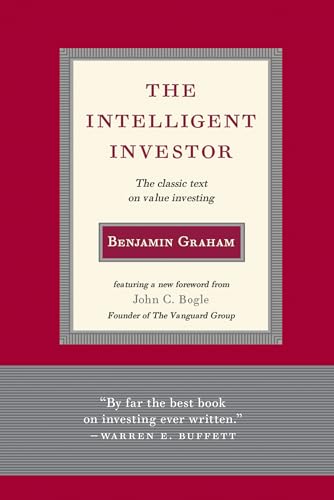
Benjamin Graham's The Intelligent Investor (1949, revised 1973) is the foundational text of value investing and one of the most cited books in the history of finance. Warren Buffett, who studied under Graham at Columbia, called it "by far the best book on investing ever written." The central concepts, the margin of safety, the distinction between investment and speculation, and the allegory of Mr. Market as a business partner with violent mood swings, are the vocabulary of serious investing.
The 2003 edition with commentary by Jason Zweig is the version to read. Zweig's chapter-by-chapter commentary updates Graham's examples to the present day and flags which passages require context for modern markets. The core chapters on defensive versus enterprising investors and on the psychology of investing are as sharp as they were in 1973.
The Intelligent Investor by Benjamin Graham is the book Buffett says every investor should own. That alone is sufficient reason to read it.
A Random Walk Down Wall Street by Burton Malkiel
Burton Malkiel's A Random Walk Down Wall Street, first published in 1973 and revised most recently in 2023, makes the case that stock prices follow a random walk, meaning that past price movements provide no useful information about future prices, and that the vast majority of active fund managers consistently fail to outperform low-cost index funds after fees. The argument is backed by decades of academic evidence and is now the mainstream view in academic finance, though the financial industry that profits from active management has limited incentive to publicize it.
The practical conclusion is simple: buy a diversified portfolio of low-cost index funds, hold them through market cycles, and stop paying someone to pick stocks on your behalf. Malkiel was making this argument before index funds existed. The fact that he has revised the book twelve times and the central thesis has only grown stronger with time says something.
The Psychology of Money by Morgan Housel
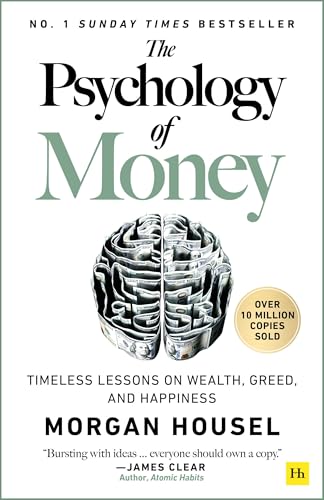
Morgan Housel's The Psychology of Money (2020) is the most readable book on this list and the best starting point if you are new to financial thinking. Housel, a former Wall Street Journal columnist, argues that financial success depends less on technical knowledge than on how you think and behave around money: how patient you are, how you respond to fear and greed, how you define enough, and what time horizon you are actually operating on.
Each of the twenty chapters presents a distinct concept through a short, concrete story. The chapter on "tail events," arguing that a small number of extreme outcomes drive the majority of wealth creation and destruction, is the most practically important. The chapter on "saving" as a hedge against future uncertainty, independent of any specific goal, is the one most readers say changed their thinking.
The Psychology of Money by Morgan Housel is the book to give someone who is not yet interested in investing but who is willing to read something short and interesting about money.
The Four Pillars of Investing by William Bernstein
William Bernstein is a neurologist turned investment theorist whose The Four Pillars of Investing (2002, revised 2023) presents investing as a discipline built on four foundations: the theory of investing, the history of market returns, the psychology of investing, and the business of the financial industry. The framing is useful because it treats investing as a learnable skill rather than a talent for stock-picking.
Bernstein is especially good on financial history, and the chapters covering market behavior across the 20th century are required reading for anyone who believes that long-run equity returns are somehow guaranteed or that today's conditions are uniquely dangerous. He has also updated the revised edition substantially to address modern low-yield conditions and the shift in bond market dynamics.
One Up on Wall Street by Peter Lynch
Peter Lynch managed Fidelity's Magellan Fund from 1977 to 1990 and produced one of the strongest long-term track records of any active fund manager in history, averaging 29% annual returns over thirteen years. One Up on Wall Street (1989) is his argument that individual investors have structural advantages over institutional ones: you can spot opportunities in your own life before Wall Street analysts do, you can hold through volatility without facing quarterly redemptions, and you are not managing enough money to move prices when you buy.
Lynch's stock-picking philosophy is entertaining and specific: buy what you know, understand the business before you buy it, and categorize stocks correctly (slow growers, stalwarts, fast growers, cyclicals, turnarounds, asset plays) before deciding how long to hold them. It is the most engaging case for active stock selection on this list, even for readers who ultimately decide Lynch was an exceptional outlier rather than a replicable model.
The Little Book of Common Sense Investing by John Bogle

John Bogle founded Vanguard and created the first index mutual fund available to retail investors in 1976. The Little Book of Common Sense Investing (2007, revised 2017) is his distilled argument for why costs are the only thing you can control in investing, and why owning "the whole market" through a broad index fund is the highest-expected-value strategy for almost every investor. The book is short, the argument is simple, and the data is overwhelming.
Bogle is not entertaining in the way Lynch is, and the book does not pretend to be. It presents the cost arithmetic clearly, shows what fees do to compounding over thirty years, and then repeats the core recommendation in slightly different form until you cannot misunderstand it. Buy total-market index funds with the lowest possible expense ratios and hold them.
The Little Book of Common Sense Investing by John Bogle is the shortest complete statement of the case for passive investing.
The Black Swan by Nassim Taleb

Nassim Taleb's The Black Swan (2007) is a book about rare, unpredictable, high-impact events and about the systematic ways in which human beings and financial models fail to account for them. Taleb argues that the bell-curve distribution of outcomes that underlies most financial risk modeling is deeply wrong for the events that matter most, those in the long tails where the largest gains and losses concentrate. The 2008 financial crisis, which arrived the year after publication, made the book required reading across finance.
Taleb is a difficult read. He is combative, deliberately repetitive in making his core points, and not interested in simplifying for readers who will not follow the argument closely. But the central ideas about tail risk, model fragility, and the danger of mistaking absence of evidence for evidence of absence are among the most practically important in finance. The companion book, Antifragile, is the constructive follow-up: what to do once you accept that black swans are real.
Rich Dad Poor Dad by Robert Kiyosaki

Robert Kiyosaki's Rich Dad Poor Dad (1997) is the best-selling personal finance book in history and also the most criticized. Kiyosaki's central concepts, the distinction between assets (things that put money in your pocket) and liabilities (things that take money out), and the argument that financial education is more valuable than job income, are genuinely useful frameworks that many readers encounter for the first time here. The book changed how a generation of readers thought about their relationship to money.
The criticisms are also real: Kiyosaki's personal financial story contains fabrications or significant embellishments, his specific investment recommendations are dated and sometimes dangerous, and the book is largely free of actionable detail. Read it for the mindset shift and the vocabulary. Do not follow it as a protocol.
Thinking, Fast and Slow by Daniel Kahneman

Daniel Kahneman won the Nobel Prize in Economics in 2002 for his work with Amos Tversky on behavioral economics, the study of how humans actually make decisions under uncertainty rather than how rational-actor models assume they do. Thinking, Fast and Slow (2011) is the complete account of that work, organized around the distinction between fast, automatic, intuitive thinking (System 1) and slow, deliberate, analytical thinking (System 2).
For investors, the most important chapters cover loss aversion (losses hurt roughly twice as much as equivalent gains feel good), overconfidence in prediction, and the planning fallacy (the systematic tendency to underestimate costs and timelines). These biases are directly responsible for a large fraction of investment underperformance, and naming them clearly is the first step toward managing them.
Your Money or Your Life by Vicki Robin and Joe Dominguez
Vicki Robin and Joe Dominguez's Your Money or Your Life (1992, revised 2008) is not a trading book or a portfolio construction guide. It is a book about the relationship between time and money: the argument that every purchase you make costs not just dollars but hours of your life, and that tracking spending through that lens changes what feels worthwhile. The FIRE (Financial Independence, Retire Early) movement cites it as a foundational text.
The nine-step program in the book is more involved than most readers complete, but the core mental model, calculating your real hourly wage by accounting for all the time your job actually costs you, is one of the most clarifying exercises in personal finance. Read it alongside The Psychology of Money for a complete picture of how to think about money as a resource rather than a score.
Three Finance Books to Start With
- The Psychology of Money by Morgan Housel. The best entry point regardless of prior knowledge. Short, concrete, and focused on the behavioral factors that determine outcomes more than any technical knowledge.
- The Intelligent Investor by Benjamin Graham. Read this after Housel. The foundational text of value investing, updated with modern commentary by Jason Zweig.
- The Little Book of Common Sense Investing by John Bogle. The complete case for index investing in a short, clear book. The practical counterweight to Graham's stock-selection framework.
Reading Order That Makes Sense
Start with The Psychology of Money to build the right mental models. Then read The Intelligent Investor for a grounding in how value investing works. Then read A Random Walk Down Wall Street for the evidence that most active stock picking does not outperform, and Bogle for the constructive response. Add The Black Swan at the point where you feel confident about what your portfolio is doing: Taleb is most useful once you have something to protect.
Your next good book, in your inbox
We only write when we find a book worth your time. Hand-picked recommendations across history, mythology, true crime and more.
Are you an author?
Get your book in front of readers like these, for free.
- Free book listing →Your own book page with an Amazon button
- Author page →Photo, bio and links to your site
- Featured placement →A spot in our best-of lists, from €29
Free tools we recommend
Get free honest reviewsReview exchange on iWrity, free to join
Books You Might Like

It Ends with Us: A Novel
Colleen Hoover

The Seven Husbands of Evelyn Hugo: A Novel
Taylor Jenkins Reid

The Song of Achilles
Madeline Miller

Educated: A Memoir
Tara Westover