Best New Weird Fiction Books in 2026 - 12 Essential Picks
New Weird fiction is a literary subgenre that blends secondary-world fantasy, science fiction, and horror, then refuses to resolve the strangeness it creates into a tidy explanation. Skriuwer's picks below cover the founding texts, the precursors who made them possible, and the range the genre has grown into since. It won't resolve into reassurance. It won't explain itself. It won't give you the satisfaction of understanding what just happened, and that refusal is the point. Where conventional fantasy offers a world with cleaner rules than ours, New Weird offers a world with stranger rules, or no rules at all, or rules that apply only once and then stop applying. Where horror reaches for the catharsis of a revealed monster, New Weird withholds it. You finish these books uncertain, and that uncertainty lodges in you in a way resolution never would.
The term itself traces to M. John Harrison, who used "New Weird" in a 2003 online forum post describing the fiction he, China Miéville, and a handful of contemporaries were writing, but the tradition it names is older. The best New Weird fiction takes secondary world fantasy and infects it with the uncanny, borrows from cosmic horror without adopting Lovecraft's racism, and imports literary modernism's comfort with irresolution into genre forms that usually demand satisfying endings. These are the best New Weird fiction books you can read right now.
What are the best New Weird fiction books?
The best New Weird fiction books are Annihilation by Jeff VanderMeer for ecological dread and an unreliable narrator, Perdido Street Station by China Miéville for the most fully realized New Weird city, and The Etched City by K.J. Bishop for pure atmosphere. Start with Annihilation, then move to Miéville.
| Book | Author | Published | Tone | Best For |
|---|---|---|---|---|
| Annihilation | Jeff VanderMeer | 2014 | Ecological dread | A short, fast entry point into the genre |
| Perdido Street Station | China Miéville | 2000 | Baroque secondary-world horror | Readers who want total immersion in an invented city |
| The City & The City | China Miéville | 2009 | Social and political weird, noir structure | Readers who like a detective-story frame |
| The Book of the New Sun | Gene Wolfe | 1980-1983 | Dying-earth, unreliable narration | Readers who enjoy rereading and decoding a text |
| Songs of a Dead Dreamer and Grimscribe | Thomas Ligotti | 1986 / 1991 | Philosophical pessimism | Readers who want weird fiction treated as philosophy |
| The Imago Sequence | Laird Barron | 2007 | Violent cosmic horror | Readers who want Lovecraft with real emotional stakes |
| Light | M. John Harrison | 2002 | Space-opera weird | Readers who want hard SF blended with the uncanny |
| The Year of Our War | Steph Swainston | 2004 | Drug-fuelled secondary world | Readers wanting an unconventional fantasy debut |
| The Folding Knife | K.J. Parker | 2010 | Political and economic tragedy | Readers who want weirdness without any magic |
| Who Fears Death | Nnedi Okorafor | 2010 | African post-apocalyptic magic | Readers looking for non-Western New Weird |
| Arabesk Trilogy | Jon Courtenay Grimwood | 2001-2003 | Alternate-history noir | Readers who like genre-blending messiness |
| The Etched City | K.J. Bishop | 2003 | Pure atmosphere | Readers who prioritize prose over plot |
The Defining Works: Where New Weird Became New Weird
1. Annihilation by Jeff VanderMeer
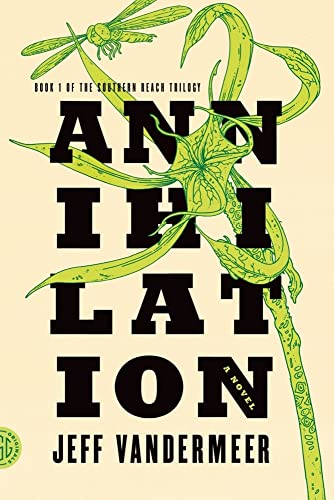
A biologist enters Area X, a stretch of wilderness that has been sealed off from the outside world after something changed there. She is part of the twelfth expedition. The previous eleven all ended in different kinds of catastrophe. VanderMeer's novel is the defining New Weird text of the twenty-first century: its biology is uncanny rather than monstrous, its narrator is unreliable in ways that multiply rather than resolve, and the horror of Area X lies precisely in its refusal to be legible. The Shimmer, as the film adaptation named it, is not malevolent. It simply is, in the way the natural world is, except that the natural world has become alien. The novel won both the Nebula Award and the Shirley Jackson Award. At under 200 pages it is dense with implication.
Annihilation by Jeff VanderMeer is the novel that brought New Weird to the widest audience and holds up to any number of re-readings, each of which produces different conclusions.
2. Perdido Street Station by China Miéville
The city of New Crobuzon is the achievement here. Miéville built a secondary world city of extraordinary complexity: part Victorian London, part insect nightmare, part political tract, populated by humans and the Khepri (human bodies with scarab heads) and the Garuda (bird-people) and the Remade (criminals whose bodies have been surgically altered as punishment). The plot involves a scientist, an artist, a fugitive bird-man, and a moth whose wings produce a psychotropic dust that destroys consciousness on contact. The moth is terrifying, but New Crobuzon itself is more terrifying because it is detailed enough to believe in and horrifying enough to want to escape. No secondary world in fantasy fiction is as elaborately realized, or as unpleasant to inhabit.
Perdido Street Station by China Miéville is the novel that established secondary-world New Weird as a genre capable of doing what literary fiction does, with the grotesque beauty turned up to maximum.
3. The City & The City by China Miéville
Two cities occupy the same physical space. Their citizens are trained from birth not to see the other city, not to perceive its buildings, its people, its traffic. Unseeing, they call it. The novel is structured as a noir detective story: Inspector Tyador Borlú investigates a murder that crosses the impossible border between the cities. The premise is outrageous and Miéville plays it completely straight, which is what makes it work. The weirdness here is social rather than biological, a strange rearrangement of how cities and perception and political identity interact. The novel won the Hugo, Arthur C. Clarke, and World Fantasy Awards in the same year, which almost never happens.
New Weird Precursors: The Books That Made the Genre Possible
4. The Book of the New Sun by Gene Wolfe
This four-volume novel is set on a dying Earth so far in the future that the sun is dimming and the technology of previous civilizations has become indistinguishable from magic. The narrator Severian is a torturer who has been exiled from his guild for showing mercy to a prisoner he loved. He is also, he tells us, incapable of forgetting anything, yet his account of events contains significant omissions. Wolfe wrote the most unreliable narrator in science fiction and embedded him in a secondary world whose true nature the reader must reconstruct from clues buried in footnotes and etymology. It is the greatest New Weird precursor and one of the greatest novels in any genre in the twentieth century.
5. Songs of a Dead Dreamer and Grimscribe by Thomas Ligotti
Ligotti is the philosopher of pessimistic weird. His short fiction proceeds from the premise that consciousness is a catastrophe, that human identity is a fiction maintained by the nervous system against the void, and that the appropriate response to existence is dread. His sentences are beautiful and his worldview is bleak in ways that make Lovecraft look like an optimist. This volume collects two of his most important story collections and is the essential introduction to his work. He has influenced every horror and New Weird writer working in the twenty-first century, mostly because his stories demonstrate that weird fiction can carry genuine philosophical weight.
The Wider Genre: New Weird in Its Range
6. The Imago Sequence by Laird Barron
Barron is the successor to Lovecraft who actually deals with the emotional deficiencies in cosmic horror. His stories are full of violence, wilderness, masculinity in crisis, and something vast and prehistoric lurking behind the natural world that is not interested in humanity except as prey. The three novellas in this collection share a connected mythology and build toward revelations that are genuinely disturbing. The title story involves a series of photographs that depict something that should not be depictable. Barron writes in a tradition of literary weird fiction (Ligotti, Langan, Kiernan) that takes the ideas seriously rather than treating them as window dressing for gore.
7. Light by M. John Harrison
Three narrative strands: a physicist in 1999 who is a serial killer, a woman in the far future who races faster-than-light ships, a man in the same future who is drawn toward something called the Kefahuchi Tract, an anomaly in space that is swallowing physics itself. Harrison weaves the three strands with complete disregard for the reader's desire for immediate clarity. The payoff, when the strands converge, is earned and strange. Harrison is one of the most important British science fiction writers and the most consistently underread; Light is where New Weird and New Space Opera intersect.
8. The Year of Our War by Steph Swainston
Jant is the only man in the world who can fly, because he is the only man in the world who is half-human and half-Rhydanne (a race adapted for mountain altitudes). He is also a drug addict. The Castle is an immortal group of humans who have been defending the world against the Insects for centuries. Swainston's debut novel is startlingly original: the worldbuilding is strange and specific in the way actual secondary worlds must be (strange in the ways that matter, specific in the details that illuminate), the protagonist is genuinely morally compromised, and the drug sequences take place in a literally different world from which Jant must be extracted by force. One of the most inventive fantasy debuts of the 2000s.
9. The Folding Knife by K.J. Parker
Parker's secondary world fantasy avoids magic almost entirely. The Folding Knife is the story of Basso, a financier who becomes First Citizen of his republic and systematically destroys everything he loves through a combination of brilliance, pride, and one catastrophic decision made in his youth. The novel's weirdness is political: Parker's world operates on economic principles that feel uncomfortably close to our own, and the horror is the horror of watching an intelligent person construct his own ruin in real time. The genre label here is secondary world fantasy; the actual experience is closer to Greek tragedy.
10. Who Fears Death by Nnedi Okorafor
Set in a post-apocalyptic Africa, Okorafor's novel follows Onyesonwu, the daughter of a rape, born with magical abilities in a society that does not know what to do with her. The World Fantasy Award-winning novel is the most fully realized African weird fiction in English: it draws on Igbo mythology and oral tradition, it takes its supernatural elements with complete seriousness, and it builds toward a confrontation with an apocalyptic future in which the protagonist's choices carry genuine moral weight. Okorafor's work established that New Weird was not a specifically Western or Northern phenomenon but a global mode that different traditions could inhabit differently.
The Transgressive Edge
11. Arabesk Trilogy by Jon Courtenay Grimwood
The three Arabesk novels (Pashazade, Effendi, Felaheen) are set in an alternate history North Africa where the Ottoman Empire won the First World War. The protagonist Ashraf Bey is a half-Berber, half-European man with a wolf living behind his eyes. Grimwood mixes science fiction, noir, alternate history, and something genuinely hallucinatory into a genre that has no good name. The books are less polished than Miéville or VanderMeer and more interesting for it: they read as if the author was not entirely certain what he was writing, which turns out to be the right attitude for this kind of fiction.
12. The Etched City by K.J. Bishop
Two survivors of a lost war travel to a city where a surgeon and a gunslinger try to build lives among the grotesque and the beautiful. Bishop's debut novel is the purest expression of New Weird aesthetic: a secondary world city that functions as a fever dream, prose that prioritizes sensory texture over plot momentum, and a refusal to deliver the moral resolution the plot seems to promise. It is a difficult book to summarize because its effects are cumulative and atmospheric rather than narrative. It is also one of the most visually striking pieces of prose fiction published this century.
The Etched City by K.J. Bishop is the New Weird novel that most completely discards conventional fantasy storytelling in favor of pure atmosphere.
Who are the most important New Weird authors?
The four authors who defined New Weird are China Miéville, Jeff VanderMeer, M. John Harrison, and Thomas Ligotti. Miéville gave the movement its signature secondary-world city in Perdido Street Station, VanderMeer gave it its defining ecological horror novel in Annihilation, Harrison brought in literary science fiction's comfort with irresolution, and Ligotti supplied the pessimistic philosophy running underneath all of it.
What order should I read the Southern Reach trilogy in?
Read Jeff VanderMeer's Southern Reach trilogy in publication order: Annihilation first, then Authority, then Acceptance. Annihilation stays inside Area X with the biologist's expedition. Authority moves outside it, into the bureaucracy trying to understand the Shimmer. Acceptance braids both perspectives together and is the only volume that attempts an answer.
Is New Weird the Same as Weird Fiction?
No. Weird fiction is the older tradition built by H.P. Lovecraft, Arthur Machen, and Algernon Blackwood in the early twentieth century, centered on cosmic dread. New Weird is the term M. John Harrison introduced in a 2003 online forum post for writers like China Miéville and Jeff VanderMeer, who blend that cosmic unease with secondary-world fantasy, urban noir, and literary modernism's refusal to resolve.
What New Weird Anthologies Should I Read?
The essential anthology is The New Weird (2008), edited by Ann and Jeff VanderMeer, which collects defining short fiction alongside essays debating what the term even means. The broader anthology The Weird: A Compendium of Strange and Dark Stories (2012), also VanderMeer-edited, runs 1,100 pages from Kafka to contemporary writers and traces the tradition New Weird grew out of.
Three New Weird Books Worth Buying Today
- Annihilation by Jeff VanderMeer, the novel that brought New Weird to a mainstream audience, dense with ecological dread and still the best introduction to what the genre can do.
- Perdido Street Station by China Miéville, the secondary world that defined what New Weird cities could be, grotesque and beautiful in equal measure.
- The Etched City by K.J. Bishop, pure New Weird atmosphere from a debut novelist who understood the genre's priorities better than most of its practitioners.
For more fiction reading lists, see our fiction collection. If cosmic horror is what you are after specifically, our horror fiction list covers that ground in more depth.
Your next good book, in your inbox
We only write when we find a book worth your time. Hand-picked recommendations across history, mythology, true crime and more.
Are you an author?
Get your book in front of readers like these, for free.
- Free book listing →Your own book page with an Amazon button
- Author page →Photo, bio and links to your site
- Featured placement →A spot in our best-of lists, from €29
Free tools we recommend
Get free honest reviewsReview exchange on iWrity, free to join
Books You Might Like

It Ends with Us: A Novel
Colleen Hoover

The Seven Husbands of Evelyn Hugo: A Novel
Taylor Jenkins Reid

The Song of Achilles
Madeline Miller
