Best Norse Mythology Books for Adults (2026): 11 Picks Beyond the Marvel Version
Norse Mythology Is Nothing Like the Movies
Thor is not a clean-cut superhero. Odin is a god who hangs himself from a tree for nine days to gain wisdom, who sacrifices one eye for knowledge, who lies to his worshippers and manipulates mortals for his own ends. Loki is not simply a villain. The Norse cosmos ends in Ragnarok, a total destruction where even the gods die, and the whole thing starts again. This is one of the richest, strangest mythological traditions ever recorded, and the books below give you access to the real thing. The reading order moves from primary sources through serious modern overviews into the academic scholarship.
The Primary Sources First
You need to read the primary sources before anything else. The Prose Edda by Snorri Sturluson is the single most important text for Norse mythology. Snorri was a 13th-century Icelandic scholar who compiled the myths from older oral tradition after Iceland converted to Christianity. His goal was to preserve the poetic vocabulary that made the old skaldic poetry comprehensible. The result is an extraordinary document. Anthony Faulkes' translation is the most accurate English version available. The Poetic Edda, translated by Carolyne Larrington, gives you the older, rougher, stranger poems that Snorri drew from. The Voluspa alone, the prophetess's account of the world's creation and destruction, is worth the price of the book. If you want a beginner-friendly bridge first, see our Norse mythology beginner reading order.
Our Top Picks
- The Prose Edda by Snorri Sturluson (trans. Faulkes): The foundation. Read this first. Everything else builds on it.
- The Poetic Edda (trans. Carolyne Larrington): Rawer and stranger than the Prose Edda. The poems preserved here are the oldest layer of the tradition.
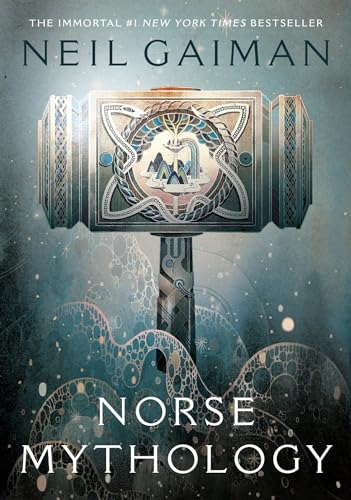
- Norse Mythology by Neil Gaiman: The best modern retelling for adult readers. Gaiman stays close to the sources while making the stories readable. Not a substitute for the Eddas, but a strong companion.
- The Viking Spirit: An Introduction to Norse Mythology and Religion by Daniel McCoy: McCoy runs Norse Mythology for Smart People and writes with real scholarly depth. The best modern introduction that covers mythology, religion, and worldview together.
- Gods and Myths of Northern Europe by H. R. Ellis Davidson: First published in 1964, still one of the best scholarly overviews. Davidson synthesizes archaeology, saga literature, and comparative mythology.
- The Norse Myths: A Guide to the Gods and Heroes by Carolyne Larrington: Larrington goes beyond the Eddas to pull in saga sources, archaeological finds, and runic inscriptions. A comprehensive picture of the whole tradition.
- Myth and Religion of the North by E. O. G. Turville-Petre: Dense and academic, but the most thorough treatment of Norse religious practice available in English. For readers who want the full picture, not just the stories.
Why the Marvel Version Gets It Wrong
The Marvel films flatten Norse mythology into a superhero template. Asgard becomes a sci-fi kingdom, Loki becomes a straightforward antagonist with a redemption arc, and the cosmological weight of Ragnarok gets reduced to an action set-piece. The real mythology is far darker and more interesting. The gods are not omnipotent. They know Ragnarok is coming and cannot stop it. Odin spends the entire mythological cycle gathering warriors for a battle he already knows he will lose. That tragic foreknowledge is completely absent from the films and it is the emotional core of the tradition.
The Sagas Are Not Mythology But You Should Read Them Anyway
The Icelandic sagas are distinct from the mythology, but they come from the same culture and give you the human side of the Norse world. Njal's Saga and Egil's Saga are the best starting points. Jesse Byock's translations are readable and well-annotated. The sagas show you how real Norse people thought about fate, honor, vengeance, and the relationship between humans and gods. Once you have the mythology in your head, the sagas become much richer. For more on the people who told these stories, see our guide to the best Viking books.
What Ragnarok Actually Means
Most people know Ragnarok as the end of the world. What many do not know is that it is also a beginning. After the gods die, after the world sinks into the sea, the earth rises again. Two humans survive hidden in a forest. The surviving gods meet on the plain of Idavoll and find the golden game-pieces of the old gods lying in the grass. A new world grows. The Norse did not see history as linear progress toward a goal. They saw it as a cycle. The end contains the seed of what comes next. That is a genuinely different way of understanding time and existence, and you will not get it from a Marvel film.
Where to Read Next
If Norse cosmology pulls you in, the natural next step is comparative work. Read the best Greek mythology books for the more familiar Mediterranean tradition, then move to Celtic and Egyptian myth. Patterns emerge across the cycles. The Indo-European root tradition that produced Odin, Zeus, and the Vedic Indra is one of the deepest currents in human storytelling. Our mythology category page collects every related reading list.
Your next good book, in your inbox
We only write when we find a book worth your time. Hand-picked recommendations across history, mythology, true crime and more.
Are you an author?
Get your book in front of readers like these, for free.
- Free book listing →Your own book page with an Amazon button
- Author page →Photo, bio and links to your site
- Featured placement →A spot in our best-of lists, from €29
Free tools we recommend
Get free honest reviewsReview exchange on iWrity, free to join
Books You Might Like

The Song of Achilles
Madeline Miller

Circe
Madeline Miller
Norse Mythology
Neil Gaiman

Heroes
Unknown Author