Best Books on the Psychology of Money
If money were just math, everyone would be rich. Compound interest is simple. Save more than you spend. Diversify your investments. The math works. But people don't follow the math.
People follow their emotions. Their history. Their fears. Their status anxiety. The best books about the psychology of money are not about formulas. They are about why intelligent people make terrible financial decisions and how to stop doing that.
Daniel Kahneman - Thinking, Fast and Slow (2011)
Kahneman won the Nobel Prize in Economics for proving that humans are not rational. He spent fifty years documenting the cognitive biases that make us predictably irrational.
Thinking, Fast and Slow is long, dense, and absolutely essential. Kahneman explains heuristics and biases that affect every decision you make with money. You overvalue what you own (the endowment effect). You fear losses more than you value gains (loss aversion). You see patterns in randomness (confirmation bias). You rely on recent information too heavily (availability heuristic).
Once you understand these patterns, you cannot unsee them. That is the point. The book wants you to notice when you are making bad decisions and develop methods to counter those instincts.
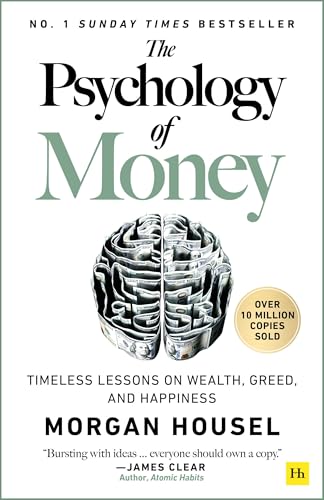
Morgan Housel - The Psychology of Money (2020)
A book about financial success written by someone who understands that financial success is mostly luck plus behavior, not intelligence plus strategy.
Housel argues that the key to financial stability is not knowing the perfect investment strategy. It is developing behaviors that work in the long term even when you are stressed, afraid, or watching your investments lose half their value in a crash.
The Psychology of Money is personal. Housel tells stories about his family, about investors he has studied, about the psychology of people who survived the Great Depression. The book shows you how to think about money across a lifetime.
Robert Cialdini - Influence: The Psychology of Persuasion (1984)
A classic. Cialdini spent years researching how persuasion actually works. He identifies six principles: reciprocity, commitment, social proof, authority, liking, scarcity. These principles are used to manipulate people into making financial decisions they don't want to make.
Influence is crucial because it teaches you to recognize when you are being manipulated. Salespeople use these principles deliberately. Credit card companies use them. The advertising industry exists to exploit them. Understanding the mechanisms makes them less effective on you.
Ariely Ariely - Predictably Irrational (2008)
Dan Ariely is a behavioral economist who designs experiments to show how people actually behave with money. Not how they should behave. Not how they think they behave. How they actually behave in controlled experiments.
The book covers anchoring (irrelevant numbers influence your decisions), the sunk cost fallacy (you chase lost money trying to recover it), overconfidence (you overestimate your ability to predict the future).
Predictably Irrational is funny and deeply unsettling. You laugh at the people described in the experiments while realizing you would make the exact same mistakes.
Jason Zweig - The Intelligent Investor Reader (2003)
A guide to reading Benjamin Graham's "The Intelligent Investor," the most influential investing book ever written. Zweig provides context, translation, and commentary. He explains why Graham's principles still work seventy years later.
Graham's main idea is simple: invest by buying stocks worth more than you pay for them. Don't speculate. Don't follow the crowd. Buy value. Wait patiently.
Zweig's version is more accessible than reading Graham directly, but reading Graham is worth the effort. Understanding his principles changes how you see the market.
Nassim Nicholas Taleb - The Black Swan (2007)
Why are we surprised by unpredictable events? Why do we build financial systems that assume the future will look like the past when the past teaches us it won't?
Taleb argues that rare, extreme events (black swans) shape the world far more than normal variation. The 2008 financial crisis was not a surprise to Taleb. It was predictable in outline if not in timing. The problem is that financial institutions spend no effort preparing for the unpredictable because it is, by definition, unpredictable.
The Black Swan is disturbing and necessary. It teaches you to live with uncertainty rather than pretending uncertainty doesn't exist.
Bruce Firestein - The Richest Man in Babylon (1926)
An older book that holds up surprisingly well. Firestein wrote short parables about money set in ancient Babylon. A poor man learns from the richest man in the city. The lessons are simple: spend less than you earn, invest your savings, don't chase get-rich-quick schemes, protect your capital.
The Richest Man in Babylon is not sophisticated finance. It is behavioral advice dressed in historical storytelling. It works because the advice is true and the stories are memorable.
Where to Start
Start with Morgan Housel's "The Psychology of Money." It is short, engaging, and it shows you why behavior matters more than strategy. You finish it understanding the psychological foundations of financial success.
Then read Daniel Kahneman's "Thinking, Fast and Slow." Now that you understand why behavior matters, you learn the specific ways your mind betrays you. You learn the biases that cost you money.
From there, read Taleb's "The Black Swan" if you want to understand uncertainty, or Cialdini's "Influence" if you want to protect yourself from manipulation.
FAQ
Do I need to be an investor to read these books? Yes. Everyone handles money. These books explain how your mind makes decisions about money. That matters whether you are investing millions or deciding how to spend your paycheck.
Isn't this just common sense? No. Common sense says to sell stocks when they are crashing (wrong). Common sense says the market is predictable (wrong). Common sense says you are better than average (definitely wrong). These books explain why common sense fails with money and what to do instead.
Which book should I read if I only have time for one? "The Psychology of Money" by Morgan Housel. It is the most balanced. It covers behavior, luck, time, and what actually matters for financial success. It is also the shortest.
Are these books about getting rich? Some are. Kahneman and Taleb are more about understanding how you fail. Housel is about stability. Graham (via Zweig) is about building wealth slowly. None of these books are about get-rich-quick. They are all about avoiding disaster while building something over time.
What's the difference between these books and personal finance books? Personal finance books tell you how to budget and invest. These books explain why you don't follow those instructions and what psychological tricks work better than willpower.
How long do these books take to read? "Thinking, Fast and Slow": 16-20 hours. "The Psychology of Money": 5-7 hours. "Influence": 7-9 hours. "Predictably Irrational": 8-10 hours. "The Black Swan": 10-12 hours. "The Intelligent Investor Reader": 12-14 hours. "The Richest Man in Babylon": 3-4 hours.
Will these books make me rich? No. But they will probably keep you from becoming poor. They will help you make better financial decisions. They will protect you from systematic mistakes. That is worth far more than any specific investment tip.
Your next good book, in your inbox
We only write when we find a book worth your time. Hand-picked recommendations across history, mythology, true crime and more.
Are you an author?
Get your book in front of readers like these, for free.
- Free book listing →Your own book page with an Amazon button
- Author page →Photo, bio and links to your site
- Featured placement →A spot in our best-of lists, from €29
Free tools we recommend
Get free honest reviewsReview exchange on iWrity, free to join
Books You Might Like

The Psychology of Money
Morgan Housel

Thinking, Fast and Slow
Daniel Kahneman

Man's Search for Meaning
Viktor E. Frankl