What Is a Conspiracy Theory? A 2026 Working Definition That Actually Holds Up
The term "what is a conspiracy theory" gets thrown around constantly, in news segments, social media arguments, and dinner table debates. But most people who use the phrase couldn't give you a clear, working definition. It's become a label, a weapon, a way to shut down questions before they're even asked. That's a problem, because understanding what the term actually means matters more now than it ever has.
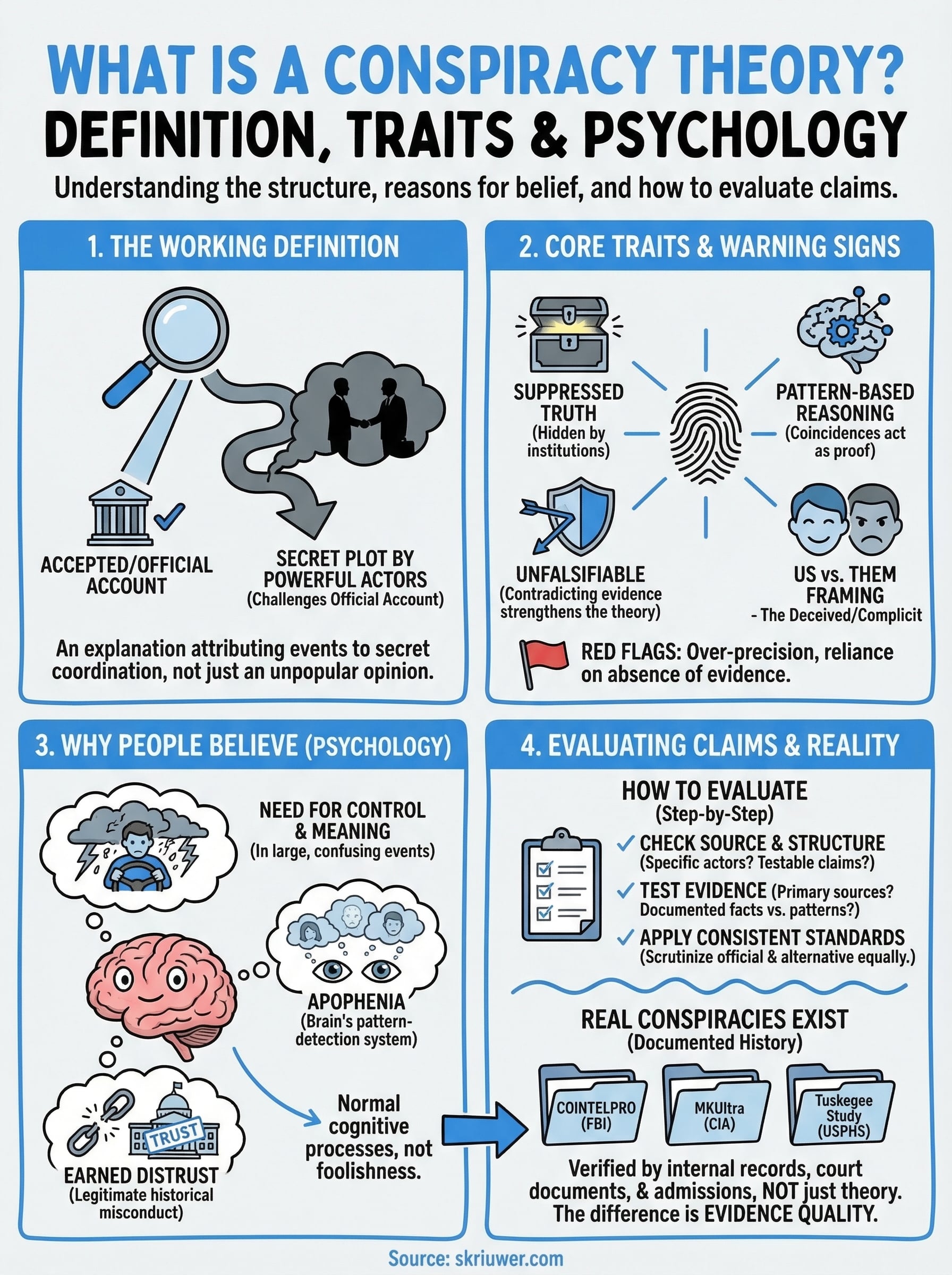
A conspiracy theory, stripped down to its core, is an explanation that attributes events to secret plots by powerful actors, rather than to accepted or official accounts. Some of these theories are baseless nonsense. Others turned out to be true, documented, verified, and entered into the historical record. The difference between the two isn't always obvious at first glance, which is exactly why critical thinking is non-negotiable when navigating this territory.
At Skriuwer, we publish books that dig into the stories mainstream publishers won't touch, dark history, hidden conflicts, and counter-narratives that challenge what you thought you knew. That mission is directly connected to this topic. You can't meaningfully engage with alternative perspectives on history or power without first understanding how conspiracy theories work, why people believe them, and where the line sits between healthy skepticism and unfounded speculation.
This article breaks down the definition, core traits, and psychology behind conspiracy theories, giving you the foundation to think clearly about claims that conventional sources often dismiss or, in some cases, refuse to examine at all.
What a conspiracy theory is and what it is not
A conspiracy theory is a specific type of explanatory claim. It proposes that a group of people, typically those with power or influence, secretly coordinated to bring about an event, conceal information, or manipulate public perception, and that the official or mainstream explanation for that event is either false or deliberately misleading. That's it. No supernatural elements required. The definition itself is actually quite neutral, which is what makes the term so frequently misused.
The working definition
When you ask what is a conspiracy theory, the answer has two required components. First, there must be an alleged secret coordination among actors with some level of power or agency. Second, that coordination must be offered as an explanation for an event, outcome, or pattern that most official sources attribute to something else. A theory without both components isn't a conspiracy theory in the technical sense. Someone claiming the economy is rigged isn't automatically offering a conspiracy theory. Someone claiming a specific group of bankers secretly rigged a specific election, while suppressing evidence of it, is.
A conspiracy theory isn't defined by being wrong. It's defined by its structure: secret actors, hidden coordination, and a direct challenge to the accepted account.
The word "theory" trips people up. In everyday speech, "theory" gets used loosely to mean a guess or a hunch. In formal usage, a theory is an explanatory framework. Conspiracy theories sit somewhere in between. They often lack the evidentiary standards of scientific theories, but they're more structured than random speculation. Treating every conspiracy theory as pure fantasy shuts down legitimate inquiry. Treating every one as credible without scrutiny opens the door to manipulation.
What a conspiracy theory is not
Understanding the label requires knowing what it does not cover. A conspiracy theory is not the same as the following things, and conflating them causes real confusion:
- A proven conspiracy: When evidence confirms that secret coordination took place, it becomes documented history. COINTELPRO, MKUltra, and the Tuskegee experiments were all real conspiracies, not theories.
- Institutional criticism: Pointing out that governments lie, corporations mislead, or media organizations have biases is a verifiable observation backed by documented cases. It's not a conspiracy theory on its own.
- Speculation without a secret actor: Wondering whether a policy failure stemmed from incompetence rather than malice doesn't qualify. No hidden coordination is implied.
- Heterodox thinking: Disagreeing with the scientific consensus or official narrative on a topic doesn't make a view a conspiracy theory unless it specifically attributes events to covert, coordinated manipulation.
People misuse the term to dismiss questions they find inconvenient, and that misuse carries real costs. When you label every uncomfortable question a conspiracy theory, you erode the public's ability to distinguish between unfounded paranoia and legitimate scrutiny. Both errors lead to harm. Believing baseless theories can distort your decisions and damage communities. Reflexively dismissing every challenge to official accounts shields powerful actors from accountability they often deserve.
The distinction matters because your ability to think clearly about historical events, political claims, and media narratives depends on having accurate tools. The phrase "conspiracy theory" is one of those tools. Using it precisely keeps it useful. Using it carelessly turns it into a thought-stopper, and that serves no one except those who benefit from keeping questions off the table.
Why conspiracy theories matter in real life
Understanding what is a conspiracy theory isn't just an academic exercise. What people believe about hidden power and secret coordination shapes how they vote, whom they trust, and how they respond to crisis. Conspiracy theories have moved markets, ended careers, and in documented cases, motivated real-world violence. Dismissing them as fringe entertainment misses just how much weight they carry in daily life.
When false theories cause real harm
Misinformation spreads faster than corrections, and conspiracy theories built on false premises carry a particularly high cost when they gain traction. During the COVID-19 pandemic, widespread belief in theories about vaccine ingredients caused measurable drops in vaccination rates in multiple countries, which public health researchers tracked directly. False narratives about election fraud have driven threats against election workers, undermined confidence in democratic institutions, and in at least one high-profile case, contributed to a violent event that played out in public view.
Conspiracy theories don't stay contained to online forums. They reach people's decisions, and those decisions have consequences in the real world.
The harm isn't limited to the people who believe the theory. Communities targeted by false conspiracy claims, whether a religious group, an ethnic minority, or a professional institution, face harassment, reputational damage, and sometimes physical danger. The theory becomes a weapon, regardless of whether those spreading it intend that outcome.
When dismissing a theory causes harm too
Not every claim labeled a conspiracy theory is wrong. The U.S. government's COINTELPRO program, which ran covert surveillance and disruption operations against civil rights leaders, was dismissed as paranoid before internal documents confirmed it was real and systematic. Reflexively dismissing uncomfortable questions allows actual misconduct to stay hidden longer, protected by the social reflex to mock anyone who asks.
Your ability to evaluate claims accurately protects you from both failure modes: believing false narratives and ignoring legitimate ones. Neither error is harmless. The person who accepts every government denial and the person who trusts every counter-narrative both lose access to the same thing: an accurate picture of events. That picture is what you need to make sound decisions about your life, your community, and the sources you choose to trust.
Core traits and common warning signs
Most conspiracy theories, regardless of topic, follow recognizable structural patterns. Once you know what those patterns look like, you can identify them quickly and apply the right level of scrutiny. Understanding what is a conspiracy theory at the structural level gives you a practical filter, not a reason to dismiss every claim, but a way to assess how much evidential weight a claim actually carries before you decide what to do with it.
The structural fingerprints of a conspiracy theory
Every conspiracy theory shares a small set of defining features. These aren't proof that a theory is wrong, but they tell you what kind of claim you're dealing with and what questions you should ask next.
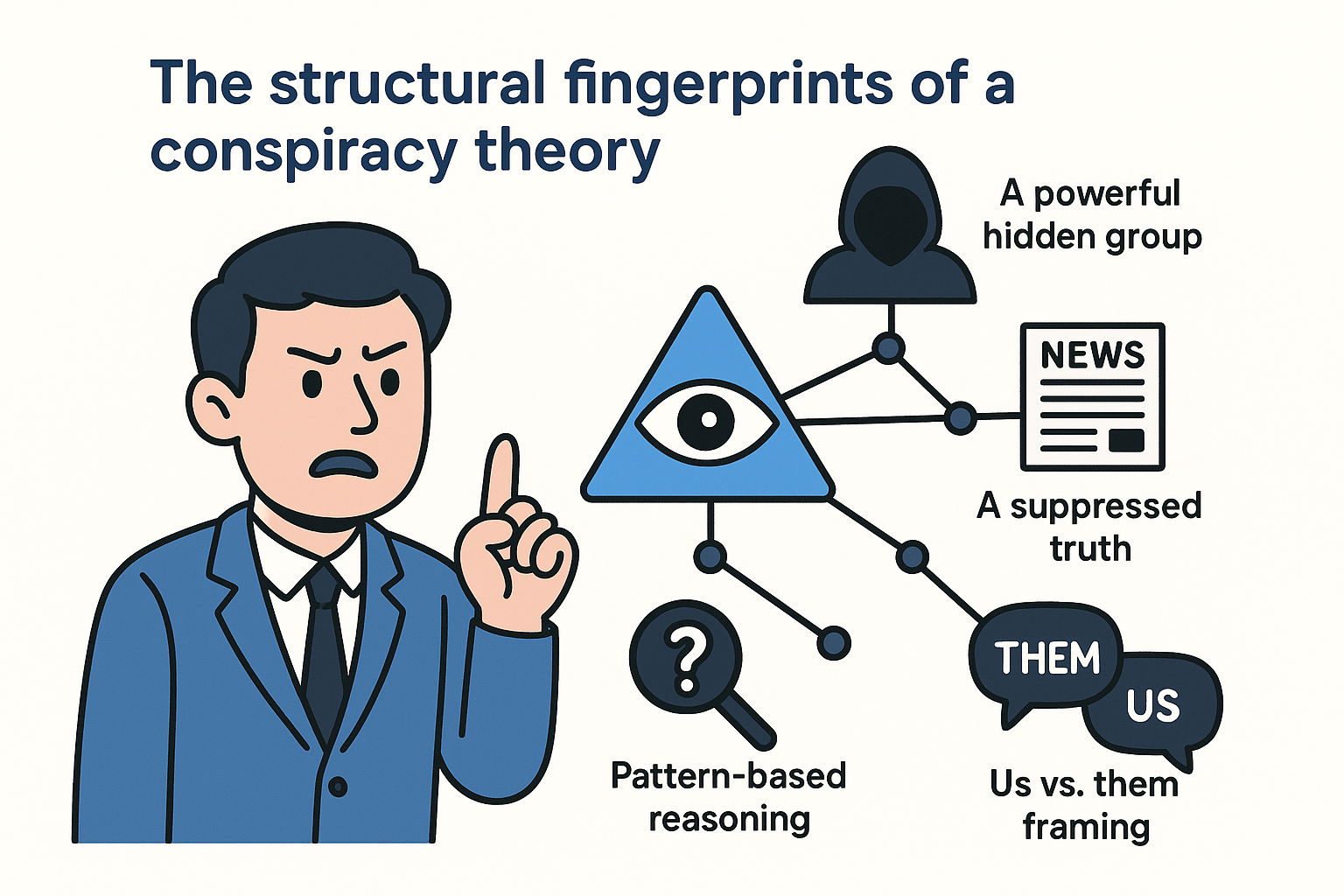
- A powerful hidden group: The alleged conspirators have the means, motive, and coordination to pull off the plan without detection.
- A suppressed truth: The real explanation is being actively hidden by institutions, media, or authorities.
- Pattern-based reasoning: Coincidences, connections, and anomalies are treated as intentional rather than incidental.
- Unfalsifiability: Contradicting evidence gets folded into the theory as proof of how deep the cover-up goes.
- Us vs. them framing: Believers are the ones who "see through" the deception, while skeptics are either deceived or complicit.
When contradicting evidence strengthens a theory rather than challenging it, you're looking at a claim that has been structured to survive scrutiny rather than invite it.
Red flags that suggest weak foundations
Several specific warning signs indicate that a conspiracy claim rests on thin ground. The first is a heavy reliance on absence of evidence. If the main argument is that the lack of documentation proves a cover-up, that's not a logical conclusion. It's circular reasoning dressed up as analysis. Legitimate claims can tolerate scrutiny without resorting to "they destroyed the proof."
Another major red flag is the over-precision trap. Some theories explain every anomaly with pinpoint certainty while offering no mechanism for how the coordination actually worked. Real events, even complicated ones, leave loose ends, inconsistencies, and people who talk. Theories that account perfectly for everything should make you more skeptical, not less, because reality is rarely that clean. Healthy skepticism means applying the same critical standard to alternative explanations that you'd apply to official ones.
Why people believe conspiracy theories
People don't believe conspiracy theories because they're foolish. The psychology behind belief in hidden plots is deeply rooted in normal cognitive processes that serve real functions in everyday life. Understanding why people arrive at these beliefs matters as much as understanding what is a conspiracy theory itself, because the same mental shortcuts that can mislead someone also help them detect genuine threats and navigate complex social environments.
The brain's search for patterns and meaning
The human brain is wired to find patterns and causal connections, even in random noise. Researchers call this tendency apophenia, and it's a feature, not a flaw. In most environments, spotting patterns quickly improves your chances of survival. This pattern-detection system runs constantly, even when no real pattern exists, and it gets triggered hard by large, traumatic, or confusing events.
When something significant happens, your brain searches for a cause that feels proportional to the scale of the outcome. A global pandemic, a major assassination, a financial collapse - the size of the event creates pressure toward a grander explanation than chance or incompetence can provide.
When the official explanation feels too small for the size of the event, the brain doesn't relax. It keeps looking.
The pull of control and the weight of earned distrust
Feelings of powerlessness push people toward explanations that offer a kind of control, even a dark one. If a hidden group is directing events, then at least someone is in charge. Randomness offers no leverage and no target, which makes it psychologically harder to accept than deliberate malice. Research in social psychology consistently shows that people under stress or facing significant uncertainty are more likely to perceive intentional patterns in ambiguous information.
Beyond cognitive bias, a portion of conspiracy belief rests on distrust that has actually been earned. Governments have lied. Corporations have hidden data. Official sources have covered up misconduct, sometimes for decades. When you've been genuinely misled by institutions, the rational response is increased skepticism. The problem is that broad skepticism without a reliable method for evaluating claims leaves a gap, and unfounded theories fill that gap quickly by confirming what you've already learned to suspect. The result isn't irrationality. It's a reasonable instinct applied without the tools to aim it accurately.
How conspiracy theories spread and gain traction
Understanding what is a conspiracy theory is only part of the picture. The other part is understanding how these theories move through populations so quickly and so effectively. A theory that stays in one person's head causes no downstream harm, but once it spreads through networks, it can reshape public opinion, shift behavior, and resist correction long after it's been debunked. The mechanics behind that spread are specific and worth learning.
The social architecture of belief transmission
Conspiracy theories spread the way all compelling stories spread: through trust networks and emotional resonance. When someone you respect shares a claim, your brain processes it differently than when a stranger posts the same thing. The messenger matters as much as the message, and conspiracy content moves fastest when it travels through existing relationships, whether those are family group chats, religious communities, or close social circles. That's not a flaw in how people communicate. It's a feature that misinformation exploits consistently.
Sharing a conspiracy theory also carries a clear social reward. Being the person who "found out first" or who warns others creates a sense of value and connection. This makes the act of spreading a theory feel generous rather than harmful, which removes the internal friction that might otherwise slow someone down before passing it along.
The theory spreads not because it's well-evidenced, but because sharing it meets real social and emotional needs.
Why platforms accelerate the process
Recommendation algorithms on major social platforms are built to maximize engagement, and emotionally charged, surprising content drives more clicks and shares than measured analysis does. A conspiracy theory, by its nature, carries the emotional weight of threat, betrayal, and hidden truth. That means these platforms surface conspiratorial content more often than they surface careful corrections or nuanced rebuttals, because the theory outperforms the fact-check by every metric the algorithm tracks.
The gap between how fast a false claim spreads and how fast a correction travels is well-documented across communication research. False information consistently reaches more people than accurate information does, largely because it generates stronger emotional reactions. Your corrective response to a false theory almost always arrives after the theory has already reached most of its intended audience, which means early scrutiny matters far more than after-the-fact debunking. Once a claim becomes part of someone's social identity or worldview, the correction doesn't just face an evidence problem. It faces a personal one, and personal challenges are much harder to resolve with facts alone.
Real conspiracies vs conspiracy theories
One of the most important distinctions when asking what is a conspiracy theory is understanding that some theories turned out to be accurate. Labeling every claim about hidden coordination as paranoid fantasy ignores the documented record. Real conspiracies exist, and they appear in declassified files, court records, and congressional testimony. The label "conspiracy theory" doesn't tell you whether something is true or false. It tells you about the structure of the claim before evidence has settled the question.
When the theory became history
Several of the most significant cases of actual government conspiracy were dismissed as paranoid speculation before documentation confirmed them. COINTELPRO ran for over a decade as the FBI surveilled, infiltrated, and actively disrupted civil rights organizations, including those led by Martin Luther King Jr. The program was not a fringe suspicion. It was a classified operation that became public through stolen files and subsequent congressional investigation. MKUltra, the CIA's covert mind-control research program involving non-consensual human experimentation, was similarly denied until internal documents surfaced. The Tuskegee syphilis study, in which U.S. government researchers withheld treatment from Black men over four decades, followed the same arc from "implausible" to confirmed and formally apologized for.
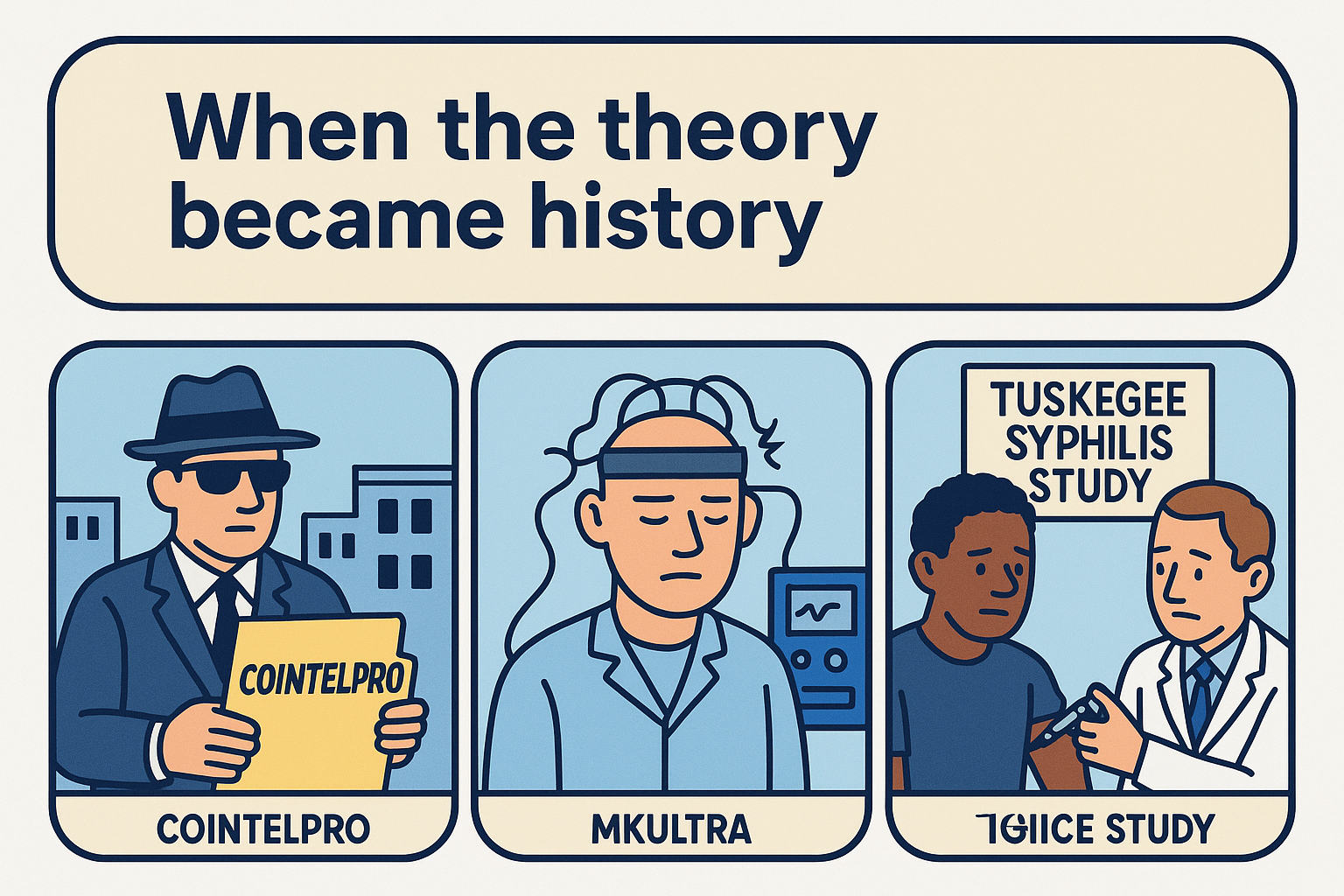
What gets called a conspiracy theory today is sometimes documented history in a decade.
These aren't edge cases. They are well-sourced historical facts now taught in universities and cited in government reports. The people who suspected these programs before the evidence surfaced were not irrational. They were often correct, and they were dismissed using the same rhetorical tools applied to genuinely baseless claims today.
What separates the two
The key difference between a real conspiracy and an unverified theory is the quality and nature of the available evidence. Real conspiracies, once exposed, produce physical documentation, named participants, internal communications, or corroborating testimony from multiple independent sources. Unverified theories typically rely on inference, pattern-matching, and the absence of evidence rather than its presence. That doesn't mean a theory without current documentation is permanently wrong. It means you should hold it proportionally to what the evidence actually supports.
You apply the same standard to both sides. Confirmed cases of real government misconduct raise your reasonable baseline for skepticism. Knowing that institutions have lied before is a legitimate input into your thinking. What it doesn't do is confirm every subsequent theory that fits the same narrative shape. Evidence still decides the question, and your job is to follow evidence rather than pattern alone.
How to evaluate a conspiracy claim step by step
When someone brings you a conspiracy claim, your first instinct may be to accept or reject it based on how plausible it feels. That instinct is unreliable. Feeling-based evaluation is exactly what makes people vulnerable to both unfounded theories and blind trust in official accounts. Understanding what is a conspiracy theory gives you the structural framework, but you also need a repeatable process for testing specific claims against evidence rather than gut reaction.
Check the source and the claim structure
Before you assess any evidence, look at where the claim originated and how it's being presented. Check whether the source has a named author, a verifiable institutional affiliation, or a documented track record. Ask whether the claim makes specific, testable assertions or relies on vague language like "many experts say." Vague sourcing doesn't automatically disqualify a claim, but claims that can't be pinned to specific names, dates, or documents are much harder to verify or correct.
A practical checklist when you first encounter a claim:
- Does it name specific actors with verifiable identities?
- Does it cite primary sources like documents, records, or named testimony?
- Does it make predictions that could be falsified?
- Does it explain how the alleged coordination worked in practice?
A claim that resists being pinned down to specific names, dates, and documents is harder to evaluate accurately, and that ambiguity tends to benefit the claim, not the reader.
Test the evidence and apply consistent standards
Once you've identified what's being claimed and who's making it, turn to the evidence itself. Determine whether the argument relies on documented facts, on patterns and coincidences, or on the absence of contradicting information. Absence of evidence is not evidence of a cover-up. It's an unknown, and unknowns deserve proportional weight, not automatic suspicion. Look for primary sources: original documents, official records, named witnesses, or independent corroboration from separate sources that arrived at their conclusions without coordinating with each other.
One of the most common errors in this process is applying stricter scrutiny to the official explanation than to the alternative. Both need to pass the same test. Ask whether the conspiracy would require large numbers of people to stay silent indefinitely, and whether simpler explanations account for the same set of facts. Your goal is not to default to authority. It's to hold every explanation to the same evidentiary standard and follow wherever the evidence actually points.
How to talk to someone who believes one
Talking to someone who holds a conspiracy theory can feel like arguing against a wall. Direct confrontation rarely works, and for reasons that are grounded in psychology rather than stubbornness. When a belief is tied to someone's sense of identity or their distrust of institutions, presenting contradicting facts doesn't update their view. It often hardens it. Understanding what is a conspiracy theory at a psychological level helps you approach these conversations with a strategy that actually has a chance of working.
Lead with questions, not corrections
Your instinct might be to present evidence immediately, but that approach tends to backfire. Asking genuine questions about how someone arrived at a belief gives you information about what's actually driving it, and it signals that you're engaging rather than dismissing. People who feel heard are more open to reconsidering their position than people who feel attacked.
The goal of the conversation is not to win. It's to create enough space that the other person can reason through the claim without feeling threatened.
Focus on the reasoning process rather than the conclusion. Ask things like: "What would it take for this to be wrong?" or "What's the strongest piece of evidence you've seen for this?" These questions don't challenge the belief directly. They invite the person to apply the same critical standard to their view that they'd apply to anything else. That shift, from defending a position to examining it, is where real reconsideration begins.
Know what you're actually trying to accomplish
Setting a realistic goal before the conversation starts saves you frustration and makes you more effective. You are almost certainly not going to change someone's mind in a single exchange, especially on a belief they've held for a long time and discussed with others who share it. What you can do is plant a question they haven't considered, reduce the certainty they feel about a specific claim, or simply model what careful reasoning looks like without turning it into a debate.
Protecting the relationship also matters. Pushing too hard too fast creates defensiveness that closes the conversation down entirely, and a closed conversation helps no one. A short exchange that ends with the other person feeling respected and slightly less certain is more valuable than a long argument that ends with them more committed to the theory and less willing to talk to you again. Progress in these conversations is usually slow, and that's normal.
Key takeaways
A conspiracy theory is a specific type of claim that attributes events to secret coordination by powerful actors and challenges the official explanation. Knowing what is a conspiracy theory means knowing its structure, not just its reputation. The label doesn't confirm or deny whether something is true. It tells you what kind of claim you're dealing with and what level of scrutiny to apply.
Real conspiracies exist and have been documented throughout history. Your job is to evaluate every claim by the same standard: check the sourcing, test the evidence, and ask what it would take for the theory to be wrong. Dismissing uncomfortable questions protects the powerful, while accepting every alternative narrative opens the door to manipulation.
Critical thinking is the only reliable tool you have, and it works in both directions. Your goal is accurate information, not confirmation of what you already suspect. If you want to go deeper on hidden histories, dark facts, and counter-narratives that mainstream publishers avoid, browse the Skriuwer conspiracy book collection or the dark history book collection.
Your next good book, in your inbox
We only write when we find a book worth your time. Hand-picked recommendations across history, mythology, true crime and more.
Books You Might Like


Behold! a Pale Horse
Milton Cooper

Manufacturing Consent: The Political Economy of the Mass Media
Noam Chomsky and Edward S. Herman