What Is Gnosticism? The Dualist Religion Christianity Tried to Erase (2026 Guide)
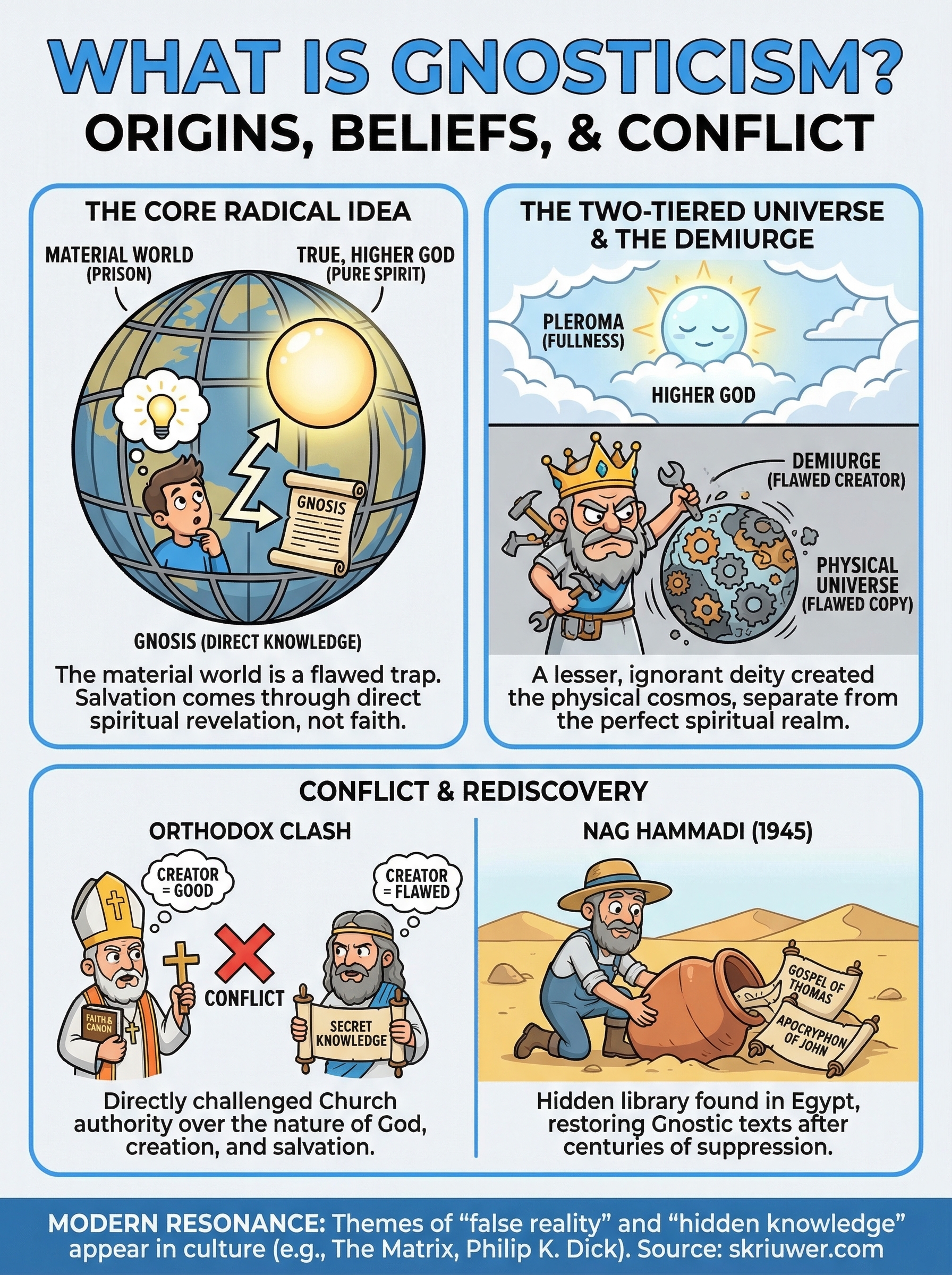
Most people have never heard of Gnosticism. Yet for the first few centuries of the Common Era, it posed the single greatest intellectual threat to what would become orthodox Christianity. So what is Gnosticism, exactly? At its core, it was a collection of religious movements built on a radical idea: that the material world is a prison, and that salvation comes not through faith or obedience, but through direct spiritual knowledge, gnosis in Greek.
Gnostic teachers claimed the God of the Old Testament was not the true God at all, but a flawed or malevolent creator who trapped divine sparks inside human bodies. The real God existed beyond this world entirely, accessible only through inner revelation. These claims put Gnostics on a direct collision course with Church authorities, who spent centuries trying to stamp out their writings and erase their ideas from history. They nearly succeeded. Until 1945, almost everything we knew about Gnosticism came from the people who hated it most.
This is exactly the kind of buried history that Skriuwer exists to publish and distribute, perspectives that mainstream institutions once tried to silence. In this article, we break down Gnosticism's origins in the Greco-Roman world, its core dualistic beliefs about spirit and matter, its many competing schools of thought, and the bitter conflict with early Christianity that shaped Western religion for centuries to come.
Why Gnosticism Matters Today
Most discussions of ancient religion treat it as a purely academic concern, something for historians and theologians to sort out while everyone else moves on. But Gnosticism cuts far closer to the present than that. The questions Gnostics raised about institutional power, the nature of reality, and who controls access to truth never went away. They just changed form. If you want to understand how Western culture thinks about spirituality, rebellion, and hidden knowledge, Gnosticism is one of the clearest starting points available.
The rediscovery that changed everything
In 1945, a farmer in upper Egypt named Muhammad Ali al-Samman broke open a sealed jar near Nag Hammadi and pulled out thirteen leather-bound books. These codices contained over fifty Gnostic texts that the orthodox Church had worked to suppress for more than a thousand years. Before that find, scholars had to reconstruct Gnostic belief almost entirely from hostile sources, figures like Irenaeus of Lyon, who invested considerable energy labeling these movements as dangerous heresy. The Nag Hammadi discovery gave Gnostics back their own voice.

The Nag Hammadi library proved that early Christianity was far more diverse than orthodox history had admitted, and that the suppression of alternative texts was deliberate, not accidental.
That recovery matters because it reshaped how historians understand the formation of Christianity itself. The question of what is Gnosticism became impossible to separate from the question of how and why certain ideas were declared heresy while others became doctrine. Scholars like Elaine Pagels brought this material into mainstream academic conversation and demonstrated that the politics of early religion were every bit as contested as the politics of any modern institution. The winners wrote the history, and the losers' texts were buried in the Egyptian desert for sixteen centuries.
Where gnostic ideas live in modern thought
You do not need a theology degree to have absorbed Gnostic thinking. The idea that the visible world is a constructed deception and that a truer reality lies beneath the surface runs through an enormous range of modern culture. The Matrix trilogy built its entire premise on a Gnostic framework: a false reality shaped by a false creator, and a small group of people who gain the knowledge to see through it. Philip K. Dick, one of the most influential science fiction writers of the twentieth century, wrote extensively about what he called the "Black Iron Prison," a concept that maps directly onto the Gnostic demiurge and the trapped divine spark.
These are not coincidences. Writers, filmmakers, and philosophers have consciously drawn on Gnostic sources, sometimes naming them directly and sometimes folding them into secular or genre frameworks. When you encounter a story built on the premise that official reality is a constructed lie and that private revelation is the only genuine path to freedom, you are watching a Gnostic structure in action, whether or not the creator knows that term.
Why it connects to suppressed history
Skriuwer publishes books that cover what mainstream institutions prefer to leave buried. Gnosticism belongs to that same category. The texts were physically destroyed, the teachers were branded heretics, and the tradition was nearly erased from the historical record by the very institution it challenged. That is not an accident of history. It is a deliberate pattern, and recognizing that pattern sharpens how you read other suppressed narratives.
Understanding why powerful institutions move to eliminate certain ideas gives you a practical framework for approaching other contested histories. Whether the subject is political, religious, or scientific, the mechanics of suppression tend to follow similar logic: control the sources, discredit the challengers, and let time do the rest. Gnosticism is one of the oldest and best-documented cases of that process at work, which makes it one of the most instructive places to start if hidden history is what interests you.
What "Gnosticism" Means and What It Does Not
The word Gnosticism comes from the Greek gnosis, which simply means knowledge. But not the kind you get from a textbook or a lecture. Gnostics used the term to describe a direct, personal experience of spiritual truth, closer to what you might call revelation or inner illumination than to anything you can memorize and repeat. When scholars ask what is Gnosticism, this is the starting point: a tradition that placed private spiritual insight above institutional authority or doctrinal conformity.
What the term actually covers
Gnosticism is not a single religion with a fixed founder, a central church, or one definitive text. It is an umbrella term that historians apply to a wide range of movements from the first through fourth centuries CE, all of which shared certain overlapping features. These include a sharp distinction between the material world and a higher spiritual realm, the belief that a lesser and flawed deity created the physical universe, and the conviction that salvation comes through knowledge rather than grace or ritual.
Calling Gnosticism a single religion is like calling "Protestant" a denomination: the label covers far more internal variation than it first appears.
Because these movements varied so widely, modern scholars sometimes debate whether Gnosticism is even a useful category. Some researchers prefer to speak of specific groups by name, such as the Valentinians or the Sethians, rather than grouping them all under one label. That debate matters for academic precision and historical accuracy, but for practical purposes the shared framework is real enough to discuss together.
What the term does not mean
Gnosticism does not mean simply believing in hidden or secret knowledge. Plenty of mystical traditions value esoteric insight without sharing Gnostic cosmology, and lumping them together causes real confusion. Mystery cults, Neoplatonism, and later traditions like Hermeticism all valued inner knowledge, but their views on the material world and the nature of the creator were fundamentally different from the Gnostic position.
You should also resist treating Gnosticism as a synonym for conspiracy thinking or general paranoia, even though some modern uses of the term drift in that direction. The Gnostic claim was a cosmological one rooted in specific myths and texts, not a blanket suspicion that institutions deceive the public. Keeping that distinction clear lets you read both ancient Gnostic sources and modern references to the tradition with far greater accuracy and confidence.
Where Gnosticism Came From in the Ancient World
Gnosticism did not emerge from one teacher or one place. It grew out of a specific historical moment when Jewish scripture, Greek philosophy, and Eastern religious dualism collided inside the cosmopolitan cities of the Roman Empire. If you want to understand what is Gnosticism at its roots, you need to look at this cultural collision first, because no single intellectual tradition produced it on its own.
The Greco-Roman world as a seedbed
The first and second centuries CE were a period of intense religious experimentation across the Roman world. Trade routes connected Alexandria, Antioch, Rome, and dozens of other cities, and ideas traveled with merchants, teachers, and missionaries. Educated people in these urban centers had direct access to Platonic philosophy, which drew a sharp distinction between the perfect, eternal realm of pure intellect and the inferior, constantly changing material world. That philosophical framework gave early Gnostic teachers a ready-made vocabulary to explain why physical existence felt fundamentally corrupt.

The Platonic argument that matter is a degraded copy of a higher reality gave Gnosticism its intellectual backbone, and Gnostic teachers adapted it into a full cosmological system with a creator, a fall, and a path to escape.
Syria and Egypt were particularly important centers of early Gnostic activity. Alexandria in particular was home to a sophisticated intellectual culture that blended Jewish theology with Greek metaphysics, and several major Gnostic teachers, including Basilides and Valentinus, either worked there or drew heavily from its traditions. You can think of Alexandria as a kind of intellectual mixing point where the ingredients for Gnostic thought became available in one place.
Jewish apocalyptic thought and Persian dualism
Jewish religious writing in the centuries before and after the Common Era included a strong apocalyptic strand, one that divided reality sharply between light and darkness, the divine and the corrupt. Gnostic thinkers took that framework and pushed it further, asking whether the creator of the physical world itself might belong to the wrong side of that divide. That was a dramatic departure from mainstream Judaism, but it built on existing tensions within Jewish theology about the origin of evil and why a good God would allow a broken world to exist.
Persian religious thought, particularly from the Zoroastrian tradition, added another layer by contributing a sharp cosmic dualism to the broader intellectual environment. The idea that two fundamental forces, one good and one corrupt, governed existence mapped directly onto what Gnostic teachers were constructing through their reading of scripture and philosophy. None of these influences alone created Gnosticism, but their combination, in cities where educated people from multiple traditions lived and argued side by side, produced something genuinely new.
Core Gnostic Beliefs in Plain English
If someone asks you what is Gnosticism at its most basic level, the answer starts with one conviction: the world you can see and touch is not the real world. Every major Gnostic teaching builds outward from that premise. Reality, in the Gnostic framework, has two distinct layers. The higher layer is a perfect, purely spiritual realm beyond time and matter. The lower layer is the physical universe, a flawed and inferior copy created by a being who either lacked the skill or the integrity to do better. Everything Gnostic thought has to say about salvation, identity, and purpose flows directly from this foundational split.
The Two-Tiered Universe
Gnostic thinkers pictured existence as a hierarchy with pure spirit at the top and dense matter at the bottom. The highest God, often called the True Father or the Invisible Spirit, existed entirely outside the physical cosmos and had no role in creating it. Below this highest God sat a series of divine emanations, spiritual beings arranged in a kind of cosmic architecture. The physical world sat at the very bottom of this structure, as far from genuine divinity as anything could be.

That positioning was not neutral. Matter was considered a kind of prison, not a gift. The body you inhabit, the rocks, the cities, the sky you look at every day: all of it belonged to the wrong side of the divide. Gnostic teachers used the language of captivity without apology, and that framing shaped every other belief in the system.
The Divine Spark and Why You Have One
At the center of Gnostic anthropology sits the idea that human beings carry a fragment of genuine divine light inside them, what the texts call a pneuma or divine spark. This spark did not originate in the material world. It fell into physical existence through a cosmic accident, and it now sits trapped inside a body and a world that work, consciously or not, to keep it ignorant of its true origin.
The Gnostic claim was not that people are sinners who need redemption, but that people are divine beings who need to wake up.
Where orthodox Christianity offered salvation through faith, grace, and sacrament, Gnostics offered salvation through direct inner knowledge. You did not need a priest or a ritual to escape the material trap. You needed revelation about your own nature and origin, the realization that your divine spark was foreign to this world and fully capable of returning to its source.
Key Myths and Terms: Demiurge, Sophia, Pleroma
If you want to understand what is Gnosticism at a practical level, you need to know the three terms that appear in almost every Gnostic text: the demiurge, Sophia, and the pleroma. These are not interchangeable labels for vague spiritual concepts. Each one names a specific player or location in the Gnostic cosmological story, and the relationships between them explain why Gnostic thinkers viewed the physical world the way they did.
The Demiurge: The God Who Got It Wrong
The demiurge is the figure Gnostics identified as the creator of the material world, and he occupies an unusual position in the story. He is not pure evil in most Gnostic accounts, but he is profoundly flawed. He either believes himself to be the only God, unaware of the higher spiritual realm above him, or he actively works to keep human beings ignorant of their true divine origin. Gnostic teachers identified this figure with the God of the Hebrew Bible, the same God who declared himself jealous, issued laws, and punished disobedience.
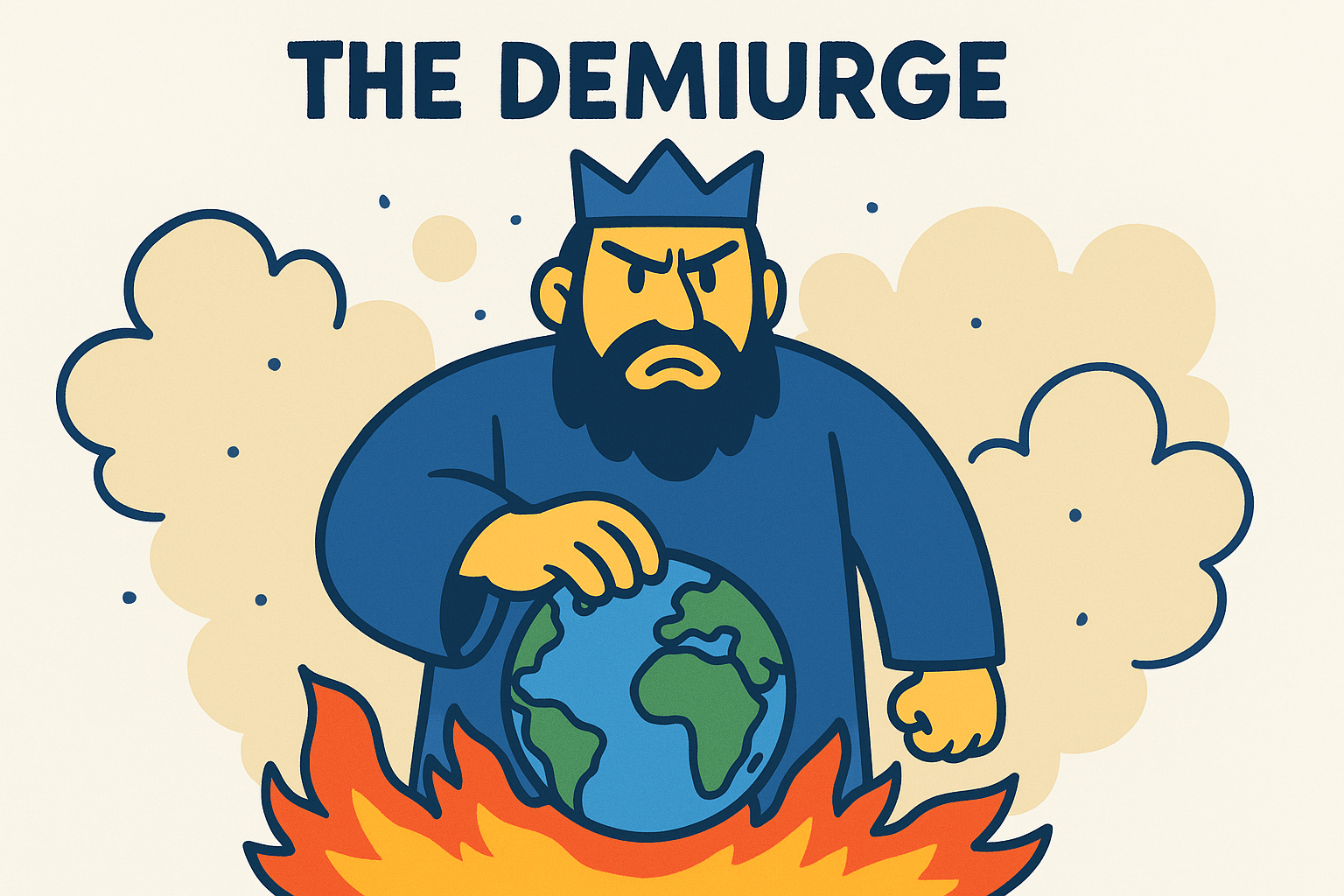
That identification was the point where Gnostic thought became most threatening to orthodox religion. By reframing the creator as a lesser being, Gnostics inverted the entire authority structure of Judaism and mainstream Christianity. The law-giver became the jailer, and obedience to his commands became a form of spiritual captivity rather than virtue.
Sophia and the Fall into Matter
Sophia, whose name means wisdom in Greek, is the divine figure whose mistake sets the entire Gnostic story in motion. In most versions of the myth, Sophia belongs to the perfect spiritual realm above and acts without the consent or knowledge of the higher divine powers. Her action, sometimes described as a desire to create or to know, produces a flawed result: the demiurge and, through him, the material world itself.
Sophia's story reframes the origin of the physical world as a cosmic accident caused by misapplied wisdom, not a deliberate act by a good and capable creator.
Her eventual restoration is often central to the Gnostic redemption narrative, making her one of the most complex and recurring figures across different Gnostic schools.
The Pleroma: The Fullness Above
The pleroma, which translates directly as fullness, is the name Gnostic texts give to the complete, perfect spiritual realm where the true God and the divine emanations exist. It stands in direct contrast to the deficient and broken material world below. Your divine spark, in the Gnostic framework, originally came from the pleroma and carries the potential to return there. Every Gnostic teaching about salvation is ultimately a teaching about how that return becomes possible.
Gnostic Texts and Groups: Nag Hammadi and Beyond
When you try to understand what is Gnosticism through primary sources rather than through its opponents' descriptions, the Nag Hammadi library is your most important starting point. That collection, discovered in 1945 in upper Egypt, contains fifty-two surviving texts written in Coptic that represent the closest thing we have to Gnostic thought in its own words. Before that discovery, almost everything scholars knew came from writers like Irenaeus and Tertullian, men who considered these movements dangerous and wrote specifically to refute them.
What the Nag Hammadi Library Actually Contains
The thirteen codices found at Nag Hammadi are not a single unified scripture. They include gospels, apocalypses, prayers, philosophical dialogues, and mythological narratives, and they vary considerably in style and focus. The Gospel of Thomas is perhaps the most widely read today: it presents 114 sayings attributed to Jesus with no narrative frame and no crucifixion, placing all emphasis on direct spiritual insight rather than ritual or faith. The Gospel of Philip and the Apocryphon of John provide dense cosmological material about the demiurge, Sophia, and the pleroma that gives researchers the most detailed window into Gnostic mythological structure.
The Nag Hammadi texts did not just fill gaps in the historical record; they demonstrated that early Christian diversity was actively suppressed rather than simply fading out on its own.
Scholars believe these texts were buried deliberately, likely by monks from a nearby monastery who were protecting them from destruction ordered by church authorities following the Council of Nicaea in 325 CE. That context tells you as much about the politics of early religion as the texts themselves do.
The Major Gnostic Schools
Gnosticism produced several distinct movements with their own teachers, texts, and interpretations. The Valentinians, founded by Valentinus in the second century CE, were among the most intellectually sophisticated and came closest to operating inside mainstream Christian communities. The Sethians built their cosmology around Seth, the third son of Adam, as a figure of divine knowledge, and produced some of the most elaborate mythological systems in the Nag Hammadi collection. The Marcionites, led by Marcion of Sinope, took a stripped-down approach by rejecting the Hebrew Bible entirely and recognizing only a revised version of Paul's letters as authoritative. Each group approached the same core dualistic premise from a different angle, which is why the label Gnosticism covers such varied material and why reading specific group texts rather than general summaries gives you a far more accurate picture.
Gnosticism vs Christianity: Where They Clash
Once you understand what is Gnosticism at its core, the conflict with orthodox Christianity becomes impossible to miss. These were not two traditions disagreeing about minor theological details. They held fundamentally opposite positions on who created the world, what that creation means, and how human beings can be saved from it. Every major point of Gnostic teaching produced a direct collision with what the orthodox Church was building.
The Creator God Problem
The sharpest clash between Gnosticism and orthodox Christianity centers on the identity of the creator. Orthodox Christianity held that the God of the Hebrew Bible was the supreme and wholly good creator, the same God worshipped by Jesus and responsible for everything that exists. Gnostics disagreed completely. For them, the creator of the physical world was the demiurge, a flawed and ignorant being who either misunderstood or actively opposed the higher spiritual realm.
That single disagreement made compromise between Gnostic and orthodox Christianity structurally impossible, because it reached all the way down to the foundation of the faith.
By identifying the God of scripture as a lesser figure, Gnostic teachers dismantled the authority of the entire biblical narrative in one move. The law, the covenant, the history of Israel, and the commands issued to Moses all became the products of a being you needed to see through rather than obey.
Salvation: Knowledge vs. Faith and Grace
Orthodox Christianity taught that salvation came through faith in Christ's death and resurrection, mediated by the Church through sacrament and scripture. You needed the institution to access the path. Gnostic teachers rejected this entirely. Direct inner knowledge was the only thing that could free the divine spark from its material trap, and no priest, ritual, or institution could provide or withhold that knowledge on your behalf.
This made Gnosticism a direct threat to the Church's authority structure. If you could achieve salvation through private revelation, the Church became unnecessary. That was not a position the emerging orthodox hierarchy could tolerate, which explains why figures like Irenaeus wrote entire volumes specifically designed to refute Gnostic claims and mark their teachers as dangerous.
Canon, Scripture, and Who Decides
The two traditions also clashed over which texts counted as authoritative. Orthodox Christianity worked through the first several centuries to define a fixed canon and exclude alternatives. Gnostic groups produced their own gospels, apocalypses, and cosmological texts and treated them as equally or more valid than what the Church eventually canonized. That dispute over textual authority was inseparable from the broader power struggle about who controlled access to truth and who had the right to speak for the divine.
Common Misconceptions and Modern "Gnostic" Labels
When people encounter the term Gnosticism for the first time, they often carry assumptions that distort what the tradition actually was. Part of the problem is that modern culture has stretched the word far beyond its historical meaning, attaching it to everything from conspiracy theories to New Age spirituality. If you want a clear answer to what is Gnosticism, you need to separate the genuine historical tradition from the loose, often inaccurate labels that get applied to it today.
Gnosticism Is Not the Same as General Esotericism
One of the most common errors is treating Gnosticism as a catch-all label for any tradition that values hidden or inner knowledge. Mystery religions, Hermeticism, Neoplatonism, Kabbalah, and various Eastern traditions all place emphasis on esoteric insight, but they do not share the Gnostic cosmological structure. The defining feature of genuine Gnosticism is the specific claim that the material world was created by a flawed lesser deity, and that a higher spiritual realm exists completely outside it. A tradition that simply values inner experience or initiation without that particular cosmological framework is not Gnostic, regardless of how often the word gets attached to it.
Using "Gnostic" as a synonym for esoteric or mystical dilutes the term to the point where it stops meaning anything precise at all.
The Conspiracy Theory Confusion
Because Gnostic thought involves a hidden truth concealed by a powerful and deceptive force, people frequently draw a line straight from Gnosticism to modern conspiracy culture. The comparison has some structural overlap: both involve a small group who sees through an official narrative and a larger population kept in ignorance. But the resemblance stops there. Gnostic cosmology was a theological and metaphysical claim backed by specific texts and mythological frameworks, not a political suspicion about human institutions. Collapsing the two categories makes it harder to think clearly about either one.
How "Gnostic" Gets Misused in Modern Contexts
Today you will encounter the word Gnostic applied to self-help philosophies, online spiritual movements, and political ideologies that bear little relationship to the ancient schools. Some modern groups call themselves Gnostic while holding beliefs that contradict the core Gnostic position on the demiurge, the pleroma, or the nature of salvation. Others use the term simply because it sounds countercultural. When you see the label in a modern context, the most useful question to ask is whether the group or idea actually shares the dualistic cosmology and salvation-through-knowledge framework that defined the historical tradition, because without those, the label is mostly decorative.
How to Recognize Gnostic Themes in Modern Culture
Once you understand what is Gnosticism at its structural core, you start noticing its fingerprints in places you would never expect. The framework does not announce itself with technical labels. Instead, it shows up as a set of recurring narrative patterns: a false or constructed reality, a hidden truth available only to a select few, and a protagonist who gains dangerous knowledge and must act on it.
The False Reality Framework in Film and Fiction
The clearest Gnostic pattern in modern storytelling is the false world narrative, where the visible environment turns out to be a constructed trap designed to keep its inhabitants compliant and ignorant. The Matrix is the example most people reach for first, and it maps almost perfectly: a malevolent system controls reality, most people remain unaware of their imprisonment, and a small group gains the liberating knowledge needed to break free. Philip K. Dick built an entire career around versions of this premise, from The Man in the High Castle to VALIS, where he named the controlling force the Black Iron Prison and described a divine spark of awareness fighting to reassert itself against a dead system.
When a story tells you that the world you see is not the real world, and that freedom comes through recognizing what the system conceals, you are reading a Gnostic structure.
You can apply the same test to a wide range of other films, novels, and television series. Look for stories where official knowledge is portrayed as false or incomplete, where institutions exist to suppress rather than reveal, and where the central character achieves transformation through inner discovery rather than external action or obedience.
The Rebel Who Sees Through the System
A second Gnostic marker is the figure of the awakened outsider, someone who has seen through the dominant reality and now carries knowledge that isolates them from everyone around them. This character type appears constantly in science fiction, literary fiction, and film. They are not simply rebellious. Their rebellion is rooted in a specific kind of knowledge that others around them either cannot access or actively refuse.
Pay attention to how these characters gain their insight. If the story frames the transformation as internal and revelatory rather than the result of following rules or institutional guidance, you are looking at a Gnostic inheritance regardless of the genre label. The knowledge that saves always comes from within, never from compliance with an external authority that claims ownership over truth. That single detail separates a genuinely Gnostic narrative structure from a story that merely uses surface-level rebellion as its theme.
Key Takeaways
Asking what is Gnosticism leads you into one of the most consequential intellectual conflicts in Western history. At its core, Gnosticism held that the material world was a flawed creation built by a lesser deity, that human beings carry a divine spark inside them, and that salvation comes through direct inner knowledge rather than faith or institutional obedience. Those claims put Gnostic teachers on a direct collision course with orthodox Christianity, which worked for centuries to suppress their texts and discredit their ideas.
Understanding this tradition gives you a sharper lens for reading suppressed history, recognizing hidden power structures, and spotting Gnostic narrative patterns everywhere from ancient mythology to modern film. The questions Gnostics raised about who controls truth and who benefits from keeping people ignorant have never stopped being relevant. If this kind of buried intellectual history interests you, explore the titles available at Skriuwer's independent bookstore for more perspectives that mainstream publishers prefer to leave on the shelf.
Recommended Reading
Continue with the suppressed and adjacent intellectual histories Skriuwer covers:
- Best Books on Gnosticism for the reading order that takes you from Pagels to the Nag Hammadi texts themselves.
- Ancient Religious Symbols and Their Meanings for the iconography that runs through Gnostic, pagan, and early Christian art.
- What Is Paganism? for the pre-Christian religious landscape Gnostic teachers were arguing with.
- Best Books About Cults for the modern study of high-control religion and the suppression of dissenting voices.
- Religion category for the wider reading list on buried theological history.
Your next good book, in your inbox
We only write when we find a book worth your time. Hand-picked recommendations across history, mythology, true crime and more.
Books You Might Like

Man's Search for Meaning
Viktor E. Frankl

Meditations
Marcus Aurelius

The Power of Now
Eckhart Tolle

The Daily Stoic: 366 Meditations on Wisdom, Perseverance, and the Art of Living
Stephen Hanselman Ryan Holiday