The Best Way to Learn Icelandic as an English Speaker
Icelandic (íslenska) is spoken by about 350,000 people, almost all of them in Iceland. Here is what makes it hard, what makes it easier than it looks, and the plan that works.
The short answer
Start with the free Icelandic Online course from the University of Iceland, learn the four cases from the start, and book a native tutor for speaking. Icelanders switch to English quickly, so online lessons are often the easiest place to practise.
Is Icelandic hard to learn?
The US Foreign Service Institute, which trains American diplomats, puts Icelandic in Category III, the harder group (about 1,100 class hours). Icelandic is North Germanic, related to Norwegian, Danish and Swedish, and further back to English, and it uses Latin alphabet with þ, ð, æ and ö.
What makes it hard
- Icelandic has kept old grammar that the other Nordic languages dropped: four cases, three genders and many noun groups.
- Pronunciation has some sounds English lacks, like the double-l in fjall (mountain).
- Icelandic creates new words from old roots instead of borrowing them, so computer is tölva, not komputer.
- In Iceland almost everyone speaks English, so practising in daily life takes persistence.
What works in your favour
- Many basic words are related to English: hús (house), mús (mouse), bók (book), móðir (mother).
- Spelling has changed little in centuries, so you can read old sagas with modern Icelandic.
- The University of Iceland offers a full course for free online.
How long does it take to learn Icelandic?
Professional working level takes about 1,100 hours of study for an English speaker, according to the FSI. Those are hours in small, intensive classes. On your own, count on more.
At one hour a day, 1,100 hours is about 36 months. At 30 minutes a day, double it. You will hold simple conversations long before that: most learners manage everyday topics after three to six months of daily practice with a tutor.
The best way to learn Icelandic for free
- Icelandic Online: a free course from the University of Iceland, from beginner to advanced.
- BÍN (Beygingarlýsing íslensks nútímamáls): the official database with every form of every Icelandic word.
- RÚV: Icelandic public broadcasting, with news and TV online.
Free material covers reading and listening well. Speaking is the gap: you need someone who answers back.
The best way to learn Icelandic online
One-on-one lessons with a native tutor are the fastest way to start speaking. You get corrected on the spot, you hear real pronunciation, and the lesson goes at your pace. Many tutors offer a cheap trial lesson, so you can try two or three before you pick one.
A beginner plan for your first month
- Week 1: Create a free account on Icelandic Online and do the first module. Learn the sounds of þ, ð and the double-l before you learn many words.
- Weeks 2 to 4: learn the 300 most common words and the basic sentence patterns, 20 to 30 minutes a day with flashcards and a course.
- Every day: 15 minutes of listening, even if you understand little. Your ear needs time before your mouth.
- From week 3: one or two short lessons a week with a native tutor, and easy reading at your level.
Can you learn Icelandic on Duolingo?
No, Duolingo does not offer Icelandic. Icelandic Online, a tutor and uTalk are the best substitutes.
Read Icelandic from the first week
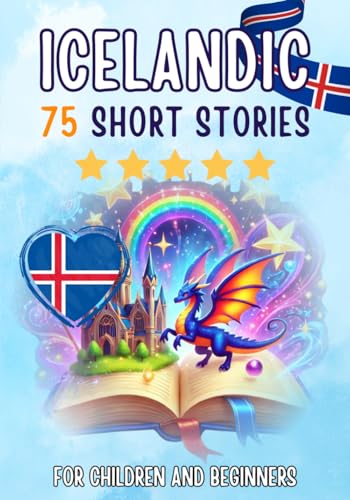
Short stories with the English text next to the Icelandic let you read real sentences before you could manage them alone. You check the meaning without a dictionary and keep going.
Questions about learning Icelandic
What is the best way to learn Icelandic?
Start with the free Icelandic Online course from the University of Iceland, learn the four cases from the start, and book a native tutor for speaking. Icelanders switch to English quickly, so online lessons are often the easiest place to practise.
Is Icelandic hard to learn for English speakers?
The US Foreign Service Institute puts Icelandic in Category III, the harder group (about 1,100 class hours). The main hurdle: Icelandic has kept old grammar that the other Nordic languages dropped: four cases, three genders and many noun groups.
How long does it take to learn Icelandic?
Reaching professional level takes about 1,100 hours of study for an English speaker. At one hour a day that is roughly 36 months. Basic conversation comes much sooner, usually within the first few months of daily practice.
What is the best way to learn Icelandic for free?
Start with Icelandic Online, BÍN (Beygingarlýsing íslensks nútímamáls), RÚV. Add free native listening every day, and read easy texts at your level. Free resources cover reading and listening well; speaking is where a tutor or a language partner makes the difference.
Can you learn Icelandic on Duolingo?
No, Duolingo does not offer Icelandic. Icelandic Online, a tutor and uTalk are the best substitutes.
Is Icelandic harder than Norwegian?
Much harder. Norwegian dropped the cases and most verb endings, while Icelandic kept them. The FSI puts Norwegian in its easiest group and Icelandic in the harder group, close to twice the class hours.
Learn another language
Looking for reading material? See the best language learning books.