Ancient Civilizations Timeline 2026: 12 Major Cultures Mapped Side by Side
Updated May 2026 to reflect the latest reading on Bronze Age trade networks and the revised radiocarbon timeline for the Indus Valley civilization.
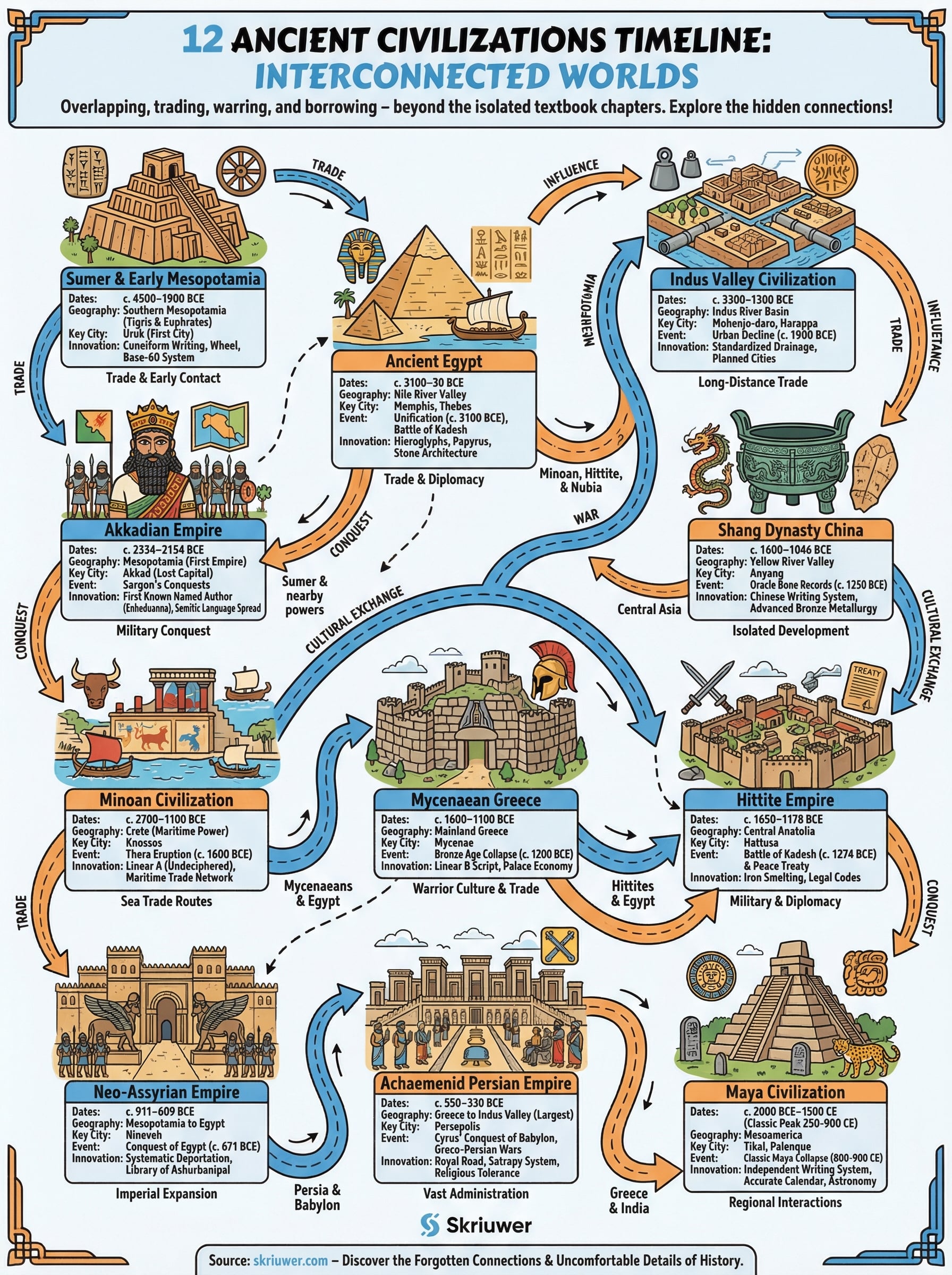
Most people learn about ancient civilizations as isolated chapters in a textbook, Egypt here, Rome there, China somewhere else. But lay them all on a single ancient civilizations timeline, and something striking emerges: these cultures overlapped, traded, warred, and borrowed from each other in ways that standard history classes rarely cover.
This article maps out 12 major civilizations in chronological order, from the earliest Mesopotamian city-states to the fall of Rome. If you want to dig deeper into the Roman entries on this timeline, our companion guide to the best books about ancient Rome ranks the strongest one-volume histories of the Republic and Empire. For a single ranked reading order that runs across every civilization on this timeline, see the Skriuwer guide to the best books about ancient civilizations. You'll find dates, key events, and maps that show not just when each civilization rose and fell, but how they existed alongside one another, sometimes separated by thousands of miles, sometimes sharing a border and a battlefield.
At Skriuwer, we publish books that dig into the parts of history that mainstream sources gloss over, the uncomfortable details, the forgotten connections, the stories that didn't make the final edit. Ancient history is full of exactly that. Consider this timeline your starting point: a clear, chronological framework to build on as you explore deeper through our catalog and beyond.
1. Skriuwer reading path for ancient timelines
Before you jump into the ancient civilizations timeline entries below, it helps to know how to use what you're reading. This section gives you a practical framework for turning dates and key events into real historical understanding, along with guidance on how to find books that support that kind of depth.
What this guide helps you understand
This guide shows you not just when each civilization existed, but how each one connected to the others through trade, conflict, and cultural exchange. By the time you work through all 12 entries, you'll carry a mental map of the ancient world that places each society in relation to its neighbors, rather than treating each as an isolated chapter in a disconnected story.
Once you see civilizations as overlapping systems rather than separate stories, the ancient world becomes far more readable.
How to pick reliable books for ancient history
The quality of a book on ancient history depends on sourcing and transparency. Look for works that cite primary sources, name the scholars or archaeologists behind their claims, and acknowledge gaps in the record rather than presenting speculation as established fact.
At Skriuwer, the titles we carry on ancient and dark history hold to that standard. They are written for readers who want depth over simplification and who are comfortable sitting with open questions.
How to build a focused reading list by region and era
Start by picking one region or one era and reading two or three titles that cover it from different angles. If you focus on Mesopotamia, pair a broad survey with a more specialized archaeological study on the same period. This layered approach builds a foundation that makes every subsequent book easier to place in context.
- Choose a starting region: Mesopotamia, Egypt, the Indus Valley, or the Americas
- Read one broad survey, then one specialist title on the same area
- Add a primary source collection if one exists in translation
- Expand outward to neighboring civilizations on the timeline
How to cross-check dates, names, and claims
Ancient history contains more contested dates and disputed names than most readers expect. When two sources disagree on a date, note both figures and look for the reasoning each author provides.
Written records and physical evidence frequently conflict, and understanding why that happens makes you a sharper reader of any ancient history text going forward.
2. Sumer and early Mesopotamia
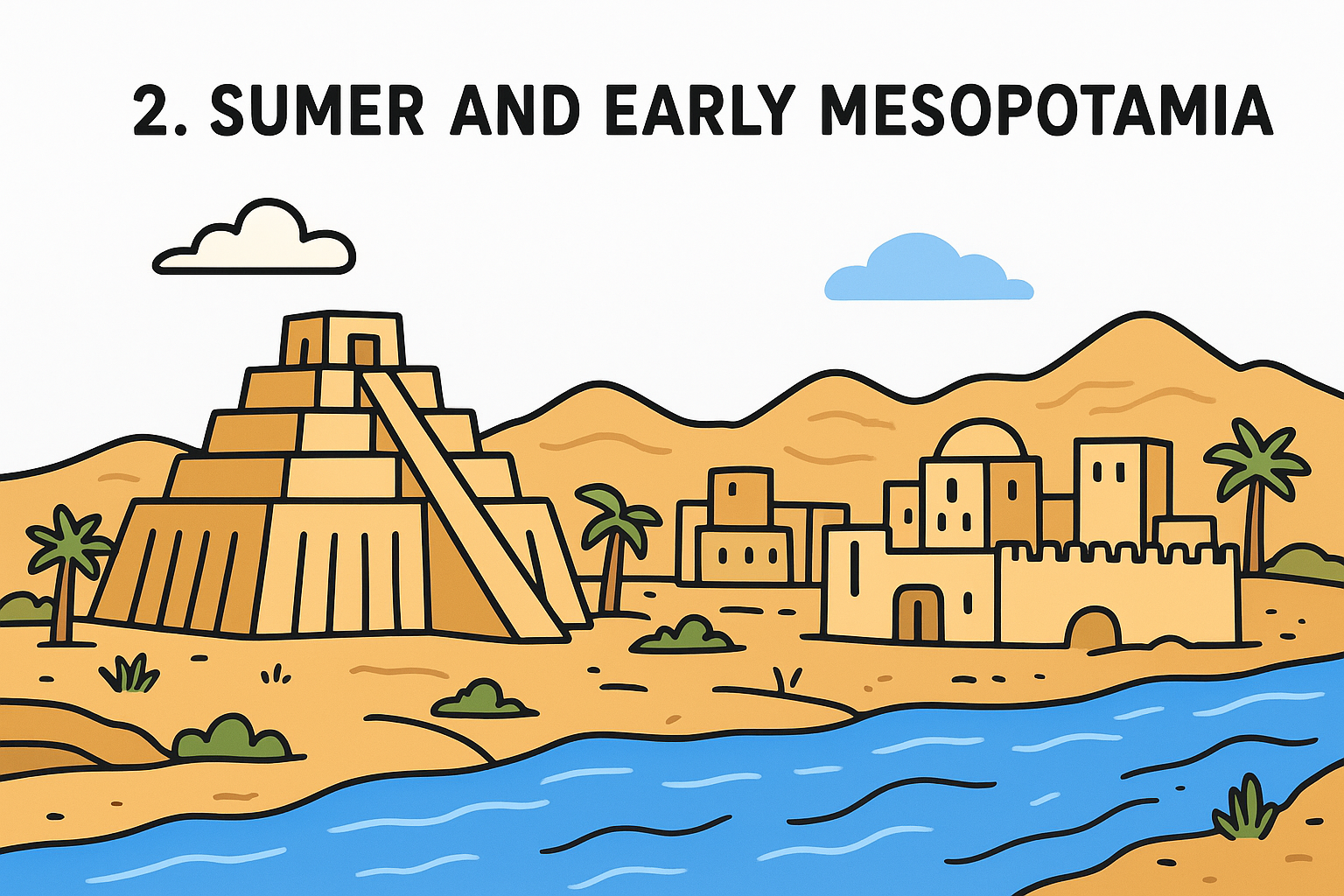
Sumer sits at the oldest end of any ancient civilizations timeline, making it the natural starting point for understanding how complex societies first formed. Located in southern Mesopotamia, roughly present-day southern Iraq, Sumer produced the world's first cities, first writing system, and first legal codes.
Dates and core geography
Sumer flourished from approximately 4500 BCE to 1900 BCE, spanning the flat, fertile land between the Tigris and Euphrates rivers. This region, part of the broader Fertile Crescent, depended heavily on irrigation to sustain agriculture at the scale that urban life required.
Map anchors and key cities
The major cities of Sumer include Uruk, Ur, Eridu, Nippur, and Lagash. Uruk, active around 4000 BCE, is widely considered the world's first true city, with a population that likely exceeded 50,000 at its peak.
Uruk's scale and organization set a blueprint that later Mesopotamian cities followed for centuries.
Key events and turning points
The invention of cuneiform writing around 3200 BCE stands as Sumer's most consequential development. Political control shifted repeatedly among city-states, with periods of inter-city warfare separating brief moments of unified rule under figures like the kings of Ur.
Big innovations and cultural impact
Sumerians developed the wheel, the plow, and a base-60 number system that still shapes how you measure time today. Their mythology, including the Epic of Gilgamesh, directly influenced later Babylonian and Biblical literature.
How it overlaps with nearby powers
Sumer maintained trade connections with early Egypt and the Indus Valley through long-distance merchant networks. Around 2334 BCE, the Akkadian Empire under Sargon absorbed Sumerian city-states, which the next entry covers in detail.
3. Ancient Egypt
Ancient Egypt is one of the most recognized entries on any ancient civilizations timeline, yet its full span and internal complexity often get compressed into a few famous pharaohs and monuments. The civilization lasted over three thousand years, making it one of the longest-running in recorded history.
Dates and core geography
Egypt ran from roughly 3100 BCE to 30 BCE, when Rome absorbed the last dynasty under Cleopatra VII. The events that led to that absorption, including Caesar's Egyptian campaign and the civil wars that followed, are covered in our guide to the best books about Julius Caesar. The civilization centered on the Nile River valley, stretching from the Delta in the north to Nubia in the south, with desert on both sides acting as a natural barrier against invasion.
Map anchors and key cities
Memphis served as the early capital, placed strategically at the junction of Upper and Lower Egypt. Thebes (modern Luxor) rose during the Middle and New Kingdoms, functioning as both a political center and home to the massive temple complexes at Karnak and Luxor.
Key events and turning points
The unification of Upper and Lower Egypt around 3100 BCE under Narmer marks the starting point. Later turning points include the Hyksos invasion around 1650 BCE, the reign of Akhenaten and his short-lived monotheistic religion, and the Battle of Kadesh against the Hittites around 1274 BCE.
The Battle of Kadesh produced the oldest surviving peace treaty in recorded history.
Big innovations and cultural impact
Egyptians developed hieroglyphic writing, papyrus production, and large-scale stone architecture centuries before most rival powers. If you trace Greek medicine or astronomy back far enough, you'll find Egyptian scholarship as a primary source.
How it overlaps with nearby powers
Active trade with Sumer and Nubia connected Egypt to the broader ancient world, while repeated wars with the Hittite Empire shaped diplomacy, religion, and material culture across the entire ancient Near East. The Ptolemaic dynasty closed Egypt's three-thousand-year run when Rome annexed it after the death of its final pharaoh, covered in our best books about Cleopatra.
4. Akkadian Empire
The Akkadian Empire holds a specific place on any ancient civilizations timeline as the world's first true empire, a political structure built on military conquest rather than city-state alliances. Under Sargon of Akkad, a previously stateless people rose to dominate the entirety of Mesopotamia in under a generation.
Dates and core geography
The Akkadian Empire ran from approximately 2334 BCE to 2154 BCE, lasting roughly 180 years before internal collapse ended it. Its core territory covered northern and central Mesopotamia, overlapping directly with the Sumerian city-states it absorbed, while military campaigns pushed its reach into modern-day Syria and parts of Iran.
Map anchors and key cities
The capital city of Akkad has never been definitively located by archaeologists, though most researchers place it somewhere near modern Baghdad. Conquered Sumerian cities such as Nippur, Ur, and Lagash remained active under Akkadian administration and continued functioning as religious and commercial centers throughout the empire's lifespan.
Key events and turning points
Sargon's initial conquest of Lugalzagesi of Uruk around 2334 BCE launched the empire. His granddaughter Enheduanna became the world's first known named author, writing hymns that survived for centuries after her death. The empire collapsed around 2154 BCE, likely due to a combination of drought and Gutian invasions from the Zagros Mountains.
Enheduanna's surviving hymns mark one of the earliest moments where an individual human voice steps clearly out of ancient history.
Big innovations and cultural impact
The Akkadians spread Semitic language and administrative practices across Mesopotamia, laying groundwork that Babylonian and Assyrian cultures later built on directly.
How it overlaps with nearby powers
Akkad ran parallel to late Sumerian city-states and maintained contact with early Egyptian trade networks. Its collapse created a power vacuum that the Third Dynasty of Ur briefly filled before Mesopotamia fragmented again.
5. Indus Valley Civilization
The Indus Valley Civilization sits at a surprising position on the ancient civilizations timeline because it rivaled Egypt and Sumer in scale yet left far fewer answers about how it actually worked. No deciphered writing system, no confirmed royal tombs, and no clear record of warfare make it one of the most puzzling major civilizations in the ancient record.
Dates and core geography
This civilization ran from roughly 3300 BCE to 1300 BCE, with its urban peak falling between 2600 and 1900 BCE. It occupied the Indus River basin, spanning modern Pakistan and northwestern India, covering an area larger than either ancient Egypt or Mesopotamia at their respective heights.
Map anchors and key cities
Mohenjo-daro and Harappa serve as the two anchor cities, both built on a grid system with standardized brick sizes. The city of Dholavira in modern India provides additional evidence of how consistently urban planning held across the civilization's broad geography.
Key events and turning points
The urban decline around 1900 BCE marks the most studied turning point you'll encounter in the literature. Climate shifts and river course changes appear to have disrupted agriculture enough to empty major cities across several generations.
The Indus collapse shows how deeply dependent early urban civilizations were on stable water sources.
Big innovations and cultural impact
Residents built standardized drainage systems and municipal water infrastructure that most contemporary civilizations never matched. Uniform weights and measures point to a sophisticated trade economy operating across long distances.
How it overlaps with nearby powers
Indus merchants traded with Sumer and early Mesopotamian city-states, exchanging goods like carnelian beads and cotton textiles. These connections place the civilization firmly within the same interconnected trade network that linked the ancient Near East during the third millennium BCE.
6. Shang Dynasty China
The Shang Dynasty sits at the far eastern edge of any ancient civilizations timeline, developing largely in isolation from the Near Eastern powers dominating the western end of Eurasia. This distance shaped a civilization with distinctly independent innovations in writing, metallurgy, and political structure that emerged without direct outside influence.
Dates and core geography
The Shang Dynasty ran from approximately 1600 BCE to 1046 BCE, occupying the Yellow River valley in northern China. The fertile floodplain supported urban centers and a stratified society with a ruling class, craftsmen, and a large farming population below.
Map anchors and key cities
Anyang, the last and best-documented Shang capital, served as the political and ceremonial center of the dynasty's final phase. Archaeological work there has uncovered royal tombs, bronze workshops, and thousands of oracle bones that give historians their most direct window into Shang governance and religion.
Key events and turning points
The reign of King Wu Ding around 1250 BCE stands as one of the most documented periods, with oracle bone inscriptions recording military campaigns, ritual activity, and royal decisions. The Zhou conquest in 1046 BCE ended the dynasty and shifted political power westward.
Oracle bones represent the oldest confirmed written records in Chinese history and remain a primary source for Shang political life.
Big innovations and cultural impact
Shang craftsmen produced bronze ritual vessels of a complexity unmatched anywhere in the ancient world at that time. Their writing system, recorded on oracle bones and bronze surfaces, became the direct ancestor of modern Chinese script.
How it overlaps with nearby powers
The Shang developed with minimal direct contact with Near Eastern civilizations, though long-distance routes carried goods across Central Asia. Their contemporaries on the timeline include the Hittites, Mycenaean Greece, and the late Indus Valley sites.
7. Minoan civilization
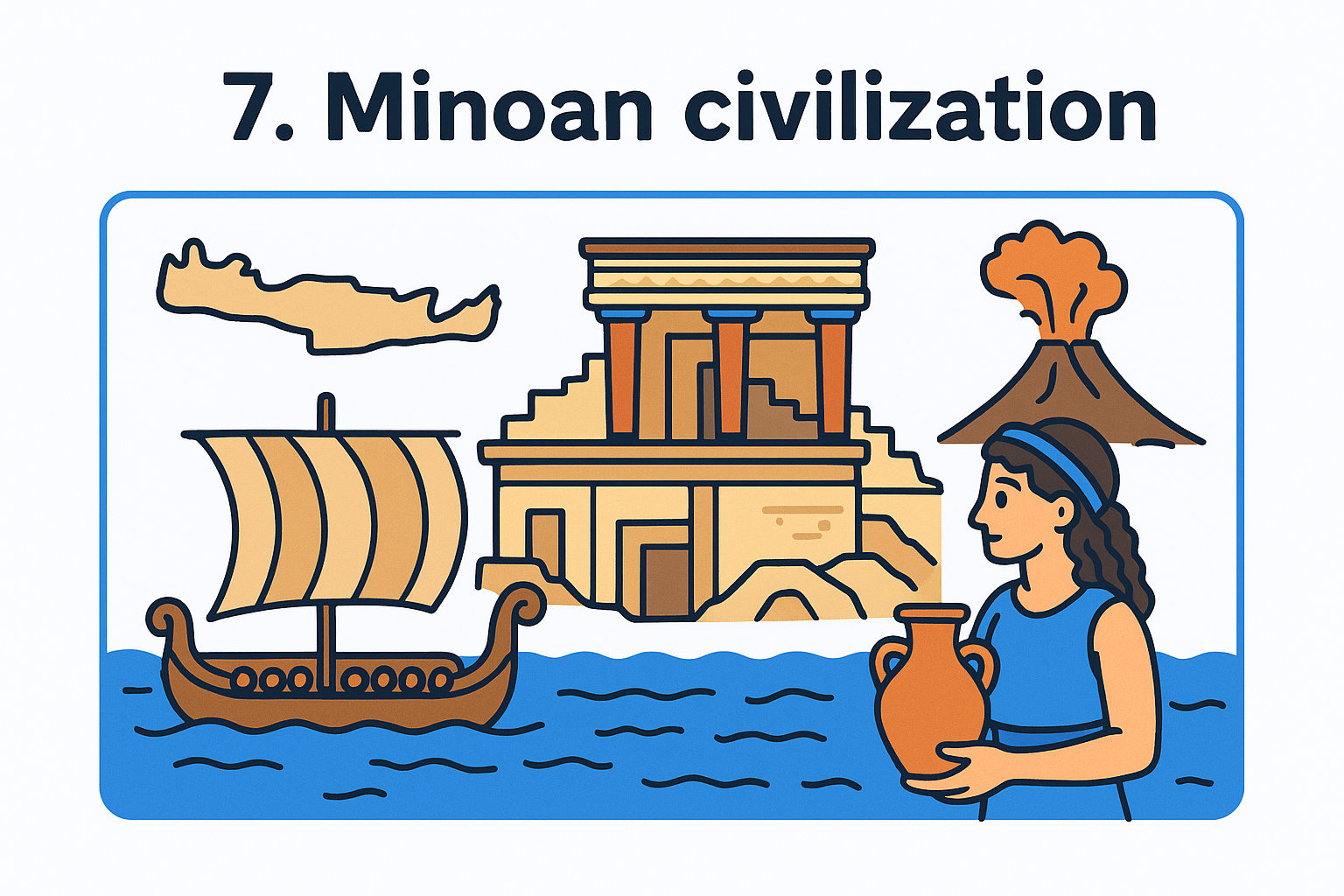
The Minoan civilization adds a distinctly maritime dimension to the ancient civilizations timeline, developing on the island of Crete while most other contemporary powers built inland empires. Minoans traded widely across the eastern Mediterranean, reaching Egypt, the Levant, and Greece with their ships and goods.
Dates and core geography
Minoans flourished from approximately 2700 BCE to 1100 BCE, centered on the island of Crete in the southern Aegean Sea. Their island location gave them natural protection from land-based armies and positioned them to control key sea trade routes across the region.
Map anchors and key cities
Knossos served as the largest and most complex palace site, built across multiple phases and notable for its multi-story architecture. Phaistos and Akrotiri on nearby Thera provide additional evidence of how Minoan culture spread across the Aegean island chain.
Key events and turning points
The volcanic eruption on Thera around 1600 BCE destroyed the Akrotiri settlement and disrupted Minoan trade networks. Mycenaean Greeks absorbed Crete by around 1450 BCE, ending independent Minoan political control.
The Thera eruption remains one of the largest volcanic events in recorded Mediterranean history and reshaped the entire Aegean region.
Big innovations and cultural impact
Minoans developed Linear A, a writing system that remains undeciphered to this day. Their fresco painting tradition and palace construction methods directly influenced later Mycenaean artistic and architectural styles.
How it overlaps with nearby powers
Minoan trade goods appear in Egyptian archaeological sites, confirming active exchange you can trace through artifact distribution and written Egyptian records. Their civilization ran parallel to the Hittite Empire and late Indus Valley sites on the broader timeline.
8. Mycenaean Greece
Mycenaean Greece brings a warrior culture to the ancient civilizations timeline that most readers recognize from Homer's Iliad without realizing the actual historical civilization behind it. These were not mythological figures but a real Bronze Age society that built fortified palaces, traded across the Mediterranean, and collapsed in ways that historians still debate.
Dates and core geography
The Mycenaeans dominated mainland Greece from approximately 1600 BCE to 1100 BCE, centered on the Peloponnese peninsula and extending northward through central Greece. Their geography gave them fertile agricultural land and access to Aegean sea routes that connected them to Crete, Anatolia, and Egypt.
Map anchors and key cities
Mycenae and Tiryns served as the dominant palace centers, both characterized by massive stone fortification walls called Cyclopean masonry. The city of Pylos in the southwest produced the largest archive of Linear B tablets discovered, giving historians their clearest record of palace administration.
Key events and turning points
The destruction of most Mycenaean palace centers around 1200 BCE marks one of the most studied collapses on the entire ancient timeline. This event coincided with the broader Bronze Age Collapse, which brought down the Hittite Empire and disrupted Egypt simultaneously.
The Bronze Age Collapse remains one of the most consequential and debated system failures in ancient history, affecting multiple civilizations within a single generation.
Big innovations and cultural impact
Mycenaeans adapted Linear B script from Minoan Linear A, producing the earliest confirmed writing in Greek. Their palace economy centralized agricultural surplus and craft production under royal control.
How it overlaps with nearby powers
Mycenaean traders operated across the same eastern Mediterranean networks as the Minoans and Egyptians. Their cultural and military overlap with the Hittite Empire during this period connects directly to the next entry on the timeline.
9. Hittite Empire
The Hittite Empire occupies a pivotal position on the ancient civilizations timeline as the dominant power of ancient Anatolia, and one of the few states capable of challenging Egypt militarily and diplomatically during the Bronze Age.
Dates and core geography
The Hittites controlled central Anatolia from approximately 1650 BCE to 1178 BCE, building their state across the rugged plateau of modern Turkey. Their inland geography forced them to develop strong land-based military tactics while remaining dependent on trade routes that connected them to the coastal Mediterranean world.
Map anchors and key cities
Hattusa, located near modern Bogazkoy in north-central Turkey, served as the imperial capital and has yielded thousands of cuneiform tablets that document Hittite law, religion, and diplomacy. The city of Carchemish on the Euphrates acted as a critical trading hub and military stronghold during the empire's expansionist phase.
Hattusa's royal archive remains one of the most important single discoveries in ancient Near Eastern archaeology.
Key events and turning points
The Battle of Kadesh around 1274 BCE against Pharaoh Ramesses II produced the oldest surviving written peace treaty between two sovereign states. A century later, raids by the Sea Peoples destabilized the empire's western borders, contributing directly to its collapse around 1178 BCE.
Big innovations and cultural impact
Hittites were among the first to smelt iron on a significant scale, giving them a military and economic edge. Their legal codes placed notable emphasis on proportional punishment rather than exclusively physical penalties.
How it overlaps with nearby powers
The Hittites fought and negotiated with Egypt, Mycenaean Greece, and Assyria across their entire lifespan, making them one of the most diplomatically connected states on the timeline.
10. Neo-Assyrian Empire
The Neo-Assyrian Empire represents one of the most militarily aggressive states on the ancient civilizations timeline, building a centralized war machine that systematically dismantled rival kingdoms across the Near East. Its scale and administrative methods set a template that later Persian and Macedonian empires studied and adapted.
Dates and core geography
The Neo-Assyrian Empire ran from approximately 911 BCE to 609 BCE, occupying the northern Mesopotamian heartland and expanding outward through military campaigns into Anatolia, the Levant, Egypt, and the Iranian plateau. At its height, it governed more territory than any preceding Near Eastern state.
Map anchors and key cities
Nineveh, located near modern Mosul in Iraq, served as the empire's grandest capital and housed the Library of Ashurbanipal, one of the most significant archive discoveries in ancient Near Eastern scholarship. The city of Assur, the empire's original religious center, remained spiritually important throughout the empire's entire lifespan.
The Library of Ashurbanipal preserved thousands of cuneiform tablets, including earlier copies of the Epic of Gilgamesh.
Key events and turning points
The conquest of Egypt around 671 BCE under Esarhaddon marked the empire's broadest territorial reach. A coalition of Babylonians and Medes destroyed Nineveh in 612 BCE, and the empire fully collapsed by 609 BCE.
Big innovations and cultural impact
Assyrians developed systematic deportation policies to break up conquered populations and prevent rebellion, a governing strategy that reshaped the ethnic composition of the ancient Near East permanently.
How it overlaps with nearby powers
Assyria clashed directly with Egypt, Elam, and Urartu while simultaneously absorbing former Hittite and Israelite territories, connecting it to nearly every other power on the timeline during its peak centuries.
11. Achaemenid Persian Empire
The Achaemenid Persian Empire was the largest political structure on any ancient civilizations timeline, stretching from Greece to the Indus Valley at its height. Its scale and administrative methods connected every major region you've read about in this article.
Dates and core geography
The empire ran from 550 BCE to 330 BCE, founded by Cyrus the Great and ending when Alexander of Macedon destroyed Persepolis. Core territory covered modern-day Iran, with campaigns extending across Anatolia, Egypt, and the northwestern Indian subcontinent.
Map anchors and key cities
Persepolis and Pasargadae served as ceremonial capitals, while Susa and Babylon handled administrative work year-round. This multi-capital structure allowed Persian kings to govern a vast territory without anchoring royal authority to a single location.
Key events and turning points
Cyrus's conquest of Babylon in 539 BCE freed captive peoples, including the Israelites, and established Persian dominance over Mesopotamia. The Greco-Persian Wars between 499 and 449 BCE defined the empire's western limits and ended Persian expansion into Europe.
Cyrus's policy of allowing conquered peoples to keep their own religions set a governing standard that later empires deliberately copied.
Big innovations and cultural impact
Persia built the Royal Road, a 1,600-mile highway connecting Sardis to Susa that moved messages and troops faster than any previous network. Their satrapy system divided territory into governed provinces accountable directly to the king.
How it overlaps with nearby powers
The Achaemenids absorbed former Assyrian and Babylonian lands directly, then clashed with Greek city-states to the west. Their eastern border connected them to early Indian kingdoms, linking the Near East to South Asia on the broader timeline.
12. Maya civilization
The Maya civilization closes out this ancient civilizations timeline as one of the few entries that developed entirely in the Western Hemisphere, independent of every Near Eastern and Mediterranean power covered above. Its scale, intellectual output, and longevity make it an essential counterweight to the Eurasian-heavy picture most ancient history surveys provide.
Dates and core geography
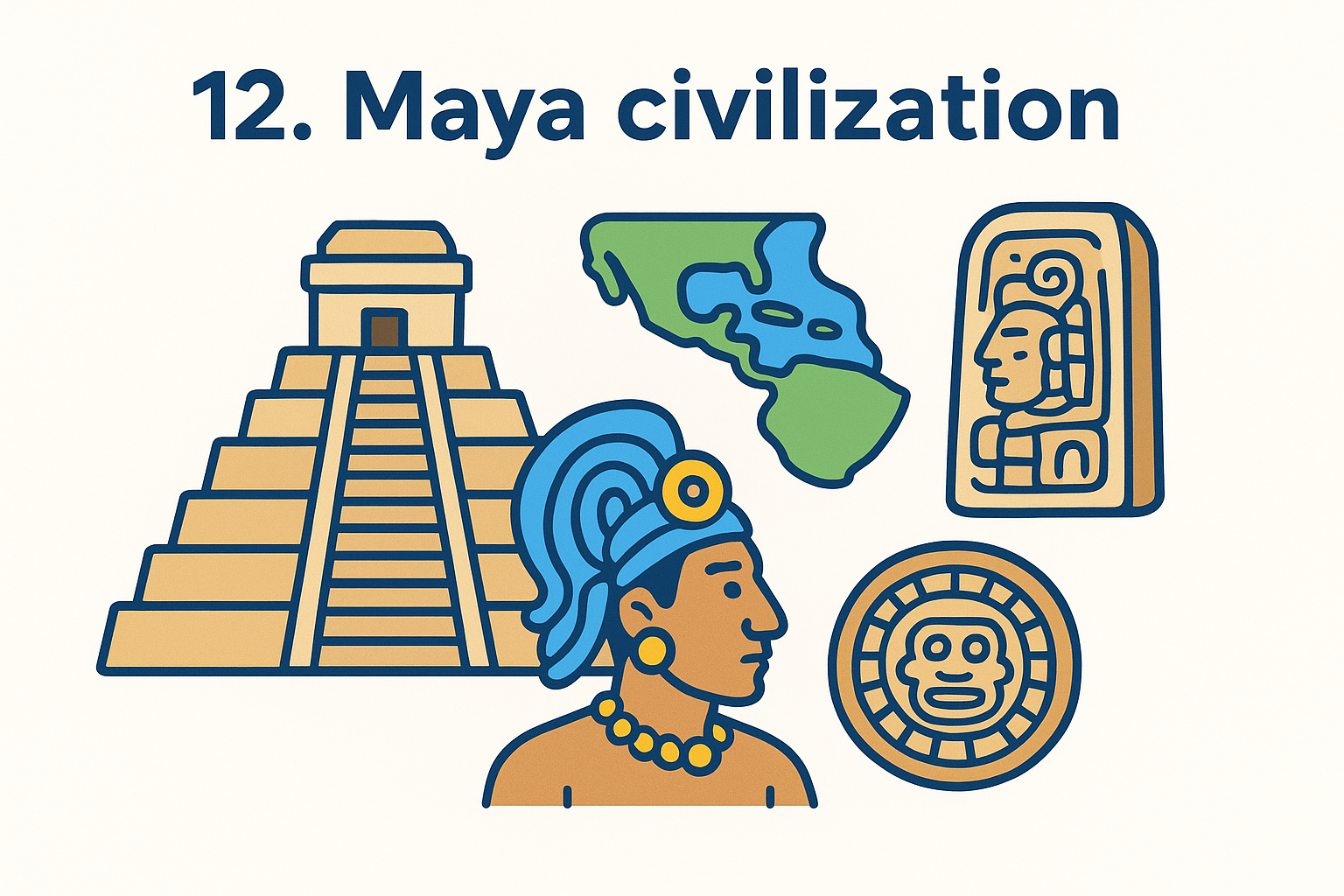
The Maya civilization spanned from roughly 2000 BCE to 1500 CE, though its Classic period peak ran from 250 CE to 900 CE. The civilization occupied southern Mexico, Guatemala, Belize, and parts of Honduras and El Salvador, covering lowland rainforest, highland valleys, and coastal zones simultaneously.
Map anchors and key cities
Tikal in Guatemala and Palenque in Mexico stand as the two most studied Classic period centers, both featuring large temple complexes, royal tombs, and carved stone monuments called stelae. The northern city of Chichen Itza rose to prominence during the Postclassic period and remained active well into the era of Spanish contact.
Key events and turning points
The Classic Maya Collapse between 800 and 900 CE depopulated dozens of southern lowland cities within roughly a century. Scholars link it to drought cycles, political fragmentation, and sustained warfare rather than any single cause.
The Maya collapse illustrates how interconnected environmental and political pressures can dismantle even highly sophisticated urban systems.
Big innovations and cultural impact
Maya scholars developed one of only five independently invented writing systems in human history. Their astronomical calculations produced a calendar system accurate enough that modern researchers still study its mathematical construction.
How it overlaps with nearby powers
The Maya traded and conflicted with other Mesoamerican cultures including Teotihuacan, whose influence appears in Tikal's art and political structure during the Early Classic period. Their civilization ran parallel in time to the Achaemenid Persian Empire and the Roman Republic on the other side of the planet.
What to do next
You now have a working ancient civilizations timeline that covers 12 major societies across five continents and roughly 5,000 years of human history. Each entry gives you enough to place a civilization in context, but the real depth comes when you start reading into the specific events, figures, and controversies behind each one. Pick one civilization that surprised you and start there.
History books that challenge the standard narrative tend to reward that kind of focused attention. Broad surveys are useful, but the most memorable reading happens when you narrow down to one era or region and follow the thread until the picture gets genuinely complicated.
If one civilization pulled you in, follow the thread into a focused reading list. Our ranked guide to the best books about ancient China is a good place to start if the Qin and Han entries caught your attention. To explore books that go further than the typical textbook version of ancient history, browse the history category at Skriuwer. You'll find titles on dark history, ancient cultures, and the gaps that mainstream publishing tends to leave behind.
Your next good book, in your inbox
We only write when we find a book worth your time. Hand-picked recommendations across history, mythology, true crime and more.
Books You Might Like

Sapiens: A Brief History of Humankind
Yuval Noah Harari
The Last Kingdom (The Saxon Stories, Book 1)
Bernard Cornwell

Meditations
Marcus Aurelius

The Hiding Place
Elizabeth Sherrill, John Sherrill Corrie ten Boom