Earliest Civilizations In The World: 8 Oldest Societies and What They Built (2026)
Long before modern nations drew their borders, the earliest civilizations in the world rose along fertile riverbanks, coastal plains, and highland valleys. These societies, spanning from Mesopotamia to Mesoamerica, didn't just survive. They built writing systems, legal codes, irrigation networks, and monumental architecture that still shape how we live, govern, and think thousands of years later.
Yet much of what we know about these civilizations barely scratches the surface. Mainstream accounts tend to repeat the same broad strokes while skipping over the stranger, darker, and more contested chapters of early human history. That's exactly the kind of gap we focus on at Skriuwer, where our catalog digs into the ancient world's untold and overlooked stories, the ones that challenge comfortable narratives and reward genuine curiosity.
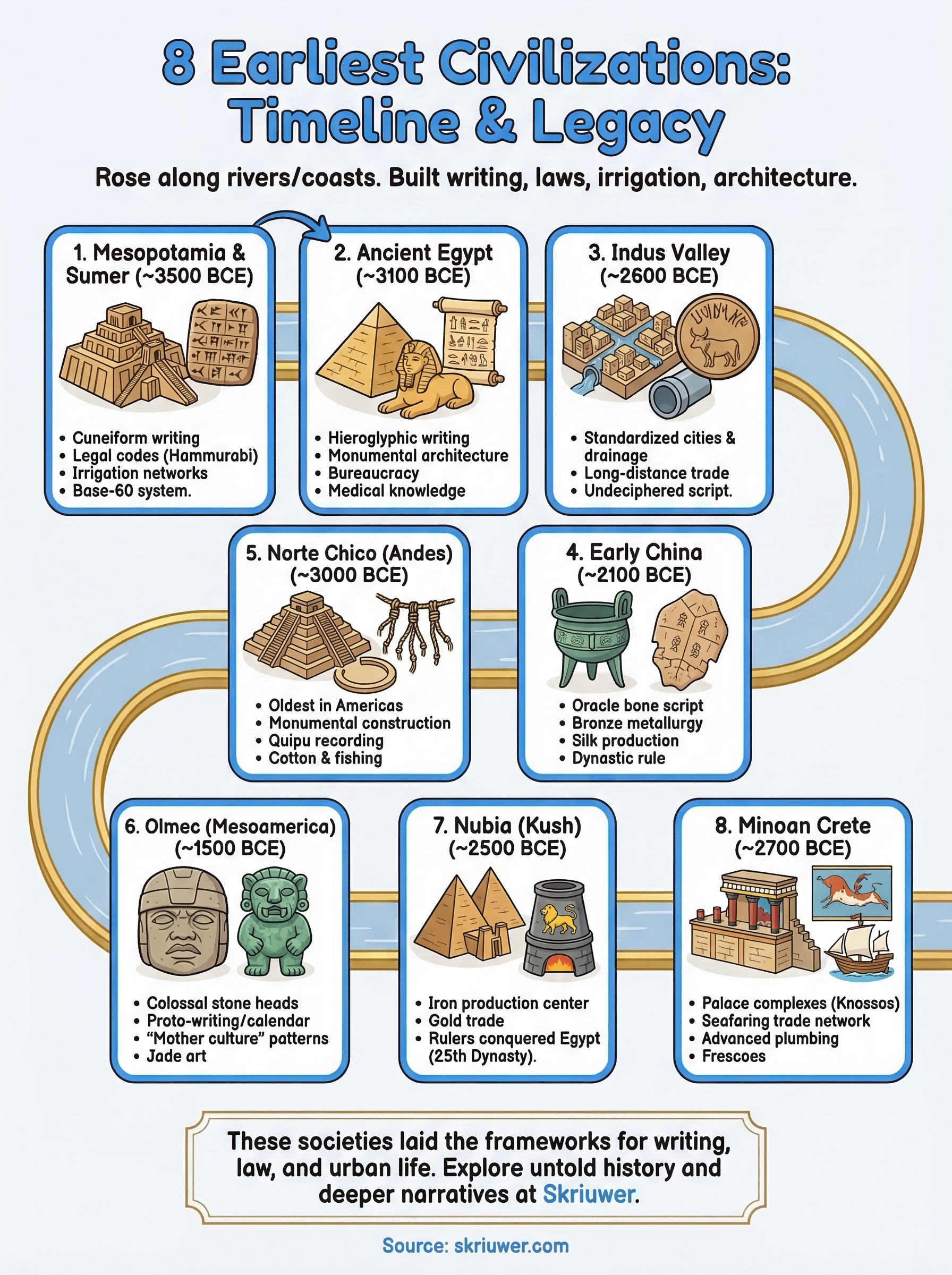
This article walks through eight of the oldest known civilizations in chronological order, covering where they emerged, when they thrived, and what they left behind. From the Sumerians who invented writing to the Olmec who carved colossal stone heads in the jungles of Central America, each entry breaks down the key facts and lasting contributions that earned these societies a permanent place in human history.
1. Mesopotamia and Sumer
When historians trace back the earliest civilizations in the world, Mesopotamia consistently tops the list. Wedged between the Tigris and Euphrates rivers in what is now modern Iraq, this region produced the first known urban societies, legal systems, and written records. Sumer, located in the southern part of Mesopotamia, stands out as the most studied and archaeologically rich of these early cultures.
Timeline and map location
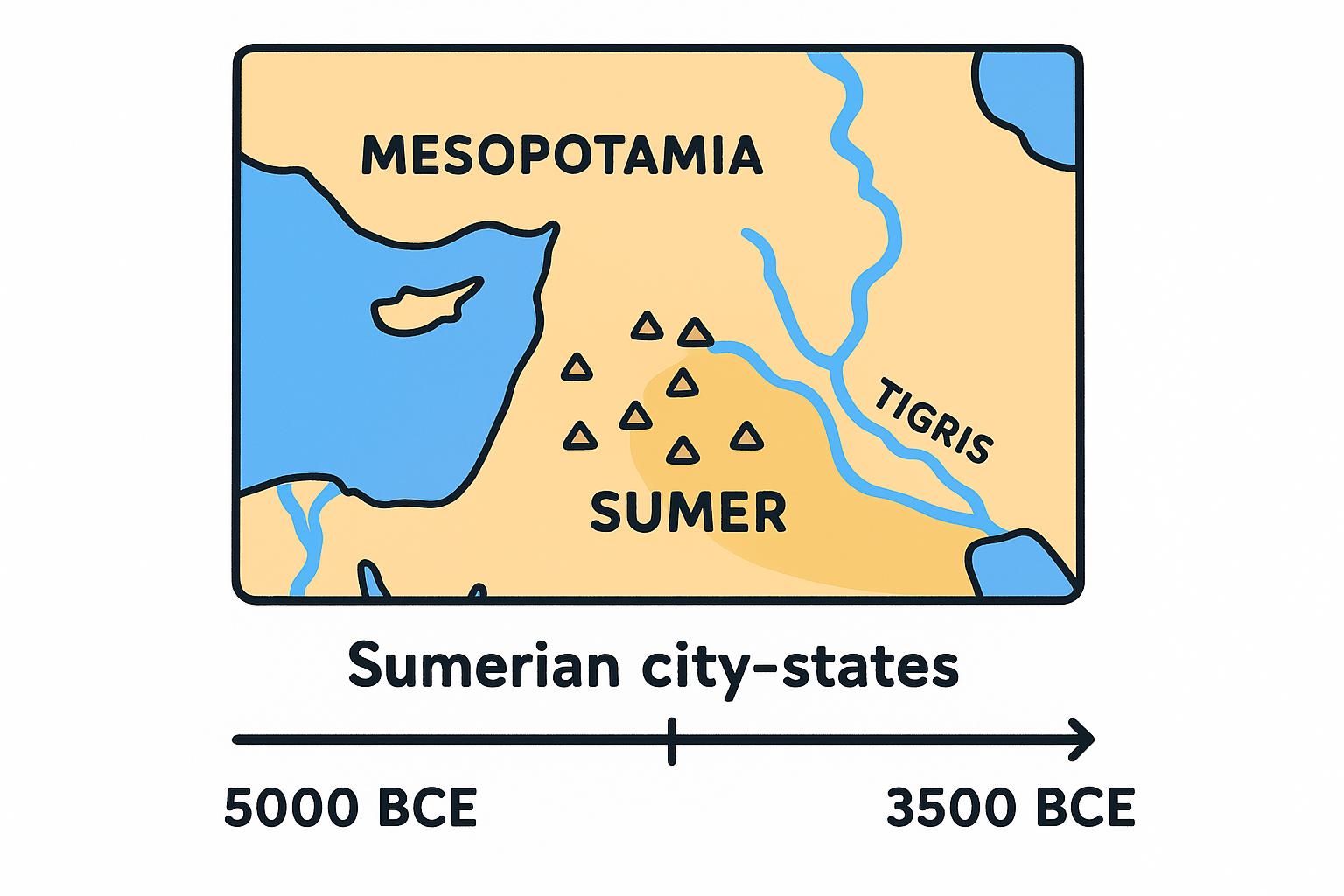
Sumerian city-states began forming around 3500 BCE, with the broader Mesopotamian region showing signs of organized settlement as far back as 5000 BCE. Geographically, Sumer occupied the flatlands of southern Iraq, where the two rivers deposited rich alluvial soil ideal for farming. The region later expanded northward through the Akkadian Empire and eventually into the Babylonian and Assyrian states.
What made it one of the first civilizations
Sumer developed several features that archaeologists use to define a civilization: centralized political authority, monumental public buildings, a specialized labor force, and long-distance trade networks. Crucially, Sumerians invented cuneiform script around 3200 BCE, making it the earliest known writing system. This shift from tokens and pictographs to abstract symbols allowed governments to track taxes, record laws, and preserve religious texts at a scale no earlier culture had managed.
Cuneiform writing gave early Mesopotamian rulers tools to govern populations and enforce accountability across entire city-states.
Landmark cities, rulers, and texts
Uruk was the largest city in the ancient world by 3000 BCE, home to an estimated 50,000 to 80,000 people. Other major centers included Ur and Nippur. Sargon of Akkad, ruling around 2334 BCE, built the first known multi-city empire. The Epic of Gilgamesh, composed in Sumer, is the oldest surviving piece of written literature and explores themes of mortality, friendship, and divine will. To read further, see our guide to the best books about ancient Mesopotamia, and for a single ranked reading order that spans every civilization on this page, the Skriuwer roundup of the best books about ancient civilizations.
Breakthroughs that shaped later societies
You can trace Mesopotamian contributions directly into modern life. Sumerians developed the base-60 numerical system, which we still use for minutes, seconds, and degrees. They also introduced large-scale irrigation infrastructure, early contract law, and one of the first codified legal frameworks, the Code of Hammurabi, drafted under the Babylonian king around 1754 BCE.
What caused major shifts and collapses
Soil salinization from over-irrigation steadily reduced agricultural output in southern Sumer after 2000 BCE, and political power shifted northward toward Babylon and Assyria. Repeated invasions by Amorites, Kassites, and later Persian forces accelerated the decline of Sumerian cultural dominance, though their intellectual and administrative legacy carried forward through every succeeding Mesopotamian state.
2. Ancient Egypt
Ancient Egypt stands as one of the most recognized of the earliest civilizations in the world, and for good reason. Its 3,000-year run of continuous statehood produced achievements in architecture, medicine, and statecraft that still draw researchers and readers today.
Timeline and map location
Egypt's Predynastic period began around 5000 BCE along the Nile Valley in northeastern Africa. The First Dynasty unified Upper and Lower Egypt around 3100 BCE, and the civilization persisted through 30 dynasties until Alexander the Great's conquest in 332 BCE.
How the Nile shaped state power
The Nile's annual flooding deposited rich silt across the floodplain, which made large-scale grain farming possible and handed the pharaoh control over one of the ancient world's most productive agricultural systems. Whoever controlled the Nile's irrigation network controlled the food supply, and through it, the entire population.
The Nile didn't just feed Egypt. It gave its rulers the economic foundation to build and sustain an empire.
Writing, bureaucracy, and religion in daily life
Egyptian scribes developed hieroglyphic writing around 3200 BCE, roughly the same period as Sumerian cuneiform. The state used this system to manage taxation, temple records, and royal decrees, creating one of the ancient world's first professional bureaucracies. Religion ran through every level of this structure, with priests holding real administrative power alongside the pharaoh.
Engineering, medicine, and math legacies
Workers built the Great Pyramid of Giza around 2560 BCE with precision that still impresses researchers today. Their medical papyri document surgical techniques, anatomical knowledge, and drug treatments that directly influenced Greek medicine and, if you trace the lineage, modern practice as well.
Key turning points and outside rule
The New Kingdom collapsed around 1070 BCE after a series of weak rulers and mounting external pressures. Nubian, Assyrian, Persian, and eventually Macedonian rulers all held Egypt at different points, each absorbing and reshaping Egyptian institutions in lasting ways.
3. Indus Valley civilization
The Indus Valley civilization ranks among the earliest civilizations in the world and is arguably the least understood of the major ancient societies. Stretching across what is now Pakistan and northwestern India, it matched Mesopotamia and Egypt in scale but left behind far fewer clear clues about its rulers, religion, and ultimate fate.
Timeline and map location
The civilization flourished from roughly 3300 to 1300 BCE, with its mature urban phase peaking between 2600 and 1900 BCE. Settlements spread across the Indus River basin, covering parts of modern-day Pakistan, northwestern India, and eastern Afghanistan, making it the largest of the three early river valley civilizations by geographic footprint.
What sets Indus cities apart
Indus cities like Mohenjo-daro and Harappa showed a level of urban standardization unlike anything else in the ancient world at the time. Streets ran on a grid, and nearly every major city shared the same brick sizes, drainage systems, and spatial layout across hundreds of miles.
Indus engineers built covered sewage and drainage systems that wouldn't appear in most European cities for thousands of years.
Urban planning, trade, and standardization
Merchants used standardized weights and measures across the entire civilization, which points to a coordinated trade network connecting hundreds of settlements. Excavations have recovered Indus seals as far away as Mesopotamia, confirming active long-distance commercial ties.
What we know and what remains uncertain
Researchers have not yet deciphered the Indus script, which leaves major questions unanswered. You can examine thousands of carved seals and still not determine whether the governing structure was religious, civic, or something else entirely.
Leading theories for decline and transition
Most scholars point to climate shifts and river course changes that disrupted agriculture around 1900 BCE. Evidence also suggests prolonged drought cycles pushed large populations eastward toward the Ganges plain, where new cultural centers eventually took shape.
4. Early China
China's earliest organized societies developed along river valleys in the northeastern and central regions of what is now the People's Republic of China. Their evolution from scattered farming communities into bureaucratic dynastic states represents one of the longest-running continuous cultural traditions among the earliest civilizations in the world.
Timeline and map location
Chinese civilization traces back to roughly 2100 BCE with the Xia dynasty, though Neolithic settlements along the Yellow River date to 5000 BCE or earlier. Later dynasties pushed southward toward the Yangtze River basin, expanding both territory and political complexity over centuries.
From river cultures to dynastic rule
The Yellow River's fertile loess soil supported early millet farming communities that gradually consolidated under centralized rulers. By the Shang dynasty (1600 to 1046 BCE), a recognizable state structure had emerged, complete with a capital city, royal court, and military hierarchy.
The transition from scattered village culture to dynastic rule in China took roughly 3,000 years of gradual consolidation.
Writing, ritual, and political order
Shang rulers used oracle bones to communicate with ancestors, carving questions into animal bones and turtle shells. This practice produced the earliest confirmed Chinese writing, directly ancestral to the characters used in Chinese script today.
Technologies and systems that endured
Bronze metallurgy, silk production, and advanced ceramics all emerged during the Shang and Zhou periods. If you trace later imperial technology back to its roots, the Zhou dynasty's bureaucratic model of governance, running from 1046 to 256 BCE, provided the direct template that every subsequent dynasty refined and built upon.
Major transitions between dynasties
Western Zhou's collapse around 771 BCE fragmented power across competing regional states. That breakdown produced the Warring States period, which ended when the Qin dynasty unified China in 221 BCE and created the imperial framework that persisted for over 2,000 years.
5. Norte Chico in the Andes
Norte Chico sits outside the usual conversation about the earliest civilizations in the world, yet it belongs there. This civilization developed along the coastal valleys of present-day Peru, making it the oldest known complex society in the Americas and one of only a handful in the world to arise independently.
Timeline and map location
Norte Chico flourished from roughly 3000 to 1800 BCE, placing it squarely alongside ancient Egypt and the Indus Valley in terms of age. Settlements clustered in four river valleys along the north-central Peruvian coast, stretching inland from the Pacific. Caral remains the best-documented and most studied city within the complex.
Why scholars treat it as an early civilization
Researchers classify Norte Chico as a true civilization based on evidence of centralized authority, monumental construction, and economic coordination across multiple settlements. The absence of a confirmed writing system once raised doubts, but the discovery of quipus at Caral (knotted cord devices used for recording information) helped resolve some of those questions.
Norte Chico challenges the assumption that writing is a prerequisite for civilizational complexity.
Monumental architecture and social organization
Workers at Caral built large platform mounds and sunken circular plazas without metal tools or wheeled vehicles. These structures required organized labor on a significant scale, pointing to a hierarchical social structure with leaders capable of directing thousands of workers.
Economy, trade networks, and daily life clues
Norte Chico's economy centered on fishing along the coast and cotton farming inland. Coastal communities traded dried fish for cotton, which inland communities used to produce fishing nets, creating a tightly linked regional exchange system.
Why it faded and what followed
Evidence points to prolonged drought and environmental disruption around 1800 BCE as the primary driver of Norte Chico's decline. Population shifted inland and southward, and later Andean cultures, including the Chavin and eventually the Inca, built on the organizational and architectural foundations Norte Chico established.
6. Olmec civilization in Mesoamerica
The Olmec civilization stands as one of the earliest civilizations in the world to emerge in the Americas, predating the Maya, Aztec, and every other Mesoamerican culture that followed. Developing along the Gulf Coast of present-day Mexico, the Olmec established cultural patterns that shaped the entire region for over two millennia.
Timeline and map location
The Olmec flourished from roughly 1500 to 400 BCE, with their heartland centered on the tropical lowlands of Veracruz and Tabasco in southern Mexico. Major centers included San Lorenzo, La Venta, and Tres Zapotes, each serving as a regional hub for political and ceremonial life.
Hallmarks of early Mesoamerican complexity
Olmec society showed clear markers of political hierarchy and organized religion, including monumental construction, a priestly class, and long-distance trade in jade and obsidian. Their colossal stone heads, some weighing up to 20 tons, required the transport of basalt from mountains over 50 miles away.
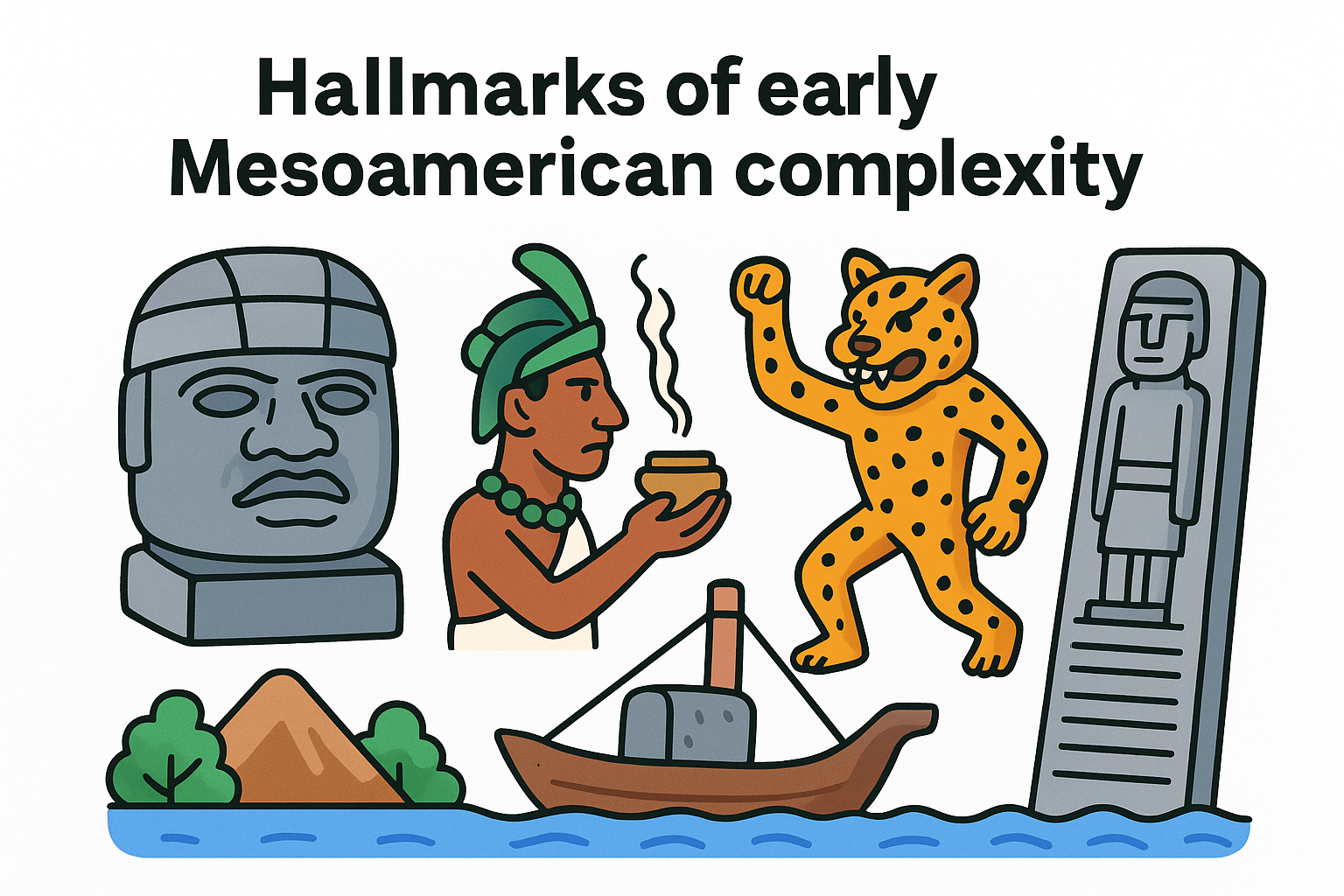
The logistics behind a single Olmec colossal head represent a level of social organization most people don't associate with pre-Maya Mesoamerica.
Art, religion, and political influence
Olmec iconography introduced the were-jaguar motif, a half-human, half-jaguar figure tied to rain and fertility worship that later appeared across dozens of Mesoamerican cultures. Their symbolic art vocabulary directly seeded later Maya and Zapotec religious traditions.
Calendars, writing debates, and core ideas that spread
Researchers debate whether the Olmec developed the earliest writing in the Americas, with some carved symbols predating confirmed Maya script. Their base-20 counting system fed directly into the broader Mesoamerican calendar complex.
What ended Olmec dominance
Environmental degradation and volcanic activity around 400 BCE disrupted the agricultural base of major Olmec centers. Regional power fragmented, and successor cultures absorbed Olmec religious, artistic, and mathematical foundations rather than rebuilding from scratch.
7. Nubia and Minoan Crete
Two civilizations that rarely get the attention they deserve when you study the earliest civilizations in the world are Nubia in northeastern Africa and Minoan Crete in the Aegean Sea. Both built complex, organized societies with influence that stretched well beyond their borders.
Nubia timeline and map location
Nubia's earliest complex societies emerged around 3800 BCE along the Nile south of Egypt, in what is now Sudan. The Kingdom of Kush, its most powerful state, dominated the region from roughly 2500 to 300 BCE.
Nubia state formation and Egyptian connections
Nubia and Egypt shared centuries of trade, conflict, and cultural exchange along shared stretches of the Nile. Nubian rulers eventually conquered Egypt itself, founding the 25th Dynasty around 747 BCE and governing the entire Nile Valley for nearly a century.
Nubia's conquest of Egypt stands as one of the most striking reversals of power in the ancient world.
Nubia's legacies in trade, iron, and kingship
Nubia controlled key gold and ivory trade routes connecting sub-Saharan Africa to the Mediterranean. The Kingdom of Meroe later became one of the ancient world's leading iron-production centers, spreading metallurgical knowledge across the African continent.
Minoan Crete timeline and map location
Minoan civilization developed on the island of Crete from roughly 2700 to 1450 BCE, centered on palace complexes at Knossos, Phaistos, and Malia in the eastern Mediterranean.
Minoan palaces, seafaring networks, and cultural impact
Minoans built multi-story palace complexes with indoor plumbing and elaborate frescoes that still impress researchers. Their seafaring trade network linked Crete to Egypt, the Levant, and mainland Greece, seeding Aegean Bronze Age culture with artistic and religious ideas that fed directly into early Greek civilization.
What 2026 Research Has Changed
The last few years have produced two notable revisions to the standard story. Continued excavation at Göbekli Tepe and the nearby Karahantepe site in southeastern Turkey now dates monumental stone architecture to around 9500 BCE, built by hunter-gatherer communities before settled agriculture. That overturns the long-standing assumption that farming had to come first before complex ritual architecture was possible. Second, isotope and ancient DNA work published across 2024 and 2025 has confirmed extensive long-distance trade and population movement between the Indus Valley and Mesopotamia from at least 2500 BCE onward, which firms up the picture of the early Bronze Age as a connected system rather than a collection of isolated river-valley societies.
Where to go from here
These eight societies represent the deepest roots of human civilization, and each one rewards far more study than any single article can provide. The earliest civilizations in the world built the frameworks that every culture since has inherited, adapted, or pushed against. Writing, law, urban planning, trade, and religious institutions all trace back to the river valleys and coastlines covered here.
If these stories sparked questions that mainstream history books tend to sidestep, you are in the right place. For more on the ancient world, see our ancient civilizations timeline, the best books about Cleopatra for the closing chapter of pharaonic Egypt, the best books about Alexander the Great for the Hellenistic moment, and our best books about Ancient Rome for the empire that eventually absorbed most of these civilizations' successors, and the best books about the Maya for the great New World civilization that developed on a separate continent entirely. The broader history category on Skriuwer is the natural starting point.
Your next good book, in your inbox
We only write when we find a book worth your time. Hand-picked recommendations across history, mythology, true crime and more.
Books You Might Like

Sapiens: A Brief History of Humankind
Yuval Noah Harari

The Last Kingdom (The Saxon Stories, Book 1)
Bernard Cornwell

Meditations
Marcus Aurelius

The Hiding Place
Elizabeth Sherrill, John Sherrill Corrie ten Boom