Best Architecture and Design History Books in 2026: 12 That Show How Buildings Shape the Way We Think
Every building is an argument. It argues about how people should live, what they deserve, what a society values, and who has the right to make those decisions for everyone else. Architecture history is the record of those arguments played out in concrete and glass, in cathedrals and housing projects, in grand boulevards and in the neighborhoods that were destroyed to build them.
The books below cover twelve of the most important arguments in that record, from the founding documents of modernism and postmodernism to the user who destroyed them, from Palladian proportions to the urbanism that stopped highway demolition of American cities. Some are manifestos. Some are critiques. All of them will change how you look at the built world around you.
Where Most Lists Agree: The Accessible Entry Points
1. The Architecture of Happiness by Alain de Botton
De Botton's 2006 book is the most widely read entry point into architecture for general readers, and it earns that position. He asks a question that professional architects often find embarrassingly simple: can buildings make people happy? He then spends 300 pages taking the question seriously, drawing on psychology, philosophy, and specific buildings to argue that the aesthetics of our environments are not superficial preferences but affect mood, concentration, and self-understanding in measurable ways. You do not need to know anything about architecture to read this. By the end, you will look at every room you enter differently.
Best for: Complete beginners. Anyone who wants to understand why some spaces feel good and others feel deadening before reading more technical histories.
2. A Place of My Own by Michael Pollan
Pollan, best known for writing about food, decided to build a small writing hut in the woods behind his Connecticut house. He did not know how to build anything. The memoir follows his education, from learning to read architectural drawings to understanding why a window placed thirty centimetres too low ruins a room. It is the best account of what architecture actually feels like from the inside of making it, written by someone who approached the discipline as a curious outsider rather than a trained professional.
The Modernist Manifestos
Two books defined architectural modernism and between them shaped most of the buildings built between 1920 and 1970.
3. Towards a New Architecture by Le Corbusier
Published in 1923, Le Corbusier's manifesto is the founding document of architectural modernism. "A house is a machine for living in." The book argues that the industrial age required a new architecture stripped of ornament, built from standardised components, flooded with light and air. The argument was wrong in most of its social predictions and right in most of its aesthetic ones, and the buildings it inspired range from genuine masterpieces to the worst public housing projects in human history. You cannot understand twentieth-century architecture without reading this. The prose is polemical and enjoyable, which is rare for architecture theory.
4. Complexity and Contradiction in Architecture by Robert Venturi
Published in 1966, Venturi's book is the founding document of architectural postmodernism and one of the most important texts in twentieth-century architecture. His opening line: "I like complexity and contradiction in architecture." He was pushing directly against Mies van der Rohe's "less is more." Venturi's counter-slogan was "less is a bore." The book argues that great architecture has always been ambiguous, layered, and historically referential, and that modernism's rejection of ornament and history had produced a built environment of totalising sterility. The Museum of Modern Art published it. The architectural establishment was furious. Within fifteen years, Venturi had won.
The Critics Who Changed Public Thinking
5. The Death and Life of Great American Cities by Jane Jacobs
This is the most important book on urbanism published in the twentieth century, and it was written by someone who had no formal training in architecture or planning. Jacobs wrote it in 1961 to stop Robert Moses from running a highway through Greenwich Village in Manhattan. She succeeded, which is remarkable. The book argues that the urban renewal projects of the 1950s, with their superblocks, cleared slums, and separated land uses, were destroying the conditions that made cities liveable and safe: mixed uses, old buildings, short blocks, concentrated density. Everything she predicted about what urban renewal would do to American cities came true. The book stopped highway demolition across North America and is still the standard reference for anyone who wants to understand why some city neighbourhoods work and others do not.
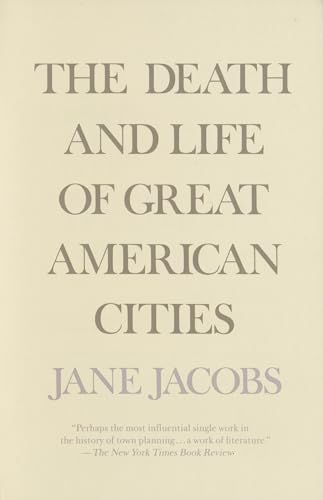 The Death and Life of Great American Cities by Jane Jacobs is the essential starting point for anyone interested in urbanism.
6. On Architecture by Ada Louise Huxtable
Huxtable was the New York Times architecture critic from 1963 to 1982, the first architecture critic at any major American newspaper, and the person most responsible for making architecture a subject of public concern rather than professional interest only. This collection draws from her best reviews and essays. She wrote about buildings the way serious critics write about literature: with the assumption that what is built matters, that bad architecture is not a neutral aesthetic failure but a civic harm, and that the public has a right to demand better. She won the first Pulitzer Prize ever awarded for criticism, in 1970.
Historical Depth and Proportion
7. The Perfect House by Witold Rybczynski
Rybczynski examines Palladio's Villa Rotonda, built outside Vicenza in the 1560s, and uses it to explain how one building's proportions became the template for Western domestic architecture. His argument is that Palladio solved a problem that no one before him had solved properly, the problem of making a country house that felt both dignified and comfortable, and that the solution was so elegant that architects have been copying it for five centuries without fully understanding why it works. Rybczynski is the most readable writer on architecture for general audiences working today.
8. An Outline of European Architecture by Nikolaus Pevsner
Pevsner's survey, first published in 1943 and revised through the 1970s, covers Western architecture from the Roman basilica through the twentieth century. It is the standard one-volume introduction used by architecture schools, and it earns that position because Pevsner is genuinely interested in understanding each building in its historical context rather than just cataloguing it. The prose is dry by modern standards, but the analytical framework is still the one that most architectural history uses. Read it after the accessible entry points, when you want the full chronological map.
The Radical Visions
9. Delirious New York by Rem Koolhaas
Published in 1978 and subtitled "A Retroactive Manifesto for Manhattan," Koolhaas's book argues that Manhattan was the most radical architectural experiment of the twentieth century and that nobody who was building it knew what they were doing. The grid, the skyscraper, the block, the elevator, the zoning law: Koolhaas analyses each as an invention that enabled a density of human activity without precedent, a "culture of congestion" that produced modernism's most spectacular results. The book is illustrated like a Surrealist novel and argued like a philosophy paper, and it remains the most useful framework for understanding what cities actually are at their most extreme.
10. The Language of Post-Modern Architecture by Charles Jencks
Jencks coined the term "postmodern architecture" and his 1977 book is the first attempt to describe what the movement was actually doing after Venturi broke the door open. He argues that architecture is a language that communicates meaning to its users and that modernism had reduced that language to a single, alienating dialect. Postmodernism was the attempt to restore complexity and communication to the built environment. The book is polemical and historically specific, but if you want to understand why buildings from the 1980s and 1990s look the way they do, this is where the explanation lives.
How Buildings Change Over Time
11. How Buildings Learn by Stewart Brand
Brand's argument is simple and devastating: architectural photography always captures buildings immediately after completion, before anyone has lived in them. But buildings are not finished when architects leave. They are transformed by their occupants over decades, adapted for uses their designers never imagined, improved or degraded by the thousands of small decisions that accumulate around them. Brand documents this process across multiple time scales and argues that the best buildings are the ones designed for change, not the ones preserved as frozen masterpieces. It is the book that the sustainability movement in architecture has been trying to catch up with since it was published in 1994.
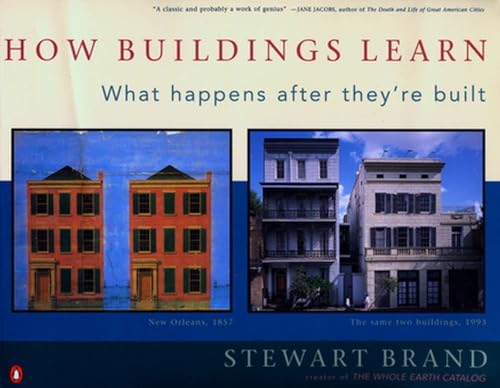 How Buildings Learn by Stewart Brand is the most useful book for understanding why the buildings most admired by architects are often the worst to actually use.
Three Architecture Books Worth Buying Today
- The Architecture of Happiness by Alain de Botton, the most accessible entry point into why buildings matter.
- The Death and Life of Great American Cities by Jane Jacobs, the book that changed urban planning and stopped highway demolition across North America.
- How Buildings Learn by Stewart Brand, the argument that no architect wants to hear and that every building user knows is true.
For related reading, see the history category or the guide to the best books about ancient civilizations for the architectural traditions that preceded everything on this list.
Your next good book, in your inbox
We only write when we find a book worth your time. Hand-picked recommendations across history, mythology, true crime and more.
Are you an author?
Get your book in front of readers like these, for free.
- Free book listing →Your own book page with an Amazon button
- Author page →Photo, bio and links to your site
- Featured placement →A spot in our best-of lists, from €29
Free tools we recommend
Get free honest reviewsReview exchange on iWrity, free to join
Books You Might Like

Sapiens: A Brief History of Humankind
Yuval Noah Harari
The Last Kingdom (The Saxon Stories, Book 1)
Bernard Cornwell

Meditations
Marcus Aurelius

The Hiding Place
Elizabeth Sherrill, John Sherrill Corrie ten Boom