Best Books About Ancient Egypt in 2026: 10 Novels and Histories That Bring the Pharaohs to Life
Ancient Egypt covers three thousand years of continuous civilization and leaves behind more physical evidence than almost any other culture in antiquity. That means there is a lot of ground to cover and a lot of bad books willing to cover it badly. The good ones are very good. This guide separates the historical fiction from the Egyptology, ranks the strongest titles in each category, and tells you where to start depending on what you actually want.
The dividing line matters. If you want to understand the actual New Kingdom, the Ptolemaic period, or the evidence behind the Tutankhamun theories, you want non-fiction. If you want to feel what it was like to walk the halls of a pharaoh's palace, you want fiction. Some books do both. All the ones below are worth your time.
The Best Ancient Egypt Historical Fiction
1. River God by Wilbur Smith
River God is the entry point for most readers who come to ancient Egypt through fiction, and for good reason. Smith's novel is set during the Second Intermediate Period, when the Hyksos occupied Lower Egypt, and follows Taita, a eunuch slave of extraordinary intelligence who serves the household of a nobleman and the woman he loves. Smith wrote in the epic register, and River God earns that scale. The Egyptian world it builds is physically vivid, politically detailed, and emotionally relentless. It spawned the Egyptian Series, which continues through The Seventh Scroll and beyond, but River God is the one that matters most.
One caveat: Smith takes liberties with history and occasionally with taste. If you want documentary accuracy, this is not your book. If you want to be transported for 600 pages, it absolutely is.
2. Ramesses: The Son of Light by Christian Jacq
French Egyptologist Christian Jacq wrote five novels about Ramesses II, and they are the most academically grounded Egypt fiction in print. Jacq spent decades studying the New Kingdom before writing fiction about it, and the detail shows: temple rituals, administrative hierarchies, military campaigns, and court politics are all handled with a care that most novelists working in the period cannot match. The Son of Light is the first in the sequence and follows Ramesses from childhood through the early years of his reign.
The prose is sometimes stiff in translation from French, but the authenticity makes up for it. If you want Egypt fiction built on serious scholarship, Jacq is the name to know.
Get Ramesses: The Son of Light on Amazon
3. Crocodile on the Sandbank by Elizabeth Peters
Elizabeth Peters was the pen name of Barbara Mertz, who held a PhD in Egyptology from the University of Chicago and used it to write one of the most beloved mystery series in the genre. Crocodile on the Sandbank introduces Amelia Peabody, a Victorian heiress who goes to Egypt, meets an archaeologist, and proceeds to solve crimes across dozens of novels set around real archaeological digs and real historical finds. The series is funny, the Egyptology is sound, and Amelia herself is one of the most entertaining characters in historical fiction.
This is also the best series for readers who want Egypt fiction that captures the history of Egyptology itself, the Victorian and Edwardian period when the great excavations were happening, rather than ancient Egypt directly.
4. Child of the Morning by Pauline Gedge
Gedge's novel about Hatshepsut, the female pharaoh who ruled Egypt for twenty years and whose monuments Thutmose III later tried to destroy, is the finest treatment of that story in fiction. Gedge writes with restraint and psychological depth, and she takes Hatshepsut seriously as a political and religious figure rather than reducing her to a symbol. The Egyptology is careful and Gedge's prose has a quality that the more commercial Egypt fiction rarely achieves.
Child of the Morning was first published in 1977 and has been reissued several times. It holds up completely.
Get Child of the Morning on Amazon
The Best Ancient Egypt Non-Fiction and Archaeology
5. The Rise and Fall of Ancient Egypt by Toby Wilkinson
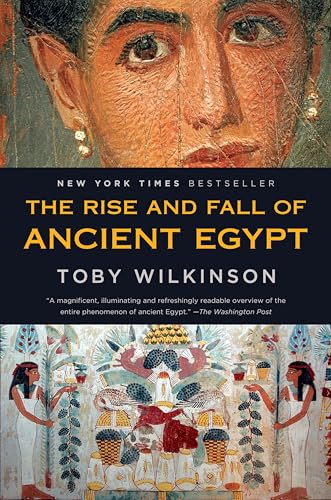
Wilkinson's book is the best single-volume history of ancient Egypt available in English. It covers three thousand years without losing clarity, builds the political narrative around concrete evidence rather than speculation, and is readable enough for a general audience without dumbing anything down. Wilkinson is an Egyptologist at Cambridge and the prose reflects that: precise, confident, and free of the mystical tone that infects a lot of popular Egypt writing.
If you read nothing else on this list from the non-fiction side, read this one.
Get The Rise and Fall of Ancient Egypt on Amazon
6. The Murder of Tutankhamen by Bob Brier
Bob Brier is an Egyptologist who made his name by mummifying a human body using ancient techniques to test ancient texts. His book on Tutankhamun applies forensic analysis to the physical evidence from the tomb, the X-rays of the king's skull, the administrative records from the period, and the careers of the figures around the young king, to build a murder case against Ay, the general who succeeded him. Brier writes accessibly and the argument is compelling even for readers who are sceptical of the conclusion.
This is the best example of a kind of Egyptology book that treats the ancient world as a crime scene rather than a museum exhibit.
7. Valley of the Kings by John Romer
John Romer is the Egyptologist most interested in the human story behind the monuments. Valley of the Kings follows the history of the royal necropolis from the earliest New Kingdom burials through the modern archaeological excavations, including the discovery of Tutankhamun's tomb by Howard Carter in 1922. Romer writes about archaeological method, the politics of excavation, the looting and the preservation, with an authority built on years of fieldwork in the valley itself.
For readers who want to understand not just what the pharaohs built but how we know what we know about them, this is essential.
Two More Worth Reading
8. Egyptian Mythology: A Guide to the Gods, Goddesses, and Traditions of Ancient Egypt by Geraldine Pinch

Pinch's guide covers the religious world that underpins all the fiction on this list. Egyptian mythology is not a single coherent system like the Olympian pantheon; it is a layered accumulation of local traditions, rival theological schools, and changing dynastic emphases. Pinch maps all of that in readable form. After reading this, both the Jacq novels and the Wilkinson history make more sense.
9. Nefertiti by Michelle Moran
Moran's novel about the Amarna period, the heretical reign of Akhenaten and his queen Nefertiti, is the most accessible entry point for readers new to Egypt fiction. The pacing is faster than Gedge or Jacq, the political drama is sharp, and Moran does the research. The novel follows Nefertiti's younger sister as a narrator, which gives it an outsider perspective that makes the strangeness of the Amarna religious revolution land harder.
10. The Complete Valley of the Kings by Nicholas Reeves and Richard H. Wilkinson
This one is for readers who want to go deep. Reeves and Wilkinson produced the most comprehensive study of the Valley of the Kings available, covering every tomb, every burial, every known king and official interred there. It is as much reference book as narrative history, but the photographic material and the detail of each entry make it genuinely readable rather than just consultable. Reeves is also the scholar behind the hypothesis that Nefertiti's tomb may be hidden behind a wall in Tutankhamun's burial chamber, a claim that is still generating active research.
Where to Start
For fiction, begin with River God if you want scale and pace, or Child of the Morning if you want something more considered. For history, The Rise and Fall of Ancient Egypt by Toby Wilkinson is the right starting point for almost everyone. The Murder of Tutankhamen is the natural follow-up if the forensic angle appeals.
The Amelia Peabody series sits in a separate category: it is less about ancient Egypt directly and more about the Edwardian Egyptologists who excavated it, and it is one of the most pleasurable long-run series in all of historical fiction. If you have not met Amelia Peabody, Crocodile on the Sandbank is the door.
Three to Buy Today
- River God by Wilbur Smith is the most cinematic ancient Egypt novel, set during one of the most dramatic periods in Egyptian history.
- The Rise and Fall of Ancient Egypt by Toby Wilkinson is the best single-volume history of ancient Egypt in English, readable and authoritative.
- Child of the Morning by Pauline Gedge is the finest literary treatment of Hatshepsut, written with depth and restraint that the more commercial titles cannot match.
Your next good book, in your inbox
We only write when we find a book worth your time. Hand-picked recommendations across history, mythology, true crime and more.
Are you an author?
Get your book in front of readers like these, for free.
- Free book listing →Your own book page with an Amazon button
- Author page →Photo, bio and links to your site
- Featured placement →A spot in our best-of lists, from €29
Free tools we recommend
Get free honest reviewsReview exchange on iWrity, free to join
Books You Might Like

Sapiens: A Brief History of Humankind
Yuval Noah Harari
The Last Kingdom (The Saxon Stories, Book 1)
Bernard Cornwell

Meditations
Marcus Aurelius

The Hiding Place
Elizabeth Sherrill, John Sherrill Corrie ten Boom