Best Books About Ancient Mesopotamia (2026): 12 That Reveal the First Civilisation
The best books about ancient Mesopotamia cover a civilisation that invented writing, codified law, built the first cities, and wrote the world's oldest surviving story, and yet most reading lists treat the subject as a footnote to Egypt or Greece. That is a gap worth closing. This guide covers the books that actually deliver on the subject: readable for adults with no prior background, honest about what the evidence shows, and specific enough to be worth your time.
Mesopotamia spans roughly 3500 BCE to the fall of Babylon in 539 BCE, covering Sumer, Akkad, Babylon, and Assyria across what is now Iraq. The books below handle different parts of that territory. Some are narrative histories, some are collections of primary texts, one covers daily life in enough detail to make the ancient world feel genuinely inhabited. Each entry tells you what it covers, what kind of reader it suits, and where it fits in a longer reading plan. For the wider sweep from Sumer through Rome and beyond, see our best books about ancient civilizations.
What are the best books about ancient Mesopotamia?
The best books about ancient Mesopotamia are Marc Van De Mieroop's A History of the Ancient Near East for a serious survey, Paul Kriwaczek's Babylon for a readable narrative introduction, and Andrew George's translation of The Epic of Gilgamesh for the world's oldest surviving story. Start with Kriwaczek or Van De Mieroop, then read Gilgamesh.
The Best Single-Volume History of Mesopotamia
If you want one book that gives you the full shape of the civilisation before you go further, there is a clear answer.
1. A History of the Ancient Near East, ca. 3000-323 BC by Marc Van De Mieroop
Van De Mieroop's survey is the book academic historians point undergraduates to, and it works equally well for general readers who want a serious grounding. It covers Sumer and Akkad, the Old Babylonian period (this is where Hammurabi's law code belongs), Assyria's rise and fall, and the Neo-Babylonian empire through to Alexander's conquest. The writing is clear without being dumbed down. Van De Mieroop draws on cuneiform sources directly rather than filtering everything through Greek secondary accounts, which makes this feel like the real thing rather than a filtered summary.
Best for: Anyone starting from scratch who wants a solid historical framework before picking up more focused books.
2. Babylon: Mesopotamia and the Birth of Civilization by Paul Kriwaczek

Kriwaczek is the more readable entry point for readers who find academic survey history dry. He covers the same ground as Van De Mieroop but with a journalist's instinct for the telling detail and a clear argument: that Mesopotamia did not just precede Western civilisation, it invented the categories that still organise it. Cities, writing, bureaucracy, trade, debt, law, astronomy, the week divided into seven days. The book reads fast and leaves you with a sense of just how much of what we consider modern arrived from the floodplains between the Tigris and Euphrates.
Best for: Readers who want narrative and argument rather than a structured survey. A strong first book before the more detailed titles below.
The Epic of Gilgamesh: Two Translations Worth Owning
The Epic of Gilgamesh predates the Iliad by at least 1,500 years. It is the world's oldest surviving narrative poem and it covers a king's quest for immortality after watching his closest friend die. Every serious Mesopotamia reading list includes it. The question is which translation to read.
3. Myths from Mesopotamia translated by Stephanie Dalley
Dalley's Oxford World's Classics edition is the scholarly standard for English readers. It includes not just Gilgamesh but Atrahasis (the Babylonian flood narrative that predates the Genesis version), Enuma Elish (the Babylonian creation epic), Nergal and Ereshkigal, and several shorter texts. The introduction and footnotes are genuinely useful: Dalley places each text in its literary and archaeological context without making the reading experience feel like homework. If you want to understand where the flood narrative and creation myth come from, this is the book that shows you the sources underneath the sources.
Best for: Readers who want more than just Gilgamesh, and who want scholarly context alongside the texts themselves.
4. The Epic of Gilgamesh translated by Andrew George
Andrew George's Penguin Classics translation is the other major option and the one many readers find more accessible as a reading experience. George worked directly from cuneiform tablets and his translation of the Standard Babylonian version is considered the most accurate currently available in English. He also includes older Sumerian Gilgamesh poems alongside the later unified epic, which shows how the story evolved across centuries of retelling. Where the Dalley is the better scholarly collection, the George is the better choice if you want to read Gilgamesh specifically as a piece of literature.
Best for: Readers who want to engage with Gilgamesh as a story first and a historical document second.
Both translations are worth having. Buy one, read it, then pick up the other. The differences in how each translator handles the gaps in the tablets (and there are significant gaps) tell you something important about how fragile our connection to this material actually is.
 Myths from Mesopotamia (Oxford World's Classics) by Stephanie Dalley covers the full range of Babylonian myth in one authoritative volume.
Daily Life and Social History
Most Mesopotamia reading lists stop at political and military history. That leaves out the texture of the civilisation: what people ate, how they worked, what their homes looked like, what it meant to be a woman, a slave, a merchant, or a temple administrator in ancient Sumer or Babylon. These two books fill that gap.
5. Daily Life in Ancient Mesopotamia by Karen Rhea Nemet-Nejat
Nemet-Nejat covers housing, food, clothing, education, medicine, music, law, marriage, slavery, trade, and religion across Mesopotamian history from Sumer through the Babylonian period. The structure is encyclopedic, which makes it the kind of book you consult as much as read straight through. The material is drawn from cuneiform records: administrative tablets, letters, contracts, receipts, and legal documents that give you a granular picture of how the civilisation actually functioned at ground level. If you have read Kriwaczek or Van De Mieroop and want to understand what life felt like rather than just how empires rose and fell, this is the next book.
Best for: Readers who want social and cultural history rather than political narrative. Excellent as a companion to the survey histories.
6. Brotherhood of Kings: How International Relations Shaped the Ancient Near East by Amanda Podany
Podany's book covers something most popular histories of Mesopotamia ignore entirely: the diplomatic correspondence between Bronze Age kingdoms. The Amarna letters, the Mari archives, the treaties between Hittite kings and Egyptian pharaohs. Podany shows that the ancient Near East was not a collection of isolated civilisations but a connected network of great powers that negotiated alliances, exchanged royal gifts, arranged dynastic marriages, and wrote each other letters that survive in cuneiform. The book is also a reminder that the Bronze Age collapse around 1200 BCE wiped out a level of international organisation that would not reappear for centuries.
Best for: Readers with some background in the period who want a different angle: Mesopotamia in its regional context, not in isolation.
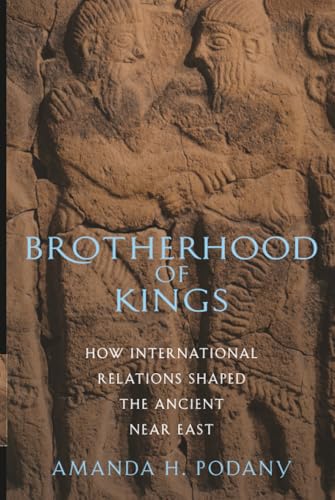 Brotherhood of Kings by Amanda Podany is one of the few accessible books that treats Bronze Age diplomacy as seriously as war and religion.
Archaeology and the Discovery of Mesopotamia
Mesopotamia as a subject was reconstructed almost entirely from scratch between 1840 and 1930, when British and French archaeologists dug up the libraries of Nineveh, the ruins of Ur, and thousands of cuneiform tablets that nobody had read for two millennia. The books below cover how that happened.
7. The Buried Book: The Loss and Rediscovery of the Great Epic of Gilgamesh by David Damrosch
Damrosch tells two stories in parallel: the life of Ashurbanipal, the Assyrian king who assembled the library at Nineveh in which the most complete Gilgamesh tablets were found, and the story of George Smith, the Victorian self-taught scholar who first translated the flood tablet in 1872 and caused a sensation in London when he announced that the Bible's flood narrative had a Babylonian predecessor. The book is readable as a thriller and also as an argument about how civilisations transmit knowledge across time.
8. The Art of the First Cities: The Third Millennium B.C. from the Mediterranean to the Indus (Metropolitan Museum of Art)
Not a conventional history book: this is the catalogue from a major Metropolitan Museum exhibition covering early urban civilisations from Sumer to the Indus Valley. The images alone make it worth having. Cylinder seals, lapis lazuli jewellery from the Royal Cemetery at Ur, bronze sculptures, carved ivories, and architectural reconstructions. If you want a visual understanding of the material culture of early Mesopotamia, this is where to find it.
Assyria: The Military Empire Most People Know Least About
Babylon gets most of the popular attention, but the Assyrian Empire was the dominant power in the Near East for three centuries (roughly 900 to 612 BCE) and produced some of the most extraordinary palace art in the ancient world. It also invented techniques of organised mass deportation and psychological terror that later empires copied.
9. Assyria: The Rise and Fall of the World's First Empire by Eckart Frahm
Frahm's 2023 book is the most comprehensive recent history of Assyria available to general readers. He covers the full arc from the Old Assyrian merchant colonies in Anatolia through the Neo-Assyrian empire's peak under Sargon II and Ashurbanipal to the catastrophic fall of Nineveh in 612 BCE. The book draws on new archaeological discoveries and recent translations of cuneiform texts that were not available to earlier popular histories, and Frahm is a working Assyriologist so the scholarship is current.
Best for: Readers who have a general grounding in Mesopotamia and want to go deeper on the Assyrian period specifically.
What is the best book about ancient Sumer specifically?
The best book on Sumer alone is Samuel Noah Kramer's The Sumerians: Their History, Culture, and Character. Kramer was one of the first scholars to translate Sumerian literature at scale, and the book covers law, education, and the earliest known proverbs and love poems from the world's first cities.
10. The Sumerians: Their History, Culture, and Character by Samuel Noah Kramer
Kramer wrote this in 1963 and it is still the standard introduction to Sumer as a subject distinct from the wider Mesopotamian story. Van De Mieroop and Kriwaczek both treat Sumer as the opening chapter of a longer history. Kramer treats it as the main event, covering the invention of writing at Uruk, the first schools, the first law codes (predating Hammurabi by centuries), and the earliest recorded love poem and library catalogue. The prose shows its age in places, but no later book has replaced it as the place to start on Sumer specifically.
Best for: Readers who want to go deep on the earliest phase of Mesopotamian history rather than treat Sumer as a prologue to Babylon.
What is the most recent book about Mesopotamian history?
The most recent major survey is Amanda Podany's Weavers, Scribes, and Kings: A New History of the Ancient Near East, published in 2022. It replaces the region's kings-and-battles framing with everyday voices drawn from cuneiform tablets: weavers, scribes, merchants, and midwives.
11. Weavers, Scribes, and Kings: A New History of the Ancient Near East by Amanda Podany
Podany already appears on this list for Brotherhood of Kings, and this 2022 follow-up is arguably her best book. Where the survey histories above move through dynasties and battles, Podany builds her narrative from the ordinary people cuneiform tablets happen to record: a weaver negotiating her wages, a scribe training in a Sumerian school, a midwife's fee schedule. It covers the same 3,000 year span as Van De Mieroop, but the ground-level detail makes it a genuinely different reading experience, and its 2022 publication date means it folds in archaeological finds the older surveys could not.
Best for: Readers who have already read one of the standard surveys and want the same history told from a different, more human angle.
12. Ancient Iraq by Georges Roux
Roux's book predates Van De Mieroop and Kriwaczek by decades (first published 1964, revised 1992), and some historians still call it out by name as the introduction no newer text has fully replaced. It is denser and more traditional than Kriwaczek, closer in tone to Van De Mieroop, but with a tighter focus purely on Mesopotamia rather than the wider ancient Near East. Worth reading as a second opinion once you have a first survey under your belt, since Roux occasionally disagrees with newer scholarship in useful ways.
Best for: Readers who have finished one survey and want a second, more traditional academic perspective to compare it against.
Where to Go After These Books
The books above give you the shape of Mesopotamian history from Sumer through Babylon and Assyria, the literary tradition from Gilgamesh to Enuma Elish, and the social and diplomatic history that most popular treatments skip. A reasonable reading order:
- Start with Kriwaczek's Babylon for the narrative overview.
- Then Van De Mieroop's survey for historical depth and chronological structure.
- Then Dalley's Myths from Mesopotamia for the primary texts.
- Then Nemet-Nejat for daily life and social history.
- Then Podany's Brotherhood of Kings for the diplomatic and regional context.
That is five books covering roughly 3,000 years of civilisation. By the end you will have a working understanding of why Mesopotamia matters and the vocabulary to read anything else in the field.
Three Mesopotamia Books Worth Buying Today
The three titles below are the ones readers and historians keep returning to across the subject.
- Babylon: Mesopotamia and the Birth of Civilization by Paul Kriwaczek, the most readable single-volume introduction to the subject in print.
- Myths from Mesopotamia translated by Stephanie Dalley, the standard scholarly collection of Babylonian myth including Gilgamesh, Atrahasis, and Enuma Elish.
- Brotherhood of Kings by Amanda Podany, the book that puts Mesopotamia into its Bronze Age diplomatic context and shows how connected the ancient world actually was.
For the full ranked list of ancient history titles, see our history books collection. If you want to continue into related civilisations, our guide to the best books about ancient civilizations maps the wider field, and our guide to the best books about ancient China covers the other major early urban civilisation that developed independently from Mesopotamia. For the mythology side specifically, our best Greek mythology books covers the tradition that inherited much from Babylonian and Sumerian myth.
Your next good book, in your inbox
We only write when we find a book worth your time. Hand-picked recommendations across history, mythology, true crime and more.
Are you an author?
Get your book in front of readers like these, for free.
- Free book listing →Your own book page with an Amazon button
- Author page →Photo, bio and links to your site
- Featured placement →A spot in our best-of lists, from €29
Free tools we recommend
Get free honest reviewsReview exchange on iWrity, free to join
Books You Might Like

Sapiens: A Brief History of Humankind
Yuval Noah Harari
The Last Kingdom (The Saxon Stories, Book 1)
Bernard Cornwell

Meditations
Marcus Aurelius

The Hiding Place
Elizabeth Sherrill, John Sherrill Corrie ten Boom