Best Books About the KGB and Cold War Secrets: 10 That Read Like Thrillers
The Cold War produced some of the most intricate, consequential, and genuinely strange espionage operations in human history. The KGB at its peak employed more than 480,000 officers and informants inside the Soviet Union alone, with networks reaching into every significant Western government, military institution, and scientific program. The stories that have emerged from the archives, from defector memoirs, and from the painstaking reconstruction by intelligence historians are often more gripping than anything a novelist could construct.
The books below cover double agents who spent decades feeding information to both sides, KGB generals who walked into Western embassies and offered to betray their own service, and nuclear secrets passed across park benches in Washington. Every book on this list has changed what historians know about the Cold War. Several of them will change what you thought you knew about how the world nearly ended.
1. The Spy and the Traitor by Ben Macintyre
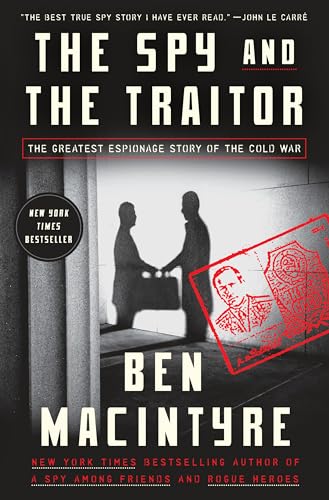
If you read only one book about Cold War espionage, make it this one. Ben Macintyre's account of Oleg Gordievsky is the most complete reconstruction of a double agent's life that has ever been published. Gordievsky was a senior KGB officer who began passing intelligence to MI6 in 1974 and continued doing so for more than a decade, eventually rising to become the KGB's station chief in London. The intelligence he provided changed British and American policy at critical moments, including the period around NATO's Able Archer 83 exercise, when the Soviet leadership genuinely believed a Western nuclear strike was imminent.
What makes Macintyre's book so extraordinary is his access to Gordievsky himself, to his former MI6 handlers, and to KGB officers who were hunting him. The exfiltration operation in 1985, when British intelligence smuggled Gordievsky out of the Soviet Union in the back of a car with a KGB surveillance team circling, is one of the most extraordinary sequences of real events you'll read. It reads exactly like a thriller, except it happened.
The Spy and the Traitor on Amazon
2. Spymaster by Oleg Kalugin
Oleg Kalugin was a KGB general who, after the Soviet collapse, became one of the most candid former intelligence officers alive. His memoir covers his rise through the KGB's foreign intelligence directorate, his work running operations against the United States (including his time as a young officer stationed at Columbia University), and eventually his disillusionment with the Soviet system that led him to speak publicly after 1990.
Kalugin is not a sympathetic figure by any conventional standard. He ran operations that destroyed lives and careers. But his willingness to describe those operations in detail, to name names, and to acknowledge what the KGB actually did rather than what it claimed to do, makes this one of the most valuable primary sources from inside the Soviet intelligence apparatus. His account of KGB penetration of American institutions and his description of how Soviet intelligence assessed its own successes and failures is worth reading alongside any academic history of the period.
3. KGB: The Inside Story by Christopher Andrew and Oleg Gordievsky
Before Gordievsky was extracted from the Soviet Union, he spent years working with Cambridge historian Christopher Andrew on a comprehensive history of the KGB from its origins in the Cheka through to the mid-1980s. The result is the most thorough institutional history of Soviet intelligence ever published, drawing on Gordievsky's direct knowledge of KGB operations and personnel that no archive could have provided.
Andrew and Gordievsky cover the Great Terror and Stalin's use of intelligence services to murder perceived rivals, the wartime penetration of the Manhattan Project, the post-war recruitment of figures in Western governments, and the KGB's global reach during the Cold War. Gordievsky's insider perspective gives the book a texture that distinguishes it from histories based purely on documents. He knew many of the officers involved. He understood how the institution actually worked, as opposed to how it presented itself.
KGB: The Inside Story on Amazon
4. Bombshell by Joseph Albright and Marcia Kunstel
The story of how the Soviet Union obtained the secrets of the American atomic bomb program is one of the most consequential espionage operations of the twentieth century. Bombshell focuses on Theodore Hall, a Harvard physics prodigy who at nineteen joined the Manhattan Project at Los Alamos and almost immediately began passing detailed information about the bomb's design to Soviet intelligence.
Albright and Kunstel tracked Hall down in Cambridge in the 1990s, where he was a retired scientist. He agreed to talk. What emerged is a portrait of a true believer who genuinely thought sharing atomic secrets with the Soviet Union would prevent American nuclear monopoly from leading to global catastrophe. Whether he was right or wrong about that geopolitical calculation, the technical information he provided accelerated the Soviet bomb program by at least a year, possibly more. The book reconstructs both the espionage operation and the FBI investigation that came close to catching Hall but ultimately failed, and it raises questions about ideological motivation that remain relevant today.
5. Spy: The Inside Story of How the FBI's Robert Hanssen Betrayed America by David Wise
Robert Hanssen was an FBI agent who sold secrets to the Soviet Union and then Russia for twenty-two years, from 1979 to 2001. He was arguably the most damaging intelligence failure in American history. He revealed the identities of Soviet officers who were working as American assets, at least three of whom were executed as a result. He disclosed the existence of a secret tunnel the NSA had dug under the Soviet embassy in Washington. He told Moscow what the United States knew about Soviet nuclear war planning.
David Wise had unparalleled access to the investigation that finally caught Hanssen, and his reconstruction of both the espionage and the failure of the FBI to catch an agent in its own ranks for two decades is a damning account of institutional complacency. Hanssen's motive was partly money, partly ideology, and partly the psychological thrill of operating inside the institution he was betraying. The portrait that emerges is of a man who held deeply held religious convictions and simultaneously spent decades working for a foreign intelligence service while attending daily mass. It's a genuinely unsettling book.
Spy: The Inside Story of Robert Hanssen on Amazon
6. Unholy Trinity by Mark Aarons and John Loftus
This is the outlier on the list, and the most controversial. Aarons and Loftus argue, using documents from the Vatican archives, American intelligence files, and post-war emigre community records, that the Vatican, Western intelligence services, and former Nazi officials collaborated after the Second World War to move war criminals out of Europe and into South America and the United States, partly to use them as intelligence assets against the Soviet Union.
The book is more sourced than its accusations suggest it should be. Loftus was a former Justice Department attorney who worked on Nazi war criminal investigations and had access to classified files through that work. The "ratlines" he describes, the Vatican-connected networks that helped former SS officers obtain false identities and passage out of Europe, are documented. The direct lines from those networks to American Cold War intelligence operations remain contested among historians, but the underlying documents Aarons and Loftus cite are real.
This is not a book to read as the final word. It's a book to read as an entry point into a corner of Cold War history that most survey histories ignore: the decision by Western intelligence services to recruit former Nazis as cold war assets, and the consequences that decision produced for postwar justice.
7. The Mitrokhin Archive by Christopher Andrew and Vasili Mitrokhin
Vasili Mitrokhin spent twelve years as the chief archivist of the KGB's foreign intelligence branch. When the Soviet Union collapsed, he spent years secretly hand-copying tens of thousands of pages of operational files, stuffed the transcripts into milk crates, buried them under his dacha, and eventually walked into a Western embassy and offered them to British intelligence.
What MI6 received, and what Christopher Andrew spent years working through with Mitrokhin before his death, is the most comprehensive archive of KGB foreign operations ever made available in the West. Andrew's first volume covers the period from the Bolshevik revolution to the 1980s. The operations described range from the assassination of Trotsky to KGB penetration of the Vatican to influence operations targeting the Western peace movement during the 1980s nuclear freeze campaign.
The Mitrokhin Archive is dense and encyclopedic, closer to a reference work than a narrative. But the detail it provides on how the KGB actually recruited agents, ran operations, and understood the world has no equivalent anywhere in the public literature.
8. The Main Enemy by Milton Bearden and James Risen
Milton Bearden ran the CIA's Soviet and East European Division from 1985 to 1994, which means he was in the room when the Cold War ended from the American side. His memoir, co-written with New York Times journalist James Risen, covers the CIA's operations against the KGB in the final decade of the Soviet Union, including the penetration operations that identified Aldrich Ames and other Soviet moles inside American intelligence.
Bearden writes with the authority of direct participation and with enough distance to be candid about what the CIA got wrong as well as what it got right. The account of Ames, the CIA officer who betrayed agents to the KGB in exchange for money and was not caught for years despite exhibiting obvious signs of unexplained wealth, is an institutional post-mortem that should be required reading for anyone interested in how intelligence failures happen.
9. Red Notice by Bill Browder
Red Notice is not primarily a Cold War book. It covers the 2000s, not the 1950s. But it belongs on this list because it provides the clearest available account of how post-Soviet Russian intelligence services, the FSB and the SVR as the KGB's successors, operate in the contemporary period. Browder ran a major investment fund in Russia and then became one of Putin's most visible critics after his lawyer Sergei Magnitsky was arrested, tortured, and killed in a Russian prison.
The book describes Browder's transformation from businessman to human rights campaigner and the sustained campaign by Russian intelligence to harass, discredit, and pursue him across multiple jurisdictions. If you want to understand the continuity between KGB methods and modern Russian intelligence practice, this is the most accessible entry point currently in print.
10. A Spy Among Friends by Ben Macintyre

Ben Macintyre appears twice on this list because he is the best writer currently working in Cold War intelligence history. A Spy Among Friends is the story of Kim Philby, the most damaging mole the Soviet Union ever placed inside British intelligence, and the friendships that allowed him to operate undetected for so long.
Philby was a KGB agent from the late 1930s who rose to become head of the Soviet section of MI6, giving him access to, and the ability to destroy, every British intelligence operation directed at the Soviet Union for nearly two decades. He was also a charming, socially gifted man who used his position in the English class system and the deep personal trust his friends placed in him as operational cover. The friends of the title, particularly Nicholas Elliott and James Angleton of the CIA, represent the two intelligence cultures most damaged by Philby's betrayal, and the book traces how both men dealt with that betrayal once the truth emerged.
Where to start
If you're new to this corner of history, begin with The Spy and the Traitor. It's the most complete single story, the best written, and it gives you enough context about how the KGB operated and how Western intelligence responded that the other books on this list will make immediate sense. From there, KGB: The Inside Story provides the institutional depth, and The Mitrokhin Archive the archival detail.
The Cold War never quite produced winners who didn't also pay enormous costs, and the espionage dimension of that conflict produced more casualties, more moral compromises, and more genuinely shocking revelations than most people realize. These books are the best way in.
Your next good book, in your inbox
We only write when we find a book worth your time. Hand-picked recommendations across history, mythology, true crime and more.
Are you an author?
Get your book in front of readers like these, for free.
- Free book listing →Your own book page with an Amazon button
- Author page →Photo, bio and links to your site
- Featured placement →A spot in our best-of lists, from €29
Free tools we recommend
Get free honest reviewsReview exchange on iWrity, free to join
Books You Might Like

Sapiens: A Brief History of Humankind
Yuval Noah Harari
The Last Kingdom (The Saxon Stories, Book 1)
Bernard Cornwell

Meditations
Marcus Aurelius

The Hiding Place
Elizabeth Sherrill, John Sherrill Corrie ten Boom