Best Books About the American Civil War in 2026: 10 That Capture America's Defining Conflict
The American Civil War killed more Americans than every other war the country has fought combined. It reshaped the nation's political system, destroyed one of the largest slave economies in history, and left a set of unresolved questions about race, memory, and national identity that the United States is still working through 160 years later. No other event in American history comes close to it in scale, consequence, or continuing relevance.
The scholarship on the Civil War is enormous, and not all of it is equally useful. Some books relitigate battles; others project modern concerns back onto 19th-century people in ways that distort more than they clarify. The ten books on this list are the ones that hold up: rigorous, readable, and honest about what the war was fought over and what it cost.
1. Battle Cry of Freedom -- James McPherson

This is the standard single-volume history of the Civil War era, and it earns that status. McPherson, a Princeton historian who won the Pulitzer Prize for this book in 1989, covers the period from the 1840s through the end of the war in 1865 with a thoroughness and clarity that no other one-volume treatment matches.
What distinguishes Battle Cry of Freedom is McPherson's insistence on treating slavery as the central cause of the war throughout, not as one factor among many. He draws on letters, diaries, and political speeches to show that both Confederate and Union soldiers understood what they were fighting about, even when they framed it differently. The military history is excellent, but it is the political and social history woven through it that makes this book essential.
2. The Civil War -- Shelby Foote
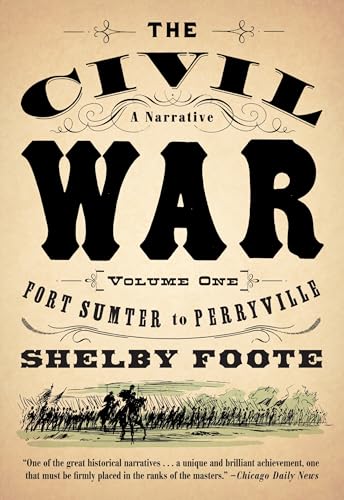
Foote's three-volume narrative history of the Civil War is one of the great works of American historical writing. It runs to nearly three thousand pages and covers every significant campaign and engagement from Fort Sumter to Appomattox in a prose style more novelistic than academic.
Foote was a Mississippian and his sympathies lean Confederate in ways that have drawn criticism, some of it fair. But the military history is unmatched in detail and readability, and his portraits of commanders on both sides remain the most vivid in the literature. The trilogy repays reading alongside McPherson, which provides the political context Foote sometimes underweights. Ken Burns used Foote extensively in his documentary, and the fame that brought Foote is deserved if you read him critically.
3. A Stillness at Appomattox -- Bruce Catton
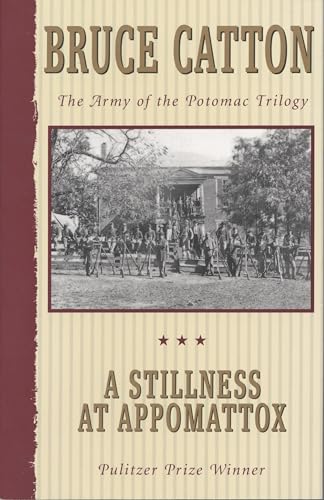
Catton's trilogy on the Army of the Potomac, of which this is the final volume covering 1864-65, won the Pulitzer Prize in 1954 and remains one of the most humane accounts of infantry warfare ever written. Catton was not an academic historian; he was a journalist who spent decades talking to survivors and reading their letters and diaries, and it shows.
A Stillness at Appomattox follows the Union Army through Grant's grinding Overland Campaign, the siege of Petersburg, and the final pursuit to surrender. What Catton captures that most military histories miss is the experience of the ordinary soldier: the exhaustion, the dark humor, the attachment to specific regiments and commanders, and the strange relief when it finally ended. The prose is beautiful in places and never loses sight of the human cost.
4. This Republic of Suffering -- Drew Gilpin Faust
The Civil War killed approximately 620,000 soldiers, a number so large that it reshaped American culture, religion, and family life in ways that historians largely ignored until Faust's 2008 book. This Republic of Suffering examines how Americans on both sides dealt with mass death on a scale the country had never experienced.
Faust, who later became president of Harvard, draws on thousands of letters and diaries to reconstruct what death meant to 19th-century Americans, how the war shattered the rituals that gave it meaning, and how the country built new institutions (the national cemetery system, standardised burial records, the culture of mourning) to cope with losses that often left no body to bury and no knowledge of what had happened. It is one of the most original Civil War histories of the last twenty years.
5. The Confederate War -- Gary Gallagher
Gallagher's 1997 book is a direct argument against the "Lost Cause" narrative but also against the academic consensus that replaced it. His case is that the Confederacy came far closer to winning the war than either romantic Confederate mythology or modern dismissal suggests, and that Confederate soldiers fought with genuine conviction and sustained military effectiveness until the very end.
Understanding why the Confederacy fought as hard as it did for as long as it did is important precisely because it resists comfortable explanations. Gallagher documents the high morale and cohesion of Confederate armies well into 1864, argues that Robert E. Lee's Virginia campaigns were strategically rational rather than recklessly offensive, and challenges historians who treat Confederate defeat as inevitable from the start. You do not have to agree with all of his conclusions to find the argument valuable.
6. Reconstruction -- Eric Foner
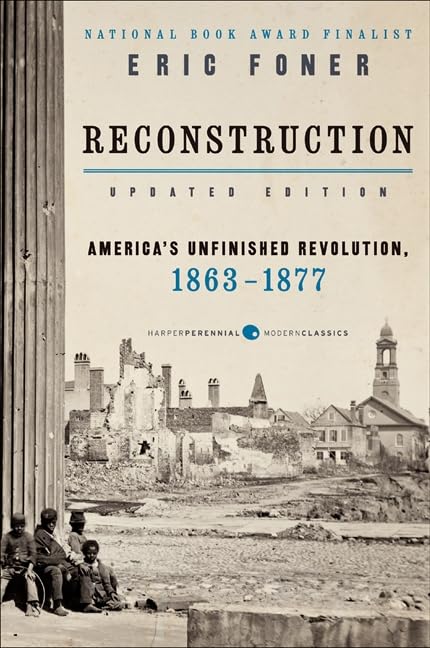
Foner's 1988 masterwork covers the period from 1863 to 1877, the twelve years after the war when the United States attempted to rebuild the South on the basis of legal equality for formerly enslaved people and then abandoned that project under political and violent pressure. It is arguably the most important American history book of the last forty years.
What Foner does that no previous history had managed is to take both the achievements and the failure of Reconstruction equally seriously. He documents how much Black Americans accomplished politically and economically in the years before the counter-revolution crushed it, and he traces precisely how and why the federal government withdrew the commitment it had made. Understanding Reconstruction is essential to understanding American race relations from the end of the Civil War to the present, and Foner's account is the place to start.
7. The Civil War (Ken Burns companion book) -- Geoffrey C. Ward, Ric Burns, Ken Burns
The book that accompanied Ken Burns's landmark 1990 documentary series draws on the same archive of photographs, letters, and diaries that made the film so affecting. It works as a standalone text as well as a companion, with Ward's narrative prose giving structure to material that the documentary format presents episodically.
The strength here is the primary source material. The letters quoted throughout, particularly those of Sullivan Ballou and Joshua Lawrence Chamberlain, are extraordinary documents, and seeing them in print alongside the photographs that have become the war's visual record is a different experience from watching the documentary. This is a good entry point for readers who are new to the subject.
8. Team of Rivals -- Doris Kearns Goodwin
Political history rather than military, Team of Rivals examines how Lincoln managed his cabinet of former rivals and political enemies through four years of war. Goodwin's research is deep and her narrative gifts are considerable, and the book remains the best account of Lincoln as a political operator rather than a symbol.
The sections on the political crisis of 1864, when Lincoln genuinely believed he would lose reelection and the war would end in Confederate independence, are particularly valuable. The gap between Lincoln as mythology and Lincoln as a working politician navigating catastrophic pressures is one of the book's central contributions.
9. The Half Has Never Been Told -- Edward Baptist
Baptist's 2014 book on slavery and American capitalism is essential context for the Civil War. His argument, backed by extensive quantitative research into cotton production data, is that the growth of American slavery between 1800 and 1860 was not a premodern remnant of an earlier era but an integral part of the industrialising US economy, driven by systematic violence and financial innovation.
Understanding what was at stake economically in 1861 changes how you read the war. Baptist's account of enslaved people's economic contributions, and of the specific mechanisms of violence used to extract that production, provides the ground-level reality beneath the political history that books like McPherson and Foner document at the institutional level.
10. Grant -- Ron Chernow
Chernow's massive 2017 biography of Ulysses Grant is the best single account of the military figure who won the war and the president who tried, with some success, to enforce Reconstruction. Chernow draws on a complete archive of Grant's correspondence and papers to produce a portrait of a man whose military genius and personal decency coexisted with real political limitations.
The Civil War sections are the best military biography in the literature: Chernow explains Grant's strategic thinking clearly and shows how his approach to warfare differed from every commander before him. The Reconstruction sections are equally valuable, documenting how Grant used the army to suppress Ku Klux Klan violence in the early 1870s and why those efforts ultimately failed.
The Civil War generated more writing than any other event in American history, but most of it is either too narrowly tactical or too freighted with regional mythology to be useful. These ten books give you the war as it was actually fought, what it cost, and what it failed to resolve.
Your next good book, in your inbox
We only write when we find a book worth your time. Hand-picked recommendations across history, mythology, true crime and more.
Are you an author?
Get your book in front of readers like these, for free.
- Free book listing →Your own book page with an Amazon button
- Author page →Photo, bio and links to your site
- Featured placement →A spot in our best-of lists, from €29
Free tools we recommend
Get free honest reviewsReview exchange on iWrity, free to join
Books You Might Like

Sapiens: A Brief History of Humankind
Yuval Noah Harari
The Last Kingdom (The Saxon Stories, Book 1)
Bernard Cornwell

Meditations
Marcus Aurelius

The Hiding Place
Elizabeth Sherrill, John Sherrill Corrie ten Boom