Best Books About the British Empire in 2026: 10 That Reckon With 400 Years of Power
At its peak, the British Empire covered a quarter of the world's land surface and governed a quarter of its population. It built railways, abolished the slave trade it had previously dominated for two centuries, spread English common law, created famines that killed tens of millions, and drew the borders that define many of the world's current conflicts. Whether it was a net good or a catastrophe or something more complicated than either is one of the most actively contested questions in contemporary history.
The ten books here represent the full range of serious historical opinion on the Empire, from defences to prosecutions to analyses that resist both. They disagree with each other, sometimes sharply, and that is the point. The British Empire deserves engagement, not a settled verdict.
1. Empire -- Niall Ferguson

Ferguson's 2003 book is the most prominent defence of the British Empire published in the last thirty years, and it is worth reading seriously even if you end up disagreeing with most of it. Ferguson argues that the Empire, on balance, exported institutions, legal systems, and economic frameworks that benefited colonised populations, and that the counterfactual, a world without British imperial expansion, would have been dominated by less liberal European powers.
The argument is provocative and sometimes persuasive on specific points, particularly on the role of British investment in building infrastructure in India and Africa. It is much weaker on the violence, famines, and systematic extraction that accompanied that infrastructure, which Ferguson tends to treat as regrettable but peripheral. Read it as one serious position in the debate rather than a settled case.
2. Inglorious Empire -- Shashi Tharoor
Tharoor's 2017 book is the direct counter-argument to Ferguson, written from the perspective of India, the most important and most damaged of Britain's colonial possessions. Tharoor, a former UN official and Indian politician, uses economic data and historical evidence to document the scale of extraction from India during the colonial period: the deliberate deindustrialisation of Indian manufacturing, the famines caused by colonial economic policy, and the extent to which British prosperity in the 18th and 19th centuries was built on Indian resources.
The two books belong together. Tharoor's case that India was systematically impoverished by British rule is backed by serious economic history, and his anger is calibrated rather than rhetorical. Reading Ferguson and Tharoor back to back gives you a sharper sense of what the debate actually involves than either book does alone.
3. Pax Britannica -- Jan Morris
Morris's three-volume history of the British Empire at its height, of which Pax Britannica (covering the Victorian peak) is the central volume, is one of the great works of historical prose in English. Morris, who travelled to every corner of the former empire to research the books, writes about the imperial project with the eye of a journalist and the range of a historian.
What makes the trilogy distinctive is its focus on the empire's culture and self-image rather than its politics and economics. Morris is interested in what it felt like, for the people who ran it and for many of those who lived under it, and her account of the imperial confidence of the Victorian era is both sympathetic and clear-eyed about its foundations. She does not defend the empire but she takes it seriously as a human project, which is different.
4. The Rise and Fall of the British Empire -- Lawrence James
James's 1994 single-volume history is the most comprehensive narrative account of the empire from Roanoke to the 1980s in a single book. At 700 pages it covers an enormous amount of ground with considerable fairness, acknowledging both the genuine achievements of specific colonial administrators and the systematic violence and exploitation that underpinned the whole enterprise.
The book is strongest on the 19th and early 20th centuries, the period of greatest imperial expansion and confidence, and it provides essential context for understanding how a relatively small island came to govern a quarter of the world. James is not an apologist, but he is also not interested in condemnation for its own sake, which makes his account more useful as history than many books written closer to the present political debate.
5. Time's Monster -- Priya Satia
Satia's 2020 book takes on a question that most Empire histories avoid: how did British historians and intellectuals justify the empire to themselves, and how did that justification shape the practice of history as a discipline? Her argument is that the very idea of historical progress, which British historians invented as a professional framework, was designed in part to make imperial violence look like the inevitable cost of civilisational advancement.
The book is challenging and its argument is not always easy to follow, but it offers something genuinely different from narrative history: an analysis of the ideological infrastructure that made the empire possible and that continues to shape how it is remembered. Satia is particularly good on the ways in which empire shaped British domestic culture, education, and national self-understanding in ways that persist long after the formal end of colonial rule.
6. Unfinished Empire -- John Darwin
Darwin's 2012 book is the best scholarly synthesis of recent empire historiography, arguing that the British Empire was less unified and less deliberately planned than both its defenders and critics tend to assume. His case is that the empire was assembled piecemeal, driven by merchants, missionaries, soldiers, and settlers pursuing specific local interests rather than a coherent imperial strategy from London.
This perspective has important implications for both the pro-empire and anti-empire arguments. If the empire was not a unified project, it cannot be evaluated as if it were, which means neither Ferguson's balance sheet nor Tharoor's prosecution quite captures its actual character. Darwin's account is the most sophisticated theoretical framework available for thinking about what the empire actually was.
7. The Scramble for Africa -- Thomas Pakenham
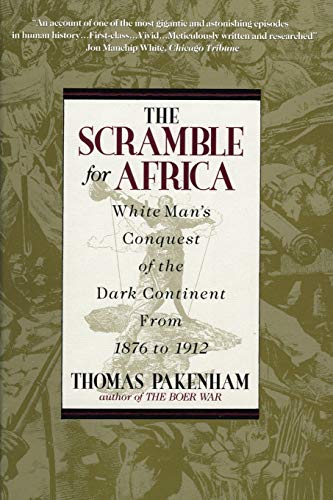
In 1880, European powers controlled about 10 percent of the African continent. By 1900 they controlled 90 percent. Pakenham's 1991 account of how that happened in twenty years is the most readable and most thoroughly researched narrative of the partition of Africa available in English.
Pakenham had access to the private papers of the main participants on the European side, and he reconstructs the combination of strategic competition, commercial ambition, missionary zeal, and individual adventurism that produced the scramble with remarkable granularity. The book is necessarily told largely from the European perspective, a limitation Pakenham acknowledges, but it is the essential account of one of the Empire's most consequential phases.
8. Late Victorian Holocausts -- Mike Davis
Davis's 2001 book is the most important economic history of the empire's human cost. He documents the famines that killed between 12 and 29 million people in India, China, and Brazil between 1876 and 1902, arguing that these were not natural disasters but the product of specific colonial economic policies, principally the enforcement of free-trade rules that prevented governments from protecting food supplies during drought.
The title is deliberately provocative, and the argument is contested in its details. But Davis's core claim, that Victorian liberalism's insistence on market mechanisms caused mass death on a scale that colonial administrators knew about and allowed, is backed by substantial evidence and has reshaped the field. No serious engagement with the British Empire's legacy can ignore it.
9. The British Empire in Colour -- Trevor McDonald
Less a scholarly history than a curated archive, this book accompanies a documentary series and presents photographs and film footage from across the empire alongside personal testimonies from people who lived under British rule in its final decades. The visual record it provides complements the written histories and gives the abstract economic arguments a human face.
It belongs on this list because it is the most accessible entry point for readers who are new to the subject and want something that conveys the empire's scale and diversity before going deeper into the historical arguments.
10. Empireland -- Sathnam Sanghera
Published in 2021, Empireland is the most recent book on this list and the most personal. Sanghera, a British-Indian journalist, investigates how the empire shaped Britain itself: its institutions, its self-image, its curriculum, and its continued difficulty acknowledging what it did. He interviews historians, politicians, and ordinary people and finds that the empire is simultaneously everywhere in British culture and almost nowhere in British public memory.
The book is not a comprehensive history but a provocation, asking what it would mean for Britain to genuinely reckon with its imperial past rather than selectively celebrating it. It is a useful companion to the more purely historical books on this list, and its argument about cultural amnesia is one that readers in any former colonial power will find recognisable.
The British Empire was the largest political structure in human history and its consequences, in borders, languages, institutions, and inequalities, shape the world today. The books on this list give you the tools to think about it seriously rather than sentimentally, wherever you start in the debate.
Your next good book, in your inbox
We only write when we find a book worth your time. Hand-picked recommendations across history, mythology, true crime and more.
Are you an author?
Get your book in front of readers like these, for free.
- Free book listing →Your own book page with an Amazon button
- Author page →Photo, bio and links to your site
- Featured placement →A spot in our best-of lists, from €29
Free tools we recommend
Get free honest reviewsReview exchange on iWrity, free to join
Books You Might Like

Sapiens: A Brief History of Humankind
Yuval Noah Harari

The Last Kingdom (The Saxon Stories, Book 1)
Bernard Cornwell

Meditations
Marcus Aurelius

The Hiding Place
Elizabeth Sherrill, John Sherrill Corrie ten Boom