Best Books About the Renaissance: Art, Science and Humanism
THE RENAISSANCE gave Western civilization Leonardo da Vinci, Michelangelo, Machiavelli, Gutenberg, and the political philosophy that still shapes how we think about states and power. These 10 books explain how that happened and why a 200-year period in Italian city-states still matters in 2026.
Why the Renaissance Is So Hard to Understand From a Distance
The problem with most Renaissance reading is that the era feels like a category rather than a place. It is easier to say "the Renaissance" than to picture what it meant to live in Florence in 1478, when the banking families that funded the artists were also funding assassination plots, and the pope had declared war on a city-state by sponsoring a murder in a cathedral.
The best books on this list do not treat the Renaissance as a museum piece. They treat it as a political and intellectual crisis with winners and losers, money and blood, and ideas that escaped the period and are still running.
10 Best Books About the Renaissance in 2026
1. The Civilization of the Renaissance in Italy — Jacob Burckhardt
Published in 1860, this is the book that invented the modern concept of the Renaissance. Swiss historian Jacob Burckhardt argued that 15th-century Italy produced a new type of human being: the individual, defined by personal achievement and ambition rather than by guild, church, or family. This idea, that the Renaissance created modern individualism, has been debated ever since and is still the starting point for any serious study of the period.
Burckhardt's prose is dense by modern standards, but the argument is clear and the evidence is rich. Every subsequent book on this list either builds on his framework or argues with it. Reading it first means you understand what everyone else is talking about.
2. Brunelleschi's Dome — Ross King
The story of how Filippo Brunelleschi built the dome of Florence Cathedral between 1420 and 1436. The dome was considered structurally impossible before Brunelleschi built it: 143 feet in diameter, 300 feet above the floor, with no external supports and no scaffolding from the ground. No one today is entirely sure how he did it.
Ross King uses the construction project to tell the story of early Renaissance Florence: the guild politics, the competing architects, the financing mechanisms, and the relationship between technical innovation and artistic ambition that defines the period. Short, precise, and completely gripping.
3. Leonardo da Vinci — Walter Isaacson

The best biography of the Renaissance's most famous figure. Isaacson worked directly from Leonardo's notebooks (7,200 surviving pages) and builds a portrait of a man whose curiosity outran his ability to finish things. The unfinished projects were not failures: they were evidence of how his mind worked, moving from anatomy to engineering to painting to military technology and back, all in service of understanding how the world was put together.
What the book captures better than any previous Da Vinci biography: Leonardo was not a lone genius. He ran a workshop, had apprentices, competed with Michelangelo, and operated inside the patronage system that made Renaissance art possible. The book shows the era through a single extraordinary life without flattening either.
4. In the Company of the Courtesan — Sarah Dunant
Historical fiction set in Venice in the 1520s, narrated by a dwarf companion to a high-ranking courtesan. Dunant's research is meticulous: the book captures the social structure of Renaissance Venice, where courtesans occupied a specific and well-defined position between the domestic and public spheres, with more education and more freedom than most women of the period.
It reads like a thriller. The plot involves the sack of Rome in 1527, the flight to Venice, and the reconstruction of a life in a city where survival required navigating class, gender, and religious politics simultaneously. The best Renaissance historical fiction currently available.
5. The Prince — Niccolo Machiavelli

Written in 1513, still read today. Machiavelli spent years as a Florentine diplomat, watching Italian politics up close, and 'The Prince' is what he concluded: power operates by its own logic, separate from morality, and a ruler who ignores that logic will not survive. He was not advocating cruelty for its own sake. He was describing how political reality worked.
The text is short (under 100 pages in most editions) and remarkably direct. Read it alongside any good account of Cesare Borgia, who was Machiavelli's model prince, and it transforms from a cynical handbook into a precise historical document about a specific political crisis.
6. Lives of the Artists — Giorgio Vasari
Published in 1550, this is the first major work of art history in Western literature. Vasari was a painter and architect who knew Michelangelo personally, and his biographies of Renaissance artists are the primary source for almost everything we know about the lives of Brunelleschi, Giotto, Botticelli, Raphael, and dozens of others. Many of the stories are probably embellished. All of them are vivid.
Reading Vasari is reading how the Renaissance understood itself: as a rebirth of classical excellence after centuries of medieval decline. His framing shaped how art history was written for the next 400 years.
7. The House of Medici: Its Rise and Fall — Christopher Hibbert
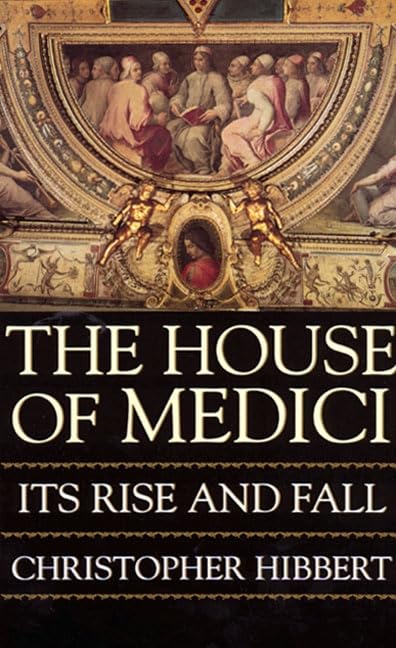
The best accessible history of the Medici family for general readers. Hibbert traces the dynasty from Giovanni di Bicci, who founded the banking empire in the early 15th century, through Cosimo, Lorenzo, and the later Medicis who became popes, to the final extinction of the main line in the 18th century.
The book covers the full arc: how Medici money created the conditions for Renaissance art, how political power corrupted the dynasty, and how Florence's fortunes rose and fell with the family's. Clean narrative history with good character portraits and no unnecessary scholarly apparatus.
8. Magnifico: The Brilliant Life and Violent Times of Lorenzo de' Medici — Miles Unger
The definitive biography of Lorenzo the Magnificent, the ruler who turned Florence into the cultural capital of Europe and survived one of the Renaissance's most spectacular assassination attempts. The 1478 Pazzi Conspiracy, funded by the Pope and the rival Pazzi banking family, aimed to kill both Lorenzo and his brother Giuliano during Easter Mass at Florence Cathedral. Giuliano was killed. Lorenzo escaped.
Unger writes this as narrative biography with real pace. He covers the banking empire, the art patronage (Botticelli, Michelangelo's early years, Poliziano), the diplomatic maneuvering, and the personal contradictions of a man who wrote poetry and ordered executions.
9. April Blood: Florence and the Plot Against the Medici — Lauro Martines
The most focused account of the Pazzi Conspiracy, drawn entirely from primary sources. Martines is a professional historian of Renaissance Italy, and this is scholarly work written for general readers: it names every conspirator, traces every financial connection, and reconstructs the planning and execution of the assassination with forensic precision.
The broader argument is about what the conspiracy reveals: the fragility of Renaissance city-state politics, the intertwining of banking, church, and political power, and how close the Medici came to losing everything. Essential reading for anyone who wants to understand how Renaissance Florence actually worked rather than how it was mythologized.
10. Forbidden Friendships: Homosexuality and Male Culture in Renaissance Florence — Michael Rocke
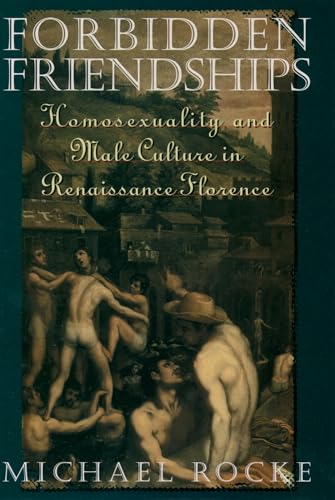
Academic history that reads like social archaeology. Rocke used the records of the Ufficiali di Notte, a Florentine magistracy created specifically to prosecute sodomy, and found that between 1432 and 1502 the office investigated more than 17,000 men. In a city of roughly 40,000 adult males, that is almost every man in Florence.
The book does not argue that Renaissance Florence was a tolerant society. It argues that same-sex relationships were embedded in the social fabric in ways that the official record of prosecutions and the art historical record of male beauty both reflect. It changes how you read the period.
Where to Start in 2026
New to the Renaissance: start with Isaacson's Da Vinci biography for a vivid entry into the period, then move to Hibbert's Medici history for the political context.
Want the primary sources: Burckhardt for the foundational argument, Machiavelli for politics, Vasari for art history.
Want narrative history at its best: King's Brunelleschi's Dome or Unger's Magnifico are the most readable options.
Browse more history reading lists or see the best books about ancient Rome for the civilization the Renaissance was trying to revive.
Your next good book, in your inbox
We only write when we find a book worth your time. Hand-picked recommendations across history, mythology, true crime and more.
Are you an author?
Get your book in front of readers like these, for free.
- Free book listing →Your own book page with an Amazon button
- Author page →Photo, bio and links to your site
- Featured placement →A spot in our best-of lists, from €29
Free tools we recommend
Get free honest reviewsReview exchange on iWrity, free to join
Books You Might Like

Sapiens: A Brief History of Humankind
Yuval Noah Harari
The Last Kingdom (The Saxon Stories, Book 1)
Bernard Cornwell

Meditations
Marcus Aurelius

The Hiding Place
Elizabeth Sherrill, John Sherrill Corrie ten Boom