Best Cold War History Books in 2026: 12 That Show How Close We Actually Came to the End
Every good Cold War history eventually arrives at the same unsettling conclusion: the conflict stayed "cold" because of luck at least as much as because of wisdom. The Cuban Missile Crisis came closer to nuclear exchange than either side's official account admitted for thirty years. The Soviet early-warning system gave a false positive in 1983 and one officer chose not to launch. The Dead Hand system that would have automatically triggered nuclear retaliation on a dead Soviet state was actually built and actually operational. The best Cold War history books are the ones that show you these near-misses in detail, because the mechanisms that kept the Cold War from becoming a hot one are still all in place, under different management.
This list covers twelve books that together give you the full Cold War: the grand diplomatic strategy, the proxy wars where most people actually died, the intelligence failures and successes, the nuclear planning, and the lived experience of people on the wrong side of the Iron Curtain. Read them as a sequence and the Cold War comes into focus not as a stable balance of terror but as a series of accidents that could have ended differently.
The Single-Volume History
If you read only one book about the Cold War, this is the one.
1. The Cold War: A New History by John Lewis Gaddis
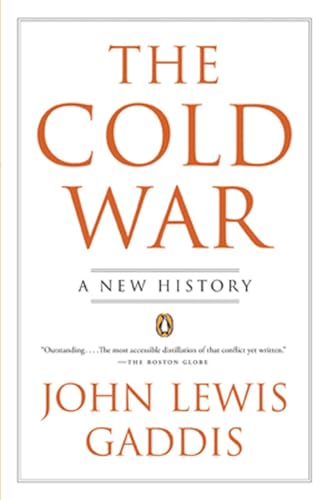
Gaddis is the leading Cold War historian in the English-speaking world, and this shorter work (he also wrote a larger two-volume history) is designed for general readers who want the full arc from 1947 to 1991 in one volume. He covers the major crises, the ideological contest, the arms race, and the final collapse of the Soviet system, with access to archives on both sides that earlier historians did not have. The book's particular value is Gaddis's argument about why the Cold War ended when it did: not primarily because of US military pressure but because the Soviet system failed to deliver the living standards its ideology promised.
The Cold War: A New History by John Lewis Gaddis is the standard single-volume history, written by the historian who spent his career with access to archives on both sides.
Best for: Anyone who wants the full Cold War narrative before reading anything more specialized.
The Third World: Where the Cold War Was Actually Hot
Most popular Cold War histories focus on Europe, the Berlin Wall, and the nuclear standoff between two superpowers who never directly fought each other. The gap in those accounts is everywhere else: Korea, Vietnam, Angola, Mozambique, Afghanistan, Latin America, the dozens of proxy conflicts in which the Cold War killed millions of people who were not American or Soviet.
2. The Global Cold War by Odd Arne Westad
Westad's argument is that the Cold War's most important arena was the Third World, not Europe. Both superpowers intervened repeatedly in developing nations, supporting or opposing governments based on ideological alignment, and the consequences of those interventions shaped the political geography of Africa, Asia, and Latin America for decades after the Cold War ended. He treats the Cold War not as a bilateral superpower conflict but as a global intervention in the decolonization process, with both the US and the USSR acting as imperial powers in different ideological registers.
This is the book that makes clear why the Cold War still matters outside the US and Russia.
3. A Thousand Days by Arthur Schlesinger Jr.
Schlesinger served in the Kennedy White House and wrote this account of the Kennedy years from the inside. The chapters on the Cuban Missile Crisis are the most valuable for Cold War readers: the internal deliberations, the false certainties, the near-misses that only became apparent years later. Schlesinger writes as a participant and an intellectual, which gives the book a texture that later academic accounts cannot replicate.
Intelligence: What the Agencies Actually Did
Cold War intelligence history is the field where the gap between the official narrative and the documented record is widest. Both the CIA and the KGB spent forty years producing accounts of their operations that bore little resemblance to what actually happened.
4. Legacy of Ashes: The History of the CIA by Tim Weiner
Weiner spent eighteen years reading declassified CIA documents and interviewing former officers, and his conclusion is blunt: nearly every major CIA covert operation of the Cold War failed, and the agency spent four decades lying about this to presidents, Congress, and itself. The coups in Iran (1953) and Guatemala (1954) appeared to succeed but created the political conditions for the Iranian Revolution and decades of Guatemalan civil war. The Bay of Pigs was a disaster the agency had been warned about internally. The book is the most thoroughly documented account of institutional failure in the history of American intelligence writing.
Legacy of Ashes by Tim Weiner is the most documented account of CIA failures during the Cold War, drawn from declassified internal records the agency spent decades suppressing.
5. The Sword and the Shield by Vasili Mitrokhin and Christopher Andrew
Mitrokhin was a KGB archivist who spent years secretly copying intelligence files before defecting to Britain in 1992. His archive was the largest intelligence leak in KGB history and gave Western historians their first systematic view of what Soviet intelligence actually did during the Cold War. The book covers KGB operations in Western Europe, the United States, and the Third World, and reveals the gap between KGB success at penetrating Western intelligence services and KGB failure at achieving any strategic objective that mattered.
The Nuclear Reality
The Cold War's defining feature was nuclear weapons, and most Cold War histories treat them as backdrop. These two books put them at the center.
6. The Dead Hand by David Hoffman
Hoffman's book covers the Soviet nuclear weapons program in detail that American readers almost never encounter, including the "Dead Hand" system (officially called Perimeter): an automated command-and-control network that would launch nuclear weapons against the United States automatically, even if every Soviet leader had been killed, if certain sensor conditions were met. The system was actually built. It was operational during the most dangerous years of the Cold War. American presidents had no idea it existed.
The book is also the most detailed account of the Soviet biological weapons program, which continued through the period when the Soviet Union was negotiating arms control agreements.
Best for: Readers who want to understand the actual nuclear infrastructure of the Cold War, not the diplomatic narrative around it.
7. The Doomsday Machine: Confessions of a Nuclear War Planner by Daniel Ellsberg
Ellsberg is best known for releasing the Pentagon Papers. Before that, he was a nuclear war planner for the Rand Corporation and the Defense Department, and he spent years working on the actual US nuclear war plans. His account of those plans, the scenarios they were designed for, the authority structure that would have used them, and the number of people who had the authority to launch nuclear weapons without presidential authorization (far more than the official account admitted) is the most important primary-source account of nuclear war planning from the American side.
The Doomsday Machine by Daniel Ellsberg is the only insider account of US nuclear war planning written by someone who actually worked on the plans and who had access to the documents that showed what those plans actually contained.
The Other Side: Soviet and Eastern European Perspectives
Cold War history written from a Western perspective systematically misses what the Cold War looked like from inside the Soviet bloc. These three books correct that.
8. Iron Curtain: The Crushing of Eastern Europe by Anne Applebaum
Applebaum's account of how the Soviet Union took over Eastern European countries between 1944 and 1956 is the most detailed study of how totalitarian systems are actually constructed. The Soviet takeovers were not sudden: they proceeded through the systematic capture of police and security services, the infiltration of political parties, the destruction of civil society organizations, and the gradual elimination of anyone capable of organizing resistance. The book is essential context for understanding why the collapse of those systems in 1989 was not simply a matter of popular will overcoming state power.
9. Russia: A 1,000-Year Chronicle of the Wild East by Martin Sixsmith
Understanding the Cold War from the Soviet side requires understanding Russian history before the Soviet Union: the patterns of centralized autocracy, the relationship between state power and individual life, the specific anxieties about Western influence that shaped Soviet foreign policy. Sixsmith's broad history of Russia from the Kievan Rus to the present is the most readable general account for Western readers who need that context.
10. Zinky Boys by Svetlana Alexievich
Alexievich, who won the Nobel Prize in Literature in 2015, spent years collecting testimonies from Soviet soldiers who served in Afghanistan and from the families of those who died there. The soldiers' bodies were returned in zinc coffins (hence "Zinky Boys"), and for years their deaths were officially unacknowledged. The oral testimonies Alexievich collected constitute the most direct account of what the Cold War cost at the human level, not the strategic level, and the disconnect between the soldiers' experience and the ideology they were supposed to be serving is the central subject of the book.
The Diplomacy
11. Nixon and Kissinger: Partners in Power by Robert Dallek
The Cold War's most consequential diplomatic period was the early 1970s: the opening to China, the SALT I arms control treaty, and the Vietnam War's end. Dallek's dual biography covers the Nixon-Kissinger partnership in detail, including the internal disagreements, the wiretapping of their own staff, and the distinction between the public diplomacy and the private one. The strategic logic that drove detente (creating a triangular relationship among the US, USSR, and China that prevented any two from aligning against the third) is the most sophisticated American Cold War strategy, and this is the most detailed account of how it was developed and executed.
12. The Pattern That Repeats
The eleven books above tell the Cold War from multiple angles: grand strategy, intelligence failure, nuclear planning, proxy wars, Eastern European oppression, and the testimony of the people on the ground who bore the costs. The pattern that emerges from all of them is consistent: the Cold War was managed less by rational deterrence theory than by the individual decisions of specific people at specific moments, many of whom knew less than they thought, and most of whom were working with false information from their own intelligence services.
The nuclear weapons that kept the Cold War cold are all still operational. The command structures that would use them are all still in place. The difference is in the politics, not the hardware, which is why Cold War history reads less like completed history than like unresolved present.
Three Cold War Books Worth Reading First
- The Cold War: A New History by John Lewis Gaddis, the standard single-volume account with access to archives on both sides.
- Legacy of Ashes by Tim Weiner, the most documented account of CIA failure during the Cold War, drawn from declassified internal records.
- The Doomsday Machine by Daniel Ellsberg, the only insider account of US nuclear war planning written by someone who actually worked on the plans.
For the full ranked collection of history titles by verified reader count, see the history books category at Skriuwer.
Your next good book, in your inbox
We only write when we find a book worth your time. Hand-picked recommendations across history, mythology, true crime and more.
Are you an author?
Get your book in front of readers like these, for free.
- Free book listing →Your own book page with an Amazon button
- Author page →Photo, bio and links to your site
- Featured placement →A spot in our best-of lists, from €29
Free tools we recommend
Get free honest reviewsReview exchange on iWrity, free to join
Books You Might Like

Sapiens: A Brief History of Humankind
Yuval Noah Harari
The Last Kingdom (The Saxon Stories, Book 1)
Bernard Cornwell

Meditations
Marcus Aurelius

The Hiding Place
Elizabeth Sherrill, John Sherrill Corrie ten Boom