Best Economic History Books in 2026: 12 That Explain Why Some Countries Are Rich and Others Aren't
Economic history is the field that asks "why" instead of "how much." Why did some countries industrialize and others remain agrarian? Why does inequality compound instead of equalizing over time? Why did the financial panic of 1720 reproduce itself so precisely in 2008? The answers are almost never purely economic. They involve institutions, ideas, political power, culture, and sometimes luck, and the best economic history books are the ones that hold all those factors simultaneously rather than reducing everything to a single variable. This list covers the twelve books that do that most effectively, from the foundational texts that defined the field to the most recent data-driven arguments about why the wealth gap between nations persists.
The sequence below moves from foundational theory to institutional analysis to financial crises to the mathematics of inequality, which is roughly the order in which the debates developed. Each book is in conversation with the others, and reading them together is the fastest way to understand why economists still disagree about the most basic questions.
The Foundational Texts: Before You Read Anything Else
Two books from opposite ends of the political spectrum defined the terms of economic debate for two centuries. You cannot understand modern economic history without both of them.
1. The Wealth of Nations by Adam Smith (1776)
Smith's foundational argument is not what most people who cite it think it is. He was not an advocate for unregulated markets. He was an observer of how the division of labor, the specialization of tasks, and voluntary exchange between self-interested parties produces aggregate outcomes that no central planner could have designed. The "invisible hand" metaphor appears exactly once in seven hundred pages, and it is a subordinate clause in an argument about domestic investment. Read Smith directly, in an abridged edition if necessary, because the actual argument is more nuanced and more interesting than its ideological descendants suggest.
Best for: Understanding the original version of market economics before the simplified versions that came after it.
2. Capital Volume 1 by Karl Marx (1867)
Marx's analysis of the commodity form, surplus value, and the structural relationship between capital and labor is the other unavoidable foundation. His specific predictions about capitalism's collapse have not materialized in the form he expected. His analysis of how the wage relationship works, how capital accumulates by extracting unpaid labor time, and how the commodity form transforms all human relationships remains the analytical framework that even critics of Marx work against. "Commodity fetishism," his term for the way that social relationships between people appear as relations between things, is still the most useful concept for analyzing consumer culture.
Why Nations Fail: The Institutional Turn
The dominant framework in economic history for the last twenty years has been institutional. The core argument: what determines whether a country is rich or poor is not geography, culture, or natural resources, but the quality of its economic and political institutions.
3. Why Nations Fail by Daron Acemoglu and James Robinson
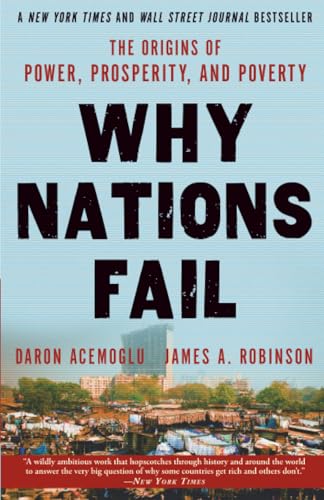
Acemoglu and Robinson make the institutional case through a series of paired comparisons: North and South Korea (same culture, same geography, divergent institutions after 1945 produced a wealth gap of forty-to-one), Nogales Arizona and Nogales Mexico (same city, same street, divided by a border that created two different institutional environments). The central distinction is between inclusive institutions (which distribute economic and political power broadly) and extractive institutions (which concentrate power and extract wealth upward). The book's argument is that once extractive institutions are entrenched, they self-perpetuate, which is why poor countries tend to stay poor.
Why Nations Fail by Daron Acemoglu and James Robinson is the book most economic historians recommend as the clearest institutional account of global wealth inequality.
Best for: Anyone who wants the modern institutional framework before reading more specialized accounts.
4. Power and Progress by Daron Acemoglu and Simon Johnson
Acemoglu's most recent book shifts focus from geography and institutions to technology. The argument is that technological change does not automatically distribute its gains broadly. Who benefits from a new technology is a political question, determined by the power structures that govern its deployment. The book covers the industrial revolution (when textile machinery immiserated workers while enriching owners), the digital revolution (when platform companies captured most of the productivity gains), and uses both to argue that the current AI transition will follow the same pattern unless the political structures governing it change.
Financial Crises: Why the Patterns Repeat
Financial crises have a pattern. Prices rise past any rational justification. Everyone knows prices have risen too far. Everyone continues buying anyway. Then they stop. The details change across four centuries; the structure does not.
5. Manias, Panics, and Crashes by Charles Kindleberger
Kindleberger's account of financial crises from the Tulip Mania of 1637 through the late twentieth century is the standard text on crisis dynamics. He identifies the five-stage structure that repeats: displacement (a new opportunity), boom, overtrading, revulsion, and discredit. His analysis of why rational actors participate in obviously unsustainable bubbles, and why regulatory intervention consistently arrives too late, is still the most useful framework for understanding 2008, 2021, and every crisis in between.
Best for: Understanding why financial crises happen and why they keep happening despite everyone knowing the last one was a crisis.
6. Golden Fetters by Barry Eichengreen
Eichengreen's argument is specific and important: the Gold Standard did not just fail to prevent the Great Depression, it caused it. Countries that stayed on gold longest suffered longest, because fixed exchange rates prevented the monetary expansion needed to end deflation. Countries that left gold (Britain in 1931, the US in 1933) recovered fastest. The book is the definitive economic history of the interwar period and the best argument for why monetary flexibility matters more than monetary discipline during crises.
The Mathematics of Inequality
The question of why inequality compounds over time rather than equilibrating has moved from the margins of economics to its center over the last twenty years. These books are the most important contributions to that debate.
7. Capital in the Twenty-First Century by Thomas Piketty
Piketty's central argument is expressed in a formula: r > g. When the rate of return on capital exceeds the rate of economic growth (which is true in most historical periods except the postwar decades), wealth accumulates faster at the top than growth distributes it. The implication is that increasing inequality is not a market failure but a market feature, the predictable output of normal capitalist dynamics. The book's data, covering three hundred years of income and wealth distribution in France, Britain, and the US, is its main contribution, and it remains the empirical starting point for any serious discussion of inequality.
Capital in the Twenty-First Century by Thomas Piketty provides the most comprehensive empirical case that rising inequality is a structural feature of capitalist economies rather than a temporary deviation.
8. The World Economy: A Millennial Perspective by Angus Maddison
Maddison spent his career constructing GDP estimates for every country going back two thousand years, and this book is the most systematic account of global economic growth ever produced. It is the statistical backbone of economic history: every argument about when the wealth gap between nations began to widen, or how fast growth accelerated during the Industrial Revolution, ultimately refers back to Maddison's numbers. The book is dense with data and rewards careful reading rather than cover-to-cover consumption.
Why the Industrial Revolution Happened Where and When It Did
The most contested question in economic history is why the Industrial Revolution started in England in the 1760s rather than China (which had the technology), India (which had the textile industry), or anywhere in continental Europe. The answers proposed by economists and historians have been debated for two hundred years.
9. Bourgeois Dignity by Deirdre McCloskey
McCloskey's argument is that institutions, geography, and natural resources do not explain the timing of the Industrial Revolution. What changed in England and the Netherlands in the seventeenth century was an idea: that trade, commerce, and innovation were socially respectable activities rather than activities associated with moral degradation. The "dignity of the bourgeoisie" created the conditions for innovation to be rewarded rather than expropriated. It is the most direct challenge to the institutional thesis of Acemoglu and Robinson, and reading both together gives you the sharpest current debate in the field.
10. A Culture of Growth by Joel Mokyr
Mokyr's account focuses on the Enlightenment as the proximate cause of the Industrial Revolution: the spread of a belief that the natural world was knowable, that knowledge was cumulative, and that improving material conditions was a legitimate social goal. He traces the Republic of Letters, the network of correspondence between European intellectuals in the seventeenth and eighteenth centuries, as the mechanism by which Enlightenment ideas spread across borders faster than political institutions could contain them.
11. The Birth of Plenty by William Bernstein
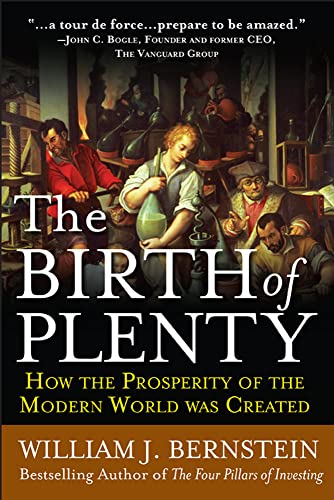
Bernstein identifies four conditions that he argues are necessary and sufficient for sustained economic growth: secure property rights, the scientific method applied to practical problems, access to capital markets, and reliable transportation and communication infrastructure. He then uses those four variables to explain both why growth happened when and where it did and why it has not yet happened everywhere. It is the most accessible synthesis of economic history research for general readers.
The Birth of Plenty by William Bernstein identifies the four structural conditions behind sustained economic growth and uses them to explain the global wealth gap in concrete terms.
Reading Economic History in the Right Order
12. The Debate That Doesn't End
The eleven books above cover the major axes of economic history debate: the foundational theoretical frameworks (Smith, Marx), the institutional turn (Acemoglu and Robinson), the financial crisis literature (Kindleberger, Eichengreen), the inequality mathematics (Piketty, Maddison), and the competing explanations for why industrialization happened where and when it did (McCloskey, Mokyr, Bernstein). What they share is a refusal to reduce economic history to economics: every book on this list concludes that political power, cultural values, institutional design, or contingent historical events matter as much as prices and markets.
A workable reading sequence: start with Why Nations Fail for the institutional framework, then Manias, Panics, and Crashes for financial crises, then Capital in the Twenty-First Century for inequality, then the industrial revolution debate (McCloskey or Mokyr) for the deeper historical question. That four-book sequence gives you the vocabulary to read anything else in the field.
Three Economic History Books Worth Buying Today
- Why Nations Fail by Daron Acemoglu and James Robinson, the clearest institutional account of why some countries are rich and others are not.
- Capital in the Twenty-First Century by Thomas Piketty, the most comprehensive empirical case that rising inequality is a structural feature rather than an accident.
- The Birth of Plenty by William Bernstein, the most accessible synthesis of economic history research for readers without an economics background.
For the full ranked collection of history and nonfiction titles by verified reader count, see the history books category at Skriuwer.
Your next good book, in your inbox
We only write when we find a book worth your time. Hand-picked recommendations across history, mythology, true crime and more.
Are you an author?
Get your book in front of readers like these, for free.
- Free book listing →Your own book page with an Amazon button
- Author page →Photo, bio and links to your site
- Featured placement →A spot in our best-of lists, from €29
Free tools we recommend
Get free honest reviewsReview exchange on iWrity, free to join
Books You Might Like

Sapiens: A Brief History of Humankind
Yuval Noah Harari
The Last Kingdom (The Saxon Stories, Book 1)
Bernard Cornwell

Meditations
Marcus Aurelius

The Hiding Place
Elizabeth Sherrill, John Sherrill Corrie ten Boom